

Edge · 8 min read
AI cameras vs IP cameras, and what changes when the model moves to the edge
The dock camera has streamed to a recorder for six years. A model can watch that stream in the cloud, on your servers or beside the recorder. No new camera.
Summary
This post takes a loading dock camera that has streamed to a recorder for years and separates two questions that get sold as one: what an AI camera adds to an IP camera, and where the model should run. It concludes that the output, a frame turned into an event with a box on it, is the whole difference, and that a model sealed inside a camera housing cannot learn the dock's winter. It is for the person deciding whether to replace cameras.
Andreas Ohrvall · CTO · Sep 27, 2026
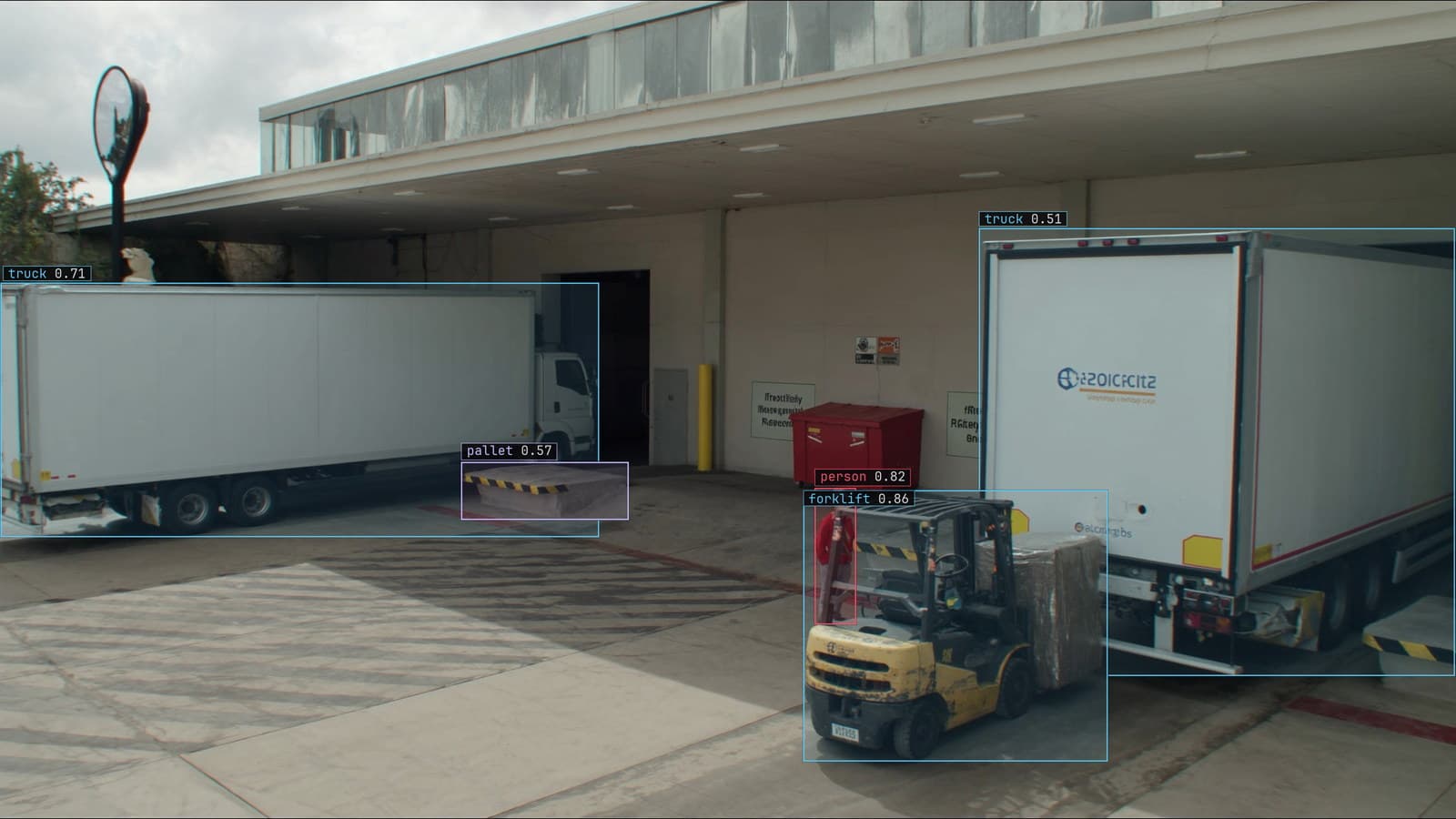
Loading dock from the mounted camera, trucks, forklift, pallet and person boxed, generated scene with detections from our model
The camera over dock door 4 was fitted six years ago, when the recorder in the shipping office was new, and it has sent the same stream to the same recorder every day since. It sees the door, the leveller, the first few metres of trailer, and the forklift traffic that crosses the apron. The recorder keeps a fortnight of it and nobody watches any of it unless a pallet goes missing.
The quote on the shipping manager's desk is for replacing that camera with one that has a model inside it. The pitch is that the new camera will know what it is looking at. Before the money is spent, it is worth separating what the new camera would add from where that addition has to live, because those are two decisions and the quote treats them as one.
An AI camera is an IP camera with a computer in the housing
An IP camera collects light, encodes it as video, and sends it to whatever asks. That is the entire product, and it has been for a long time. An AI camera does the same and then runs a model on the frames before they leave the housing. What comes out of the network port can then be a stream and can also be a message: a truck arrived, a person crossed the apron, a pallet has sat by the door for an hour.
The model inside is an ordinary detector. It draws a box around a truck or a person on each frame, keeps the box across frames so the truck stays the same truck, and applies whatever rule the camera's firmware carries. Everything that makes the camera an AI camera is that computation, and the computation does not care whether it happens in the housing on the dock, on a box in the shipping office, or in a data centre. The camera is the sensor either way.
The first IP camera was sold in the mid nineties by a company that until then made print servers, which is a fair description of what an IP camera is: a sensor with a network port. The AI part came a quarter of a century later and lives in software.
The output is the difference, a frame against an event
What changes operations is what arrives in the shipping office. From the IP camera, video, which somebody has to watch to learn anything from. From a model, wherever it runs, an event: dock 4, a trailer at the door with no forklift movement for forty minutes, the frame attached, sent to the shift lead.
The shift lead does not open the recorder. The event carries the frame with the box drawn on it, the time from the stream, and the door number, and it lands in the channel the shift lead already reads. A day of dock traffic becomes a list of the moments that needed a person, and the fortnight of video on the recorder becomes evidence rather than something to sit through.
That is the whole difference between the two kinds of camera, and it is a difference in output, which the model produces, and which the housing has nothing to do with.
A bounding box on the dock frame is what the model adds wherever it runs
The unit of that output is the bounding box. On every sampled frame from dock 4, the model draws a box around each truck, forklift, pallet and person it finds, with a class and a score, and the rules that turn frames into events are written against those boxes. A pallet box that has not moved for an hour is a dwell. A person box inside the trailer box while the leveller is down is a safety event. A truck box appearing at the door is an arrival.
None of that requires the box to be drawn inside the camera. A model on a runner beside the recorder, watching the same stream the recorder has always received, draws the same boxes on the same frames about every two seconds, and the events it produces are identical. A model in the cloud, watching the same stream, does the same. The bounding box is the product, and the dock camera fitted six years ago produces the frames it is drawn on.
Where the model runs is a separate decision from which camera you buy
The real question in the quote is where the computation should sit, and the honest answer depends on the site rather than on the vendor. On the dock 4 quote it was never asked.
In the cloud, every dock at every site is watched by the same model, and a new version reaches all of them at once; the cost is that the stream has to leave the building. On the company's own servers, the stream stays on its network, and the servers are managed by us or run by the company's own team. On a runner beside the recorder, the model watches the recorder's stream locally and alerts fire on site whether or not the link to the outside is up. The only frames that leave are the ones the model is unsure of, for a person to review. The deployment doc covers what leaves and what stays in each case.
An AI camera is a fourth option: the computation in the housing. It is the right one when there is no recorder, no network to speak of, and a single camera on a pole. On a dock with a recorder in the next room and a fortnight of video already flowing to it, it is the most expensive way to put a model within reach of a stream that is already within reach.
A camera with a sealed model cannot learn the dock's winter
The dock in January is a different place from the dock in July. The doors are open less, the apron is wet and reflects the floodlights, the forklift drivers wear high-visibility coats over their usual gear, and the trailers carry snow on the roof that slides off in the leveller's camera view. A model trained on summer frames has weak evidence for all of that, and detections on dock 4 thin out over the weeks as the light changes.
The fix is ordinary: the frames the model doubts come back to a person, the corrections retrain it, the new version rolls out. What decides whether that fix is available is whether the model can be changed. A model in the cloud or on a runner is replaced with no downtime, as often as the corrections warrant. A model sealed in a camera's firmware is replaced when the camera's maker ships an update, on their schedule, trained on their frames rather than the dock's.
My own view, and I hold it as the person responsible for where our models run, is that I would not put a model inside a housing I cannot update on a Tuesday afternoon. The value of a vision model on a dock is every week after the first, and every one of those weeks depends on the loop being able to reach it.
LexData takes the dock model through its whole life. You type what to look for, Lexi puts a box on every frame, and a person checks each label before anything trains on it. The model then watches the cameras the site already has, in the cloud, on your servers, or on a runner beside the recorder. Frames it is unsure of come back to a person, the corrections retrain it, and the new version replaces the old one with no downtime. The platform does that on the six-year-old camera over dock 4, and on the new one, if the shipping manager buys it anyway.
Buy the new camera when the view has to change and keep the old one when it does not
There are docks where the answer is a new camera. The old one is too far from the door to resolve a pallet label, or it is pointed at the wrong bay, or it is the one camera on a remote yard with no recorder and no network. Those are reasons to buy a camera, and the camera might as well be a good one.
What they are not is a reason to buy the model with the camera. The model on dock 4 should be the same model on dock 5, trained on the site's own frames, corrected by the site's own people, and updated when the dock's winter arrives. That is a property of where it runs and who can reach it, and the six-year-old camera has been supplying everything it needs since the day it was fitted.
See it on your own footage.
Start with your footageMore in Edge
Edge · 7 min read
Cloud vs on-device inference for computer vision, and why the answer is usually both
A remote substation on a thin link and a plant with a footage policy. The runner decides on site, only doubted frames leave, the cloud trains the next version.
Andreas Ohrvall · Sep 27, 2026
Edge · 8 min read
Running computer vision on the IP cameras a site already has
A store, a plant and a yard already stream RTSP to a recorder. That stream is the only requirement; the camera quote most projects begin with was never needed.
Andreas Ohrvall · Sep 27, 2026
Edge · 7 min read
Running computer vision on RTSP camera streams from the recorder you already have
A dozen IP cameras and one NVR. One consumer per stream, a frame about every two seconds, TCP when the switch is busy, and a bitrate change ruled out first.
Finn Ellingwood · Sep 27, 2026