

Product · 6 min read
Auto-labeling from a sentence, and why a person still checks every frame
Type what matters and Lexi drafts a box on every frame. The draft is strong on people and weak on your rust, and the corrections close the gap.
Summary
This post follows one drone survey of a pipeline crossing from the sentence an inspector types to the checked dataset that comes out the other end. It explains what the sentence becomes, why the first draft is strong on common objects and weak on the defects that make a site its own, and why a few hundred corrections move the draft further than a longer prompt. It is for anyone about to build a first dataset from their own footage.
Ayman Quadir · Head of Product ·
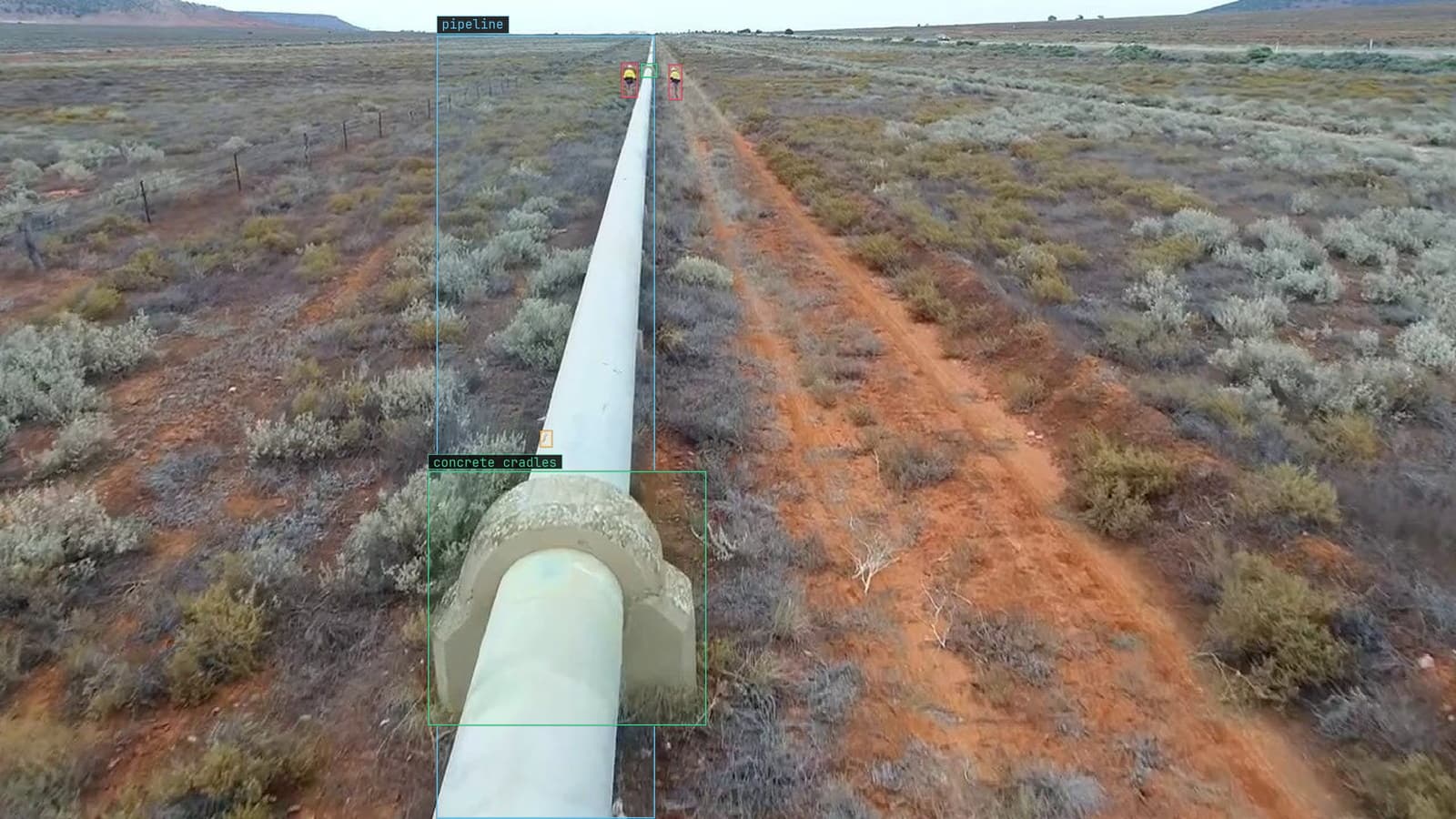
Pipeline across scrub, concrete cradles boxed and a rust mark flagged, from a customer drone survey
The drone lands at half past nine with the morning's pass over the pipeline crossing: a pipe riding on concrete cradles across scrub, a rust bloom on the crown where the coating has gone, two people from the crew walking the line behind it. The inspector who has to turn that flight into a dataset does not open a drawing tool. She types a sentence to Lexi. Find the pipeline, every concrete cradle, any rust on the pipe, and any person near the line.
That sentence is the whole interface for the first pass. It becomes a class list, the class list becomes a draft label on every frame, and the draft is on the screen before the drone's battery has cooled.
What happens after that is the part worth understanding, because a draft on every frame is where the work starts.
The sentence becomes the class list before a box is drawn
Lexi reads the sentence the way a colleague would and turns it into four classes: pipeline, concrete cradle, rust, person. The inspector can rename any of them, merge two, or add one she forgot, and the list she settles on is the vocabulary the project speaks from then on. Every label, every review, every alert the model raises a year later uses those words.
So the sentence is worth writing in the words the crew uses. If the crew says cradle and the class says support, every alert will need translating at the moment nobody has time to translate. The labeling guide covers how the classes are edited after the fact, and the honest advice is to get them right in the sentence.
With the classes fixed, Lexi puts a box on every instance of each class on every frame of the flight. The cradle on one frame and the cradle on the next are the same cradle, tracked across the pass, so the inspector is looking at a few dozen cradles rather than a few thousand boxes.
The draft is a draft until a person has confirmed it
Nothing trains on the draft. Every frame goes to a person, who confirms the box, moves it, changes its class, or rejects it, and each of those is recorded as a decision with a name on it. The dataset that comes out is one an expert has seen frame by frame, which is what up to 99.9% label accuracy means when we print it. The number describes the checked set, never the draft.
On this flight the check takes the inspector most of the afternoon. She keeps the drone's flight log in a paper notebook beside the screen, because the tablet dies in the sun and the notebook does not.
Auto-labeling is strong on common objects and weak on your defects
The person class is close to perfect on the first pass. The world photographs people constantly, and every foundation model has seen more of them than any inspector will. The pipeline and the cradles are nearly as good: large, regular, high contrast against scrub.
Rust is where the draft is weak. A rust bloom on the crown of a coated pipe in flat morning light is a brown smear that could be mud, shadow or a change in the coating, and no foundation model has flown this line. On the first pass Lexi finds the obvious bloom, misses two smaller ones under the cradle edges, and boxes a patch of dried mud as rust. The inspector fixes all four.
That ceiling is the reason a person checks every frame rather than a sample. The classes that matter most to a site are the ones the wider world has photographed least, and they are exactly where the draft needs the most help. It is also the reason the loop exists at all.
Corrections close the gap faster than a longer prompt
The instinct after a weak first draft is to rewrite the sentence. Rust becomes rust, oxidation, coating loss, brown staining on the pipe crown. A word or two of that helps. Most of it does not, because the limit was never the words. The limit was that nothing had shown the model what rust looks like on this pipe in this light.
Corrections do that. Every box the inspector moves onto a real bloom, and every mud patch she rejects, teaches the next pre-labeling pass, and a few hundred checked examples of a specialised class close more of the gap than any amount of prompt polishing. The footage lesson puts a few hundred instances per class as the practical floor for detection, and on a defect class those instances are mostly corrections.
The oil and gas inspection work behind the 12k+ precision image annotations delivered on our industries page was built this way: drafted from a sentence, checked by a person, corrected where the draft was wrong. The pipe and the cradles were mostly confirmed as drawn. The defect classes are where the reviewers earned their afternoon.
The second dataset on the same line comes together faster
A month later the drone flies the same crossing after a week of rain. This time the model trained on the first checked set draws the draft, and rust is boxed where rust is. The inspector's queue is shorter and the corrections have moved to the edge cases: a bloom in the shadow of a cradle, a stain that turns out to be a bird.
My own view is that the sentence is the most important thing a team writes in a project, ahead of the training configuration, because it fixes the vocabulary every later decision is made in, and vocabulary is the thing nobody goes back to change.
From here the project runs the way LexData takes every vision model through its life. You type what to look for, Lexi puts a box on every frame, and a person checks each label before anything trains on it. The model then watches the footage the crew already collects, in the cloud, on your servers, or on a runner beside the recorder. Frames it is unsure of come back to a person, the corrections retrain it, and the new version replaces the old one with no downtime.
On a pipeline that means the corrosion model that flew the second pass is better than the one that flew the first, and the third will be better again, without anyone writing a longer sentence.
One sentence is enough to find out
You can open an account from the product itself, with nobody from sales in the way. Upload a clip from your own site, write the sentence in your crew's words, and look at what the first draft finds and what it misses. The misses tell you where your dataset's value is, and they are what Lexi learns from next. Try it on the platform.
See it on your own footage.
Start with your footageRelated posts
Case notes · 7 min read
Corrosion detection on transmission insulators, from the inspection pass to a pin you can name
A drone pass along an extra-high-voltage line shows every shed and pin. The frame with early rust looks like the one before it; tracking makes the call stick.
Rob Hickey · Jul 2, 2026
Labeling · 6 min read
Automated image labeling, where a model proposes and a person makes it true
Type what to look for, let the model box every frame of the right-of-way, then check each label before it trains. Proposals are drafts until a person agrees.
Sheikh Srijon · Sep 23, 2026
Labeling · 6 min read
Annotation analytics, the numbers a labeling queue produces besides labels
Three labelers on a month of warehouse footage produce boxes, and also a throughput, an acceptance rate and a map of where the rejections cluster.
Rajiya Sultana · Oct 2, 2026