

Industries · 6 min read
Computer vision inventory management with a camera over the stockroom shelf
Stacks counted on sampled frames without a scan, discrepancies flagged against the ledger with the frame, and a packaging change as the relabel.
Summary
This post puts a camera over a store's stockroom shelving and counts the folded stock on sampled frames, with no scan and no clipboard, then compares the count with the ledger every day rather than at the stocktake. It covers the reorder rule written as a sentence, discrepancies flagged with the frame behind them, usage trends answered in LexInsight, and a packaging change as the moment the model needs new labels. It is written for store operations and inventory teams.
Sheikh Srijon · GTM Lead · Sep 25, 2026
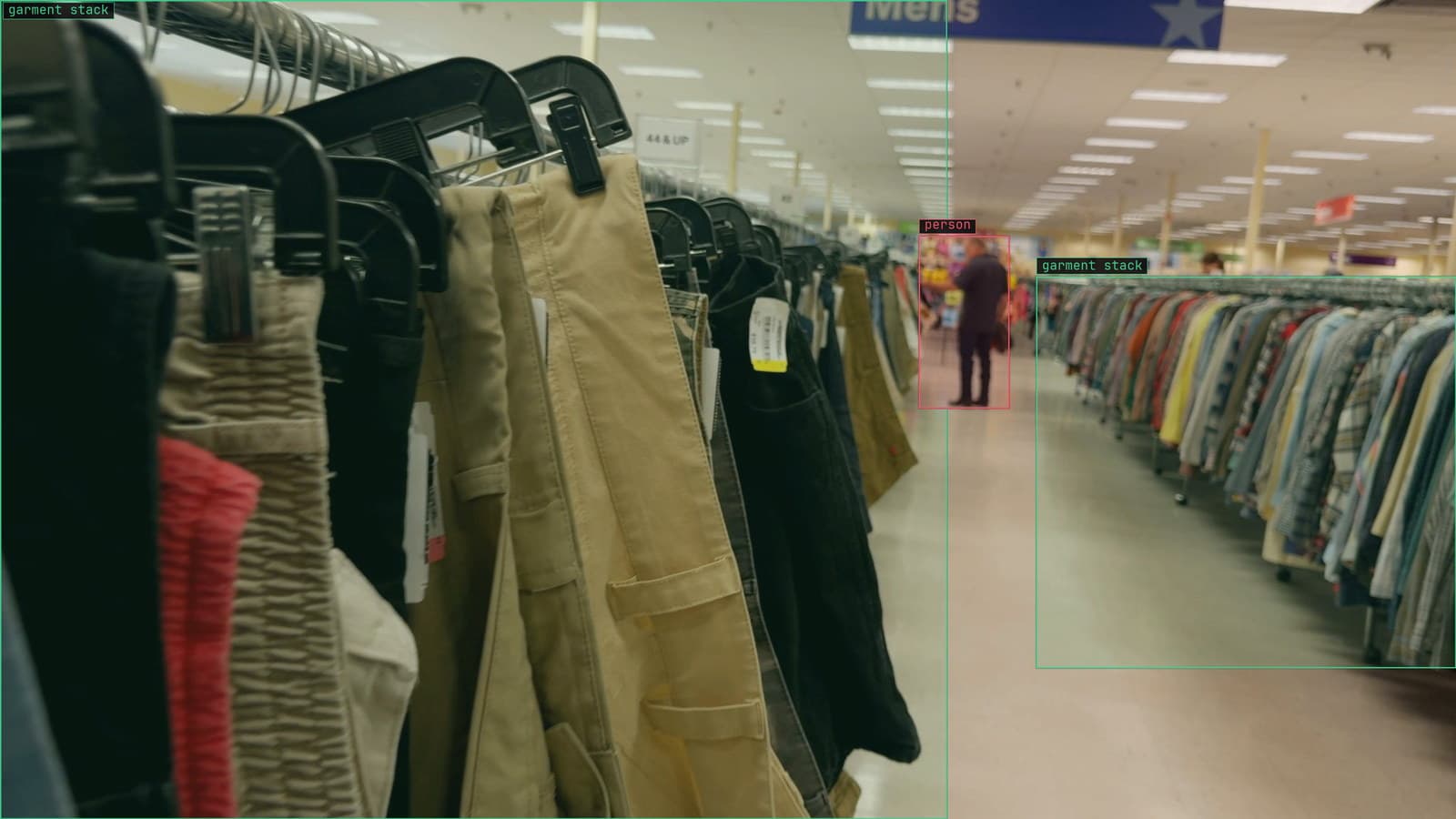
Garment stacks boxed on a rack scan, from a customer store camera
The stockroom behind the fashion floor holds folded stock on steel shelving, and the count on the clipboard is right at 9 pm on Sunday, after the stocktake, and wrong by Tuesday afternoon. Between the two, a replenishment run took twelve of one line to the floor and the assistant wrote eight, a delivery was put away on the wrong shelf, and a customer return went back into the wrong stack. Nobody did anything unusual. The ledger says thirty and the shelf holds twenty-two, and the next person to find out is the one who promises a customer the size that is not there.
The shelf labels in this stockroom are handwritten, and the new starter rewrote them in a different scheme in May, which is how two stacks of the same line came to sit on different shelves with different names.
The clipboard is right on Sunday and wrong by Tuesday
A stocktake is a photograph of the stockroom at one moment, taken by hand, at a cost of a Sunday evening for four people. The ledger between stocktakes is a set of transactions the till and the delivery scanner know about. Every movement they do not know about, the replenishment run, the misplaced delivery, the return in the wrong stack, is a gap between the ledger and the shelf that grows until the next photograph.
The camera over the shelving takes the photograph continuously. What it has to do with the frames is count.
Object detection counts the stacks without a scan
The camera sees the bays of shelving from above and in front, and on each frame the folded stacks are boxed, one box per stack with the line it belongs to as the class. The count for a bay is the number of boxes of each class on the latest frame, sampled about every two seconds, with no barcode scanned and nobody walking the aisle. That is object detection on the stockroom's own frames, because a folded jumper on a steel shelf under a strip light looks like nothing in any general set.
The classes are typed once, one per line the stockroom holds this season. Lexi proposes the boxes on frames the camera has already recorded, and the stockroom supervisor checks each one before anything trains. Her attention goes to the stacks that are two lines mixed together, and the stack with a return folded the wrong way on top, because those are where the count goes wrong. The retail work behind our numbers, 4M+ annotations and validations, is mostly frames of shelves like these.
Counting folded stacks is a count of stacks rather than of units, and the stockroom knows the units per stack for each line. A stack that is visibly shorter than a full one is a stack the model boxes as partial, and partial is the box the supervisor looks at first.
A reorder rule is written as a sentence
The reorder point for each line is a number the buyer already has. The rule is that number, written as a sentence with a severity and a cooldown, approved before it goes live: fewer than two full stacks of any line in the stockroom, routine, sent to the buyer's Monday list with the frame. The buyer sees the bay with the boxes on it and the count, and orders from the frame rather than from the ledger.
Nobody is paged for a low stack. The cooldown means the rule fires once when the second stack goes to the floor, and again only if it is still low a day later.
Discrepancies against the ledger are flagged with the frame
The count is not the finding; the difference between the count and the ledger is. Each night the camera's count for every line is compared with the ledger's number, and where they part by more than the stockroom's tolerance, the line goes on a list with the frame attached. The supervisor walks to the bay on Wednesday morning with the frame on her phone, finds the twelve that were written as eight, or the delivery on the wrong shelf, and corrects the ledger the same day.
I think the daily comparison is the whole value of the camera, and the count on its own is worth very little. A count that agrees with the ledger tells the store nothing it did not know. A count that disagrees, with the frame, is a discrepancy caught on Wednesday instead of at the next stocktake, and every one of those is a customer who was not promised a size that was not there.
Usage trends in LexInsight answer the buyer from the shelf
The frames also carry a history. LexInsight answers "how fast is this line leaving the stockroom, by day and by size" with the frames behind the answer. The answer is the rate at which stacks shorten rather than the rate at which the till rings, and the two differ by exactly the movements the till never sees. The buyer who asked in June why a line kept running short on Saturdays found that it left the stockroom on Friday afternoons, for the floor, and sat there.
The shelf and planogram compliance use case asks the same question of the sales floor, is the right product in the right facing, and the stockroom camera is the same question asked one door back. The wider retail picture, from the aisle to the till, is built from the same frames.
A packaging change is the relabel
In August the supplier for the best-selling line changes the polybag from clear to frosted and the fold from thirds to halves. The stacks on the shelf are correct, full, and unlike anything the model was trained on. The count for that line falls to nothing on the day the delivery is put away, and the reorder rule fires for a bay that is full to the top.
The drift catalog calls this a spec change: the same stock, the same definition of a stack, a different appearance, and no signal in the footage that the model would recognise as a problem. The first signal is the supervisor overriding the count, in one direction, on one line, from the day of the delivery. That override rate is the number to watch.
LexData takes the stockroom model through its whole life. You type what to look for, Lexi puts a box on every stack in every frame, and a person checks each label before anything trains on it. The model then watches the stockroom camera, in the cloud, on your servers or on a runner beside the recorder. Frames it is unsure of come back to a person, the corrections retrain it, and the new version replaces the old one with no downtime. The frosted polybags are a window of frames labeled by the supervisor on the day the delivery arrives, and the version that follows counts them.
See it on your own footage.
Start with your footageMore in Industries
Industries · 7 min read
Counting the screws in a kit with object detection over the bench
A camera over the kitting bench counts every screw and bottle one box at a time. Exact for kits, a band for cases, and a half-hidden item is a written rule.
Rajiya Sultana · Sep 25, 2026
Industries · 7 min read
Automated water meter reading with a camera in the vault
Ten digit classes in a fixed row turn a truck roll into a frame. A rolling digit and condensation on the glass are the frames that come back to a person.
Stephen Biswas · Sep 25, 2026
Industries · 7 min read
Body-in-white inspection with a station camera on unpainted steel
Dents on a bare body shell hide in the reflections. Masks give the extent, a second pass decides reportable, and a tightened tolerance is a spec change.
Finn Ellingwood · Sep 25, 2026