

Operations · 6 min read
A computer vision proof of concept that answers one question and then stops
A defect POC on stamped parts with one objective in numbers, frames from the real station, a defined endpoint, and the move to a pilot on the live line.
Summary
This post takes a defect detection proof of concept on stamped parts and describes what makes it a real one: one objective written in numbers, frames from the actual station, and an endpoint agreed before the first label. It concludes that a POC proves a model can see the defect and nothing more, and that the pilot on the live line is where the questions that matter get answered. It is for engineering managers deciding whether to run one at all.
Ayman Quadir · Head of Product · Sep 27, 2026
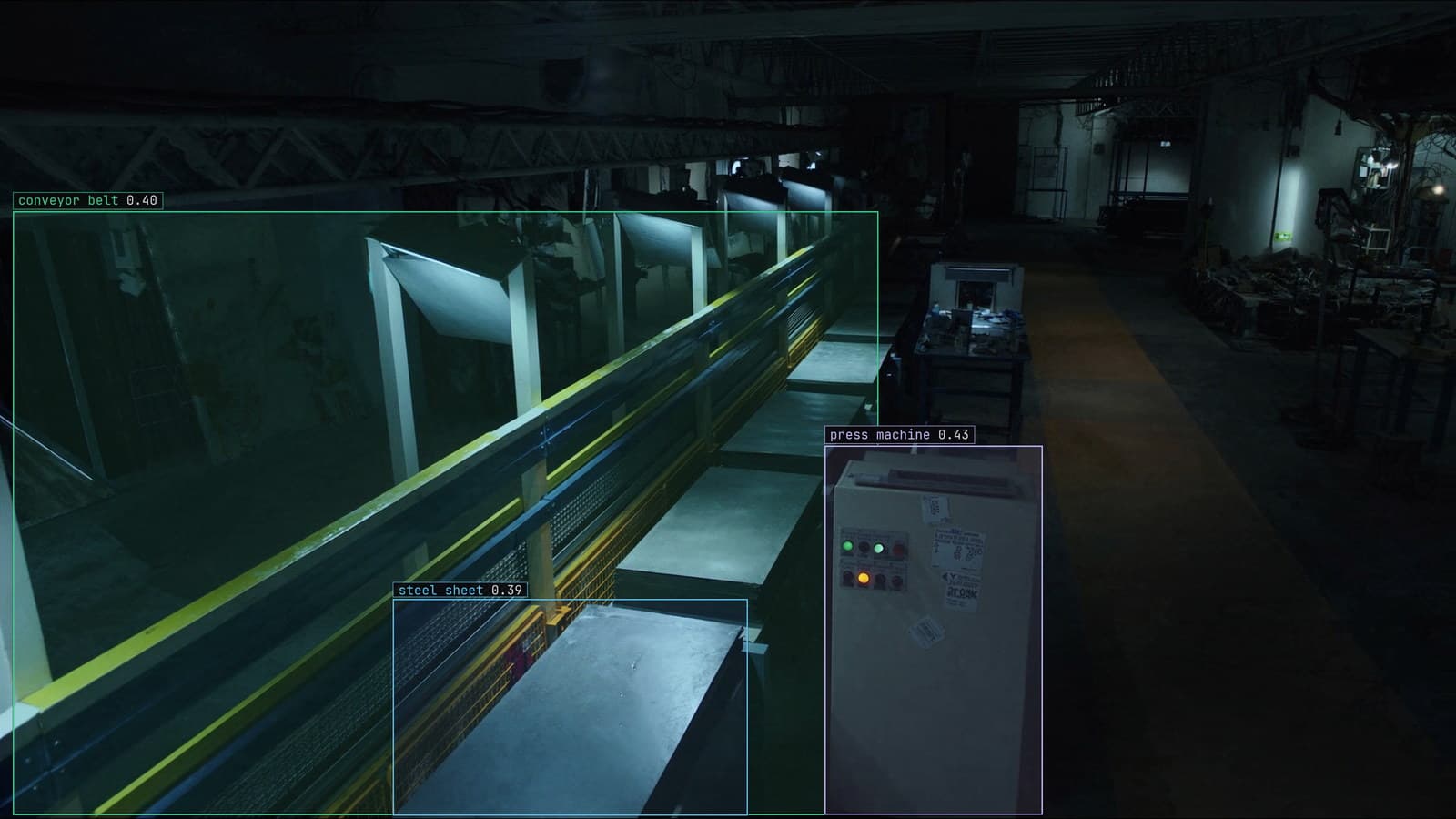
Steel panels on a stamping line conveyor passing the inspection station, generated scene with detections from our model
The stamping plant has a question it has been asking for two years: can a camera over the outfeed of line 4 see the dent that the inspector sees. Not the scratch, which is easy, and not the crack, which is rare. The dent, which is shallow, catches the light one way and not the other, and is the reason the plant still has an inspector on that press.
That is a proof of concept question. It has a yes or a no, and a plant can afford to find out which.
The objective is one sentence with numbers in it
A POC that will end has an objective that can be met. On line 4 the sentence is: the model finds the dents the inspector finds on the outfeed frames, at a miss rate the plant will state before the work starts, with a false alarm rate the inspector could live with. The plant writes the two rates down. They are the plant's numbers, chosen by the quality manager against the cost of a missed dent and the cost of a pulled good panel, and they are not borrowed from anyone's marketing.
Without that sentence the POC becomes model tuning, and model tuning has no end. With it, the work is over on the day the numbers are met, the day they are shown to be unreachable with the frames available, or the day the budget runs out, and all three are results.
My own view is that a POC which cannot fail was not a POC. If the plant is not prepared to hear no, it should skip to the pilot and save the month.
The frames come from line 4, at the height the camera will sit
The second decision is what the model sees during the POC, and the answer is the station itself. A camera at the height and angle it would have in production, over line 4, under the line 4 lights, on a Tuesday and on the night shift, with the panels the plant actually stamps. Not a bench, not a phone, not a public set of dented panels that look nothing like the plant's steel.
The lesson on how much footage you actually need makes the case that a fixed station needs less than people assume, and a POC is where that gets tested. A few hundred frames with the dents the inspector marked and a healthy class for the rest is a first model. You type "dent" once, Lexi proposes the boxes, and the inspector checks them, which is the first time the inspector's eye gets written down, and the first time the plant finds out whether two inspectors agree on what a dent is.
They usually do not, on the shallow ones. That disagreement is a POC finding.
Object detection on stamped parts is the question, and the only question
A POC on line 4 answers whether object detection can see the dent. It does not answer whether the alert reaches the shift lead in time, whether the reject arm can act on it, whether the night shift will trust it, or what the model does when the coil supplier changes. Teams that fold those into the POC get a slow POC that answers nothing cleanly.
Those are pilot questions, and they need the live line to answer. The POC's job is the narrow one: with frames from this station, labeled by this inspector, can a model reach the numbers the plant wrote down. When the answer is yes, the pilot starts. When it is no, the plant has learned whether the problem is the light, the camera's resolution on a shallow dent, or the inspectors' disagreement, and each of those is a cheaper fix than a model.
The plant keeps a shoebox of dented panels by the press, pulled over the years as examples. The POC's first hour is photographing that box under the station lights.
The endpoint is agreed before the first label
A POC needs a date and a decision. On line 4 it is four weeks. At the end of them the quality manager gets one of three answers: the numbers were met on held-out frames from the station, the numbers were not met and here is what the frames say about why, or the budget ran out first. The third is the honest answer more often than teams admit, and a POC that reports it has still told the plant something.
What the POC does not do is drift into a fifth week because the model was close. Close is a result. It goes in the report with the frames it was close on.
The pilot puts the model on the live line with the loop running
The POC proved the model can see the dent. The pilot puts it over line 4 for real, on the frames the press is stamping this shift, with the inspector still at the station. Now the questions the POC set aside get answered: the alert is a rule written as a sentence, with a severity and a cooldown, and it goes to the shift lead's phone with the frame. The inspector overrides the ones the model gets wrong, and those overrides are labels.
LexData takes the dent model through its whole life. You type what to look for, Lexi puts a box on every frame, and a person checks each label before anything trains on it. The model then watches the outfeed camera the plant already has, in the cloud, on your servers, or on a runner beside the recorder. Frames it is unsure of come back to a person, the corrections retrain it, and the new version replaces the old one with no downtime. The platform runs that loop from the pilot's first day, which is the difference between a pilot and a second POC.
The pilot has its own endpoint: the inspector's override rate on line 4, flat for a month. That is when the plant decides whether the inspector moves to the press with no camera.
See it on your own footage.
Start with your footageMore in Operations
Operations · 7 min read
Active learning for computer vision on a line camera that never stops
The weld camera runs three shifts. The model returns the frames it doubts, the inspector corrects them, and past the threshold a new version trains and ships.
Rob Hickey · Sep 27, 2026
Operations · 7 min read
Camera focus measurement for a fixed camera that slowly goes soft
A lens loosened by vibration fails over weeks, and the model suffers before anyone sees blur. A sharpness score against the camera's own history catches it.
Rajiya Sultana · Sep 27, 2026
Operations · 6 min read
Danger zone monitoring with object detection on a site camera
A polygon over the crane swing radius on a site camera. People and vehicles as classes, the bottom of the box as the test, the alert with the frame attached.
Esdras Ntuyenabo · Sep 27, 2026