

Operations · 7 min read
Closing the computer vision feedback loop from an operator's flag to next month's model
The quality engineer on the cell line saw the false pass and had nowhere to put it. A flag on the frame, an event with the lot on it, and a queue that counts.
Summary
This post follows a false pass on a battery cell line from the moment a quality engineer sees it to the version of the model that no longer makes it, through the flag on the frame, the event that carries camera, line, shift and lot, the review queue where the flag becomes a correction, and the threshold that trains the next version. It concludes that a loop the engineer can see working is the only kind that lasts. It is for quality and process engineers on inspection lines.
Rajiya Sultana · Engineering Manager · Sep 27, 2026
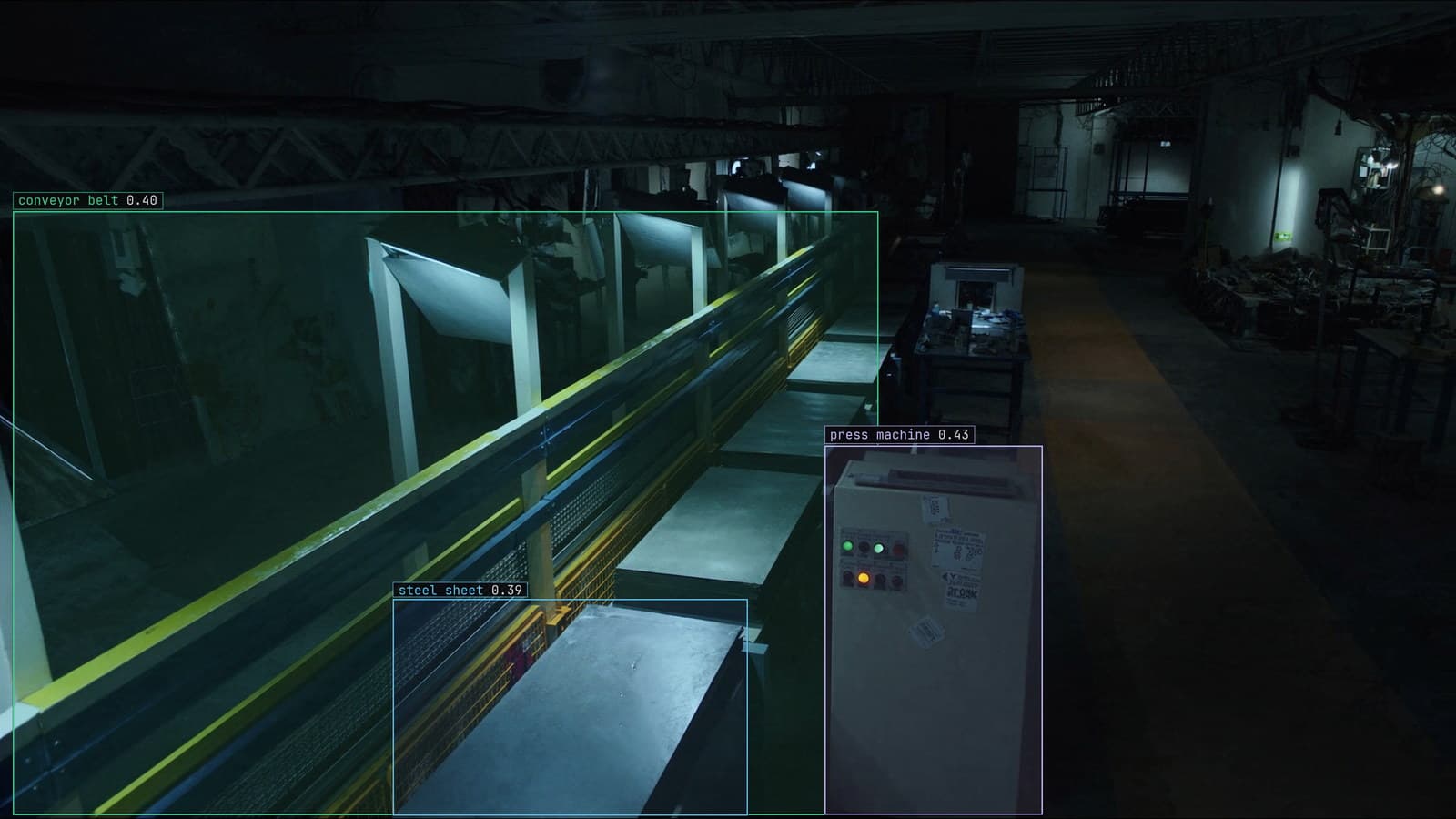
Inspection station on a stamping line, conveyor and press boxed, generated scene with detections from our model
The cell line runs casings past the inspection camera after the wrap is applied, and the model boxes scratches, dents and wrap defects on each one. On a Wednesday afternoon the quality engineer, walking the line with a tray of samples, picks up a cell the model passed and turns it under the light. There is a scratch through the wrap, the kind the guideline calls a reject. The model's frame for that cell, on the station screen, shows a clean casing with no box.
The engineer has seen a false pass, and knows the lot, the shift and the camera. What the engineer does not have, on most lines, is anywhere to put it. The frame will be overwritten by the recorder in a fortnight, the observation goes into an email, and the model makes the same pass on Thursday.
A flag on the frame from the station is the whole interface
The only thing the engineer needs at the station is a way to say this frame was wrong, in one action, on the screen that is already there. On the lines we run, that is a flag on the frame: the engineer taps the Wednesday cell's frame, marks it as a missed reject, and goes back to the tray. No form, no ticket, no description field.
My view, from watching how review tooling gets used and then quietly stops being used, is that a flag with a form attached is a way of telling the engineer no. The line moves at its own pace, and anything that takes longer than picking up the next cell will be done twice and then never. The description can be added later, by whoever reviews the frame. The flag has to be instant.
The event carries the camera, the line, the shift and the lot
A flagged frame on its own is a picture of a cell. What makes it useful is what travels with it: the camera it came from, the line, the shift, the timestamp from the stream, the lot code the line's system had loaded at that moment, and the model's own verdict, a clean casing with no box. That is an event, and the event is what gets stored, not the observation in the email.
The fields do two jobs. In the review queue they let the reviewer see the flagged frame beside the model's other frames from the same lot. That is where a pattern appears: the scratches the model misses cluster on the night shift, on line 3, on the lots wrapped after the new film roll went on. And in the evaluation of the next version, the same fields let the score be cut by exactly those conditions, so the question "does the new version catch the night-shift scratches on the new film" has a number.
On most cylindrical cells the casing is the negative terminal, and the wrap is the only insulation between it and the next cell in the pack. A scratch through the wrap is a reject for that reason, and the guideline says so.
The flagged frame joins the same queue as the doubted ones
The model already returns frames it is unsure of, the ones where a wrap defect sits at the edge of its threshold or a reflection off the casing looks like a dent. Those go to a review queue where a person confirms or corrects Lexi's proposed box. The flagged frame from Wednesday goes into the same queue, marked as an operator flag, and the reviewer draws the box on the scratch the model did not see.
One queue matters because the two kinds of frame are different evidence. The doubted frames tell you where the model's edges are. The flagged frames tell you where it is confidently wrong, which a doubted-frame queue on its own can never show, because a confident miss produces nothing for the model to doubt. A loop built on model uncertainty alone is blind to exactly the failure the quality engineer found with a tray of samples, and the flag is what closes that gap.
Corrections are counted before they are trained on
Every verdict in the queue is logged against the model's prediction. A confirmed box is agreement. A moved box, a redrawn box, or a box drawn where the model had none is a correction, and the corrections are counted per class, per camera and per shift. The Wednesday scratch is one correction on the wrap defect class on line 3. By Friday there are more, and the correction rate on that class has risen in a consistent direction on one line.
That rise is the drift signal. The film roll changed, the new wrap has a slightly different sheen, and the model has weak evidence for scratches on it. Nothing in an accuracy report would have shown this for a quarter, because the accuracy report needs fresh labels, and the corrections are the fresh labels, arriving as a side effect of the engineer's afternoon. The retraining lesson calls corrections on frames the model got wrong the highest-value labels a team will ever get, and the count is what turns them from anecdotes into a threshold.
The threshold trains the next version and the false pass becomes a class it handles
When the corrections cross the project's threshold, a new version trains: on the original set plus the corrections, with the night-shift frames from the new film weighted up rather than the old frames thrown away. It is compared with the running version per class, on frames held out by time from after the film roll changed, and it replaces the old one only when it catches the new scratches without losing the old dents. The rollout has no downtime, and the version it replaces keeps a record of what it trained on.
LexData takes the casing model through its whole life. You type what to look for, Lexi puts a box on every frame, and a person checks each label before anything trains on it. The model then watches the inspection camera the line already has, in the cloud, on your servers, or on a runner beside the recorder. Frames it is unsure of come back to a person, the corrections retrain it, and the new version replaces the old one with no downtime. The engineer's flag is an entrance to that loop from the station, and on the platform it is one tap.
A loop that lasts is one the engineer can see working
The Wednesday flag was raised in the second week of the new film. By the end of the month the version trained on those corrections was running, and the engineer, walking the line with the same tray, found that the night-shift scratches on the new wrap were being boxed. The flags on that class stopped. That is the only proof of a feedback loop that a quality engineer will accept, and it is the reason they keep flagging.
The loops that die are the ones where the flag goes into a queue nobody empties, or where the corrections train a version that never rolls out, or where the engineer cannot tell whether last month's flags changed anything. The surface defect detection use case describes the same station on any line. The manufacturing work behind our numbers holds 99%+ accuracy in production for the reason in this post: the misses are found by the people on the line, and they have somewhere to put them.
See it on your own footage.
Start with your footageMore in Operations
Operations · 7 min read
Active learning for computer vision on a line camera that never stops
The weld camera runs three shifts. The model returns the frames it doubts, the inspector corrects them, and past the threshold a new version trains and ships.
Rob Hickey · Sep 27, 2026
Operations · 7 min read
Camera focus measurement for a fixed camera that slowly goes soft
A lens loosened by vibration fails over weeks, and the model suffers before anyone sees blur. A sharpness score against the camera's own history catches it.
Rajiya Sultana · Sep 27, 2026
Operations · 6 min read
Danger zone monitoring with object detection on a site camera
A polygon over the crane swing radius on a site camera. People and vehicles as classes, the bottom of the box as the test, the alert with the frame attached.
Esdras Ntuyenabo · Sep 27, 2026