

Industries · 7 min read
What a station camera takes off the manufacturing operator's plate
Presence, orientation, fasteners and the label, checked by the camera on every part, so the operator keeps the judgment calls and the exceptions.
Summary
This post follows one assembly station where an operator checks dozens of attributes per part and describes which of those checks a camera takes over and which stay human. It concludes that the operator's corrections are what keep the model accurate, and that the camera earns trust by showing the frame rather than a verdict. It is for plant managers and quality leads who run lines with people on them.
Ayman Quadir · Head of Product · Sep 26, 2026
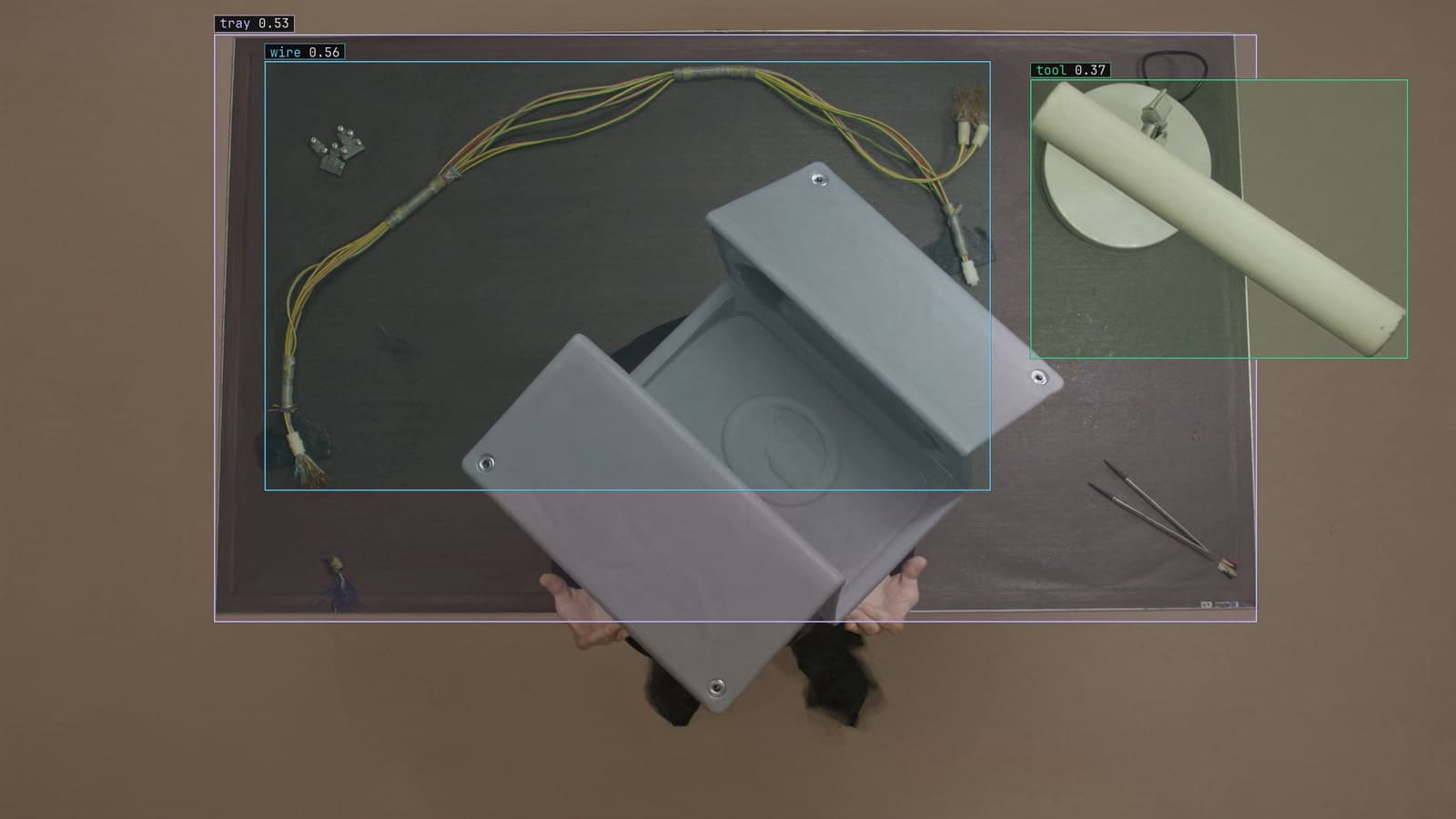
Assembly station with the tool, tray and wiring boxed, generated scene with detections from our model
Station 14 on the pump line builds up a housing every ninety seconds. The operator seats the gasket, drives four fasteners to torque, fits the serial label, checks the inlet is facing the right way, and pushes the part down the roller to the next station. Somewhere in those ninety seconds there are around two dozen things to look at, and the operator looks at all of them, on the first part of the shift and on the four hundredth.
By hour eight the looking is different. Nobody on the line would say so, and the record shows nothing, because a check that was skipped leaves no mark. The part that comes back from final inspection with three fasteners is the only evidence, and by then it has been through six more stations.
A camera over the station does not make the operator faster. It takes the looking that is the same on every part and gives it to something that does not tire.
The checks that are the same on every part go to the camera
The camera's share of the work is the part of the checklist that has a plain answer on every housing. Is the gasket present. Are all four fasteners seated. Is the label in the window, and is it legible. Is the inlet facing the roller side. Each is a yes or a no that the frame from station 14 can settle, and each one was costing the operator a glance on every single part.
What stays with the operator is everything with a judgment in it. A scratch that might be cosmetic or might be a reject. A fastener that is seated but sounds wrong on the driver. A batch of housings from the new casting that all look slightly off. Those are the calls the camera cannot make, and the assembly verification use case is honest about that split: the camera counts and confirms, the person decides.
The classes are typed once, in words: gasket, fastener, label, inlet. Lexi puts a box on each in every frame and a person checks the boxes before anything trains.
On a fixed station with a fixed housing the first labeled set is small, and the person checking it is usually the operator, who knows what a seated fastener looks like from the far side of the bench and can say so in a second.
The verdict shows up where the operator already looks
Station 14 has had a monitor on the arm above the bench for years, for the work instructions. The camera's result goes on the same screen: the frame from a second ago, a box on each fastener, and the one that is missing outlined in the colour the plant chose. No new tool, no second screen, no context switch.
The rule that holds a part is written as a sentence: a housing with fewer than four fasteners seated at station 14, critical, no cooldown. It is approved before it goes live, and what it produces when it fires is the frame with the missing fastener drawn on it, on the monitor and, if the plant wants it, in the shift lead's Slack.
My own view is that the camera should not stop the line by itself for the first month. A hold is a request to the operator with the frame attached, and the operator releases it or fixes the part. The plant that wires a hard stop on day one gets a line that stops for every shadow, and an operator who finds the bypass by Friday.
A fastener missed at the station costs seconds, missed at final it costs a teardown
The whole argument for the camera at the station rather than at the end of the line is where the defect gets found. A missing fastener at station 14 is a ten second fix with the driver still in the operator's hand. The same housing found at final inspection has been through the test rig, been boxed, and has to come back up the line for someone to take apart what six people built on top of it.
That is the lean case in one part. Error-proofing at the source, the poka-yoke the plant's own quality manual already asks for, only with the camera doing the proofing instead of a fixture that would need redesigning every time the housing changed.
The operator at station 14 keeps a tally on a strip of masking tape on the bench edge: one stroke per part the camera held. Most days there are two or three strokes.
The operator's corrections are what train the next version
The camera is wrong sometimes, and the operator can tell in a glance. A fastener seated at a slight angle reads as missing. A label with glare across it reads as absent. Each time, the operator overrides the hold with the part in hand, and each override is a labeled frame.
LexData takes the station model through its whole life. You type what to look for, Lexi puts a box on every frame, and a person checks each label before anything trains on it. The model then watches the station camera the plant already has, in the cloud, on the plant's servers, or on a runner beside the recorder. Frames it is unsure of come back to a person, the corrections retrain it, and the new version replaces the old one with no downtime. The accuracy the station launched with is the accuracy it keeps, and on the manufacturing lines we run that is 99%+ accuracy maintained in production.
The operator does not do anything extra for that to happen. The override is the correction. When enough corrections land, the next version trains on them, and the angled fastener that was held on Tuesday is passed on the following Monday.
A new supplier's casting is the day the camera needs the operator most
The failure that catches plants out is a change nobody told the camera about. Procurement switches casting suppliers and the new housing has a slightly different flange and a darker finish. Every fastener is where it should be, and the camera holds every part for an hour because it has never seen this housing.
The operator is the one who notices, because the operator is the one releasing the holds. The override rate on station 14 climbs in a single shift, and that climb is the signal that the model needs to see the new casting, well before any accuracy figure on a dashboard would move. A short window of frames from the new batch, labeled by the person who releases the holds, and the next version knows both castings.
The same shape repeats across the manufacturing work: a new shift's lighting, a fixture moved an inch, a guard added after a safety review. None of these are model failures in any interesting sense. They are the world changing under a fixed camera, and the person at the bench is the first to know.
Trust comes from the frame, and the operator has to be able to see it
An operator at station 14 who is shown "reject" with nothing behind it will start ignoring the screen within a week. An operator who is shown the frame with the box on the fastener that was missed will look, every time, because the picture is checkable against the part in their hand.
On lines where the camera has been in for a while, the pattern is that the operator stops re-checking the things the camera checks, and spends the recovered attention on the things it does not. The new casting, the fastener that sounds wrong, the housing that is fine by every rule and still is not right. The limits of what a model can see are the same limits that keep the operator at the station, and the plant that understands that split gets a camera the line actually uses.
See it on your own footage.
Start with your footageMore in Industries
Industries · 6 min read
AI crop analysis in the greenhouse, catching tomato disease before it spreads down the row
Lesions boxed by disease with a healthy class, a question of the footage about how far a patch spread since last week, and a model that turns with the season.
Rob Hickey · Sep 26, 2026
Industries · 6 min read
Ceramic defect detection for hairline cracks a fixed-rule camera cannot learn
Edge chips, hairline cracks and pinholes on the tile line after the kiln, masks where the area sets the grade, and the new glaze as the day to relabel.
Esdras Ntuyenabo · Sep 26, 2026
Industries · 6 min read
Chocolate box inspection with a camera over the tray line
Each piece boxed by type, a plain check against the box template, damage as its own class, and the new spring assortment as the day the labels go stale.
Stephen Biswas · Sep 26, 2026