

Industries · 6 min read
Surface defect detection on machined medical parts, with the scratch boxed where it is
A camera at the deburring station puts a box on the burr, the crack and the pit so the inspector sees where, and a new finish spec is the change to label.
Summary
This post follows titanium implant components and stainless instruments across a camera at the deburring station, where cracks, burrs and pits are boxed so the inspector sees where on the part they sit. It concludes that borderline parts should go to a person rather than be guessed, that every disposition belongs against the part's serial, and that a new finish specification is a labeling job before it is a model problem. It is written for quality engineers and inspection leads in orthopaedic and instrument machining.
Rajiya Sultana · Engineering Manager · Sep 24, 2026
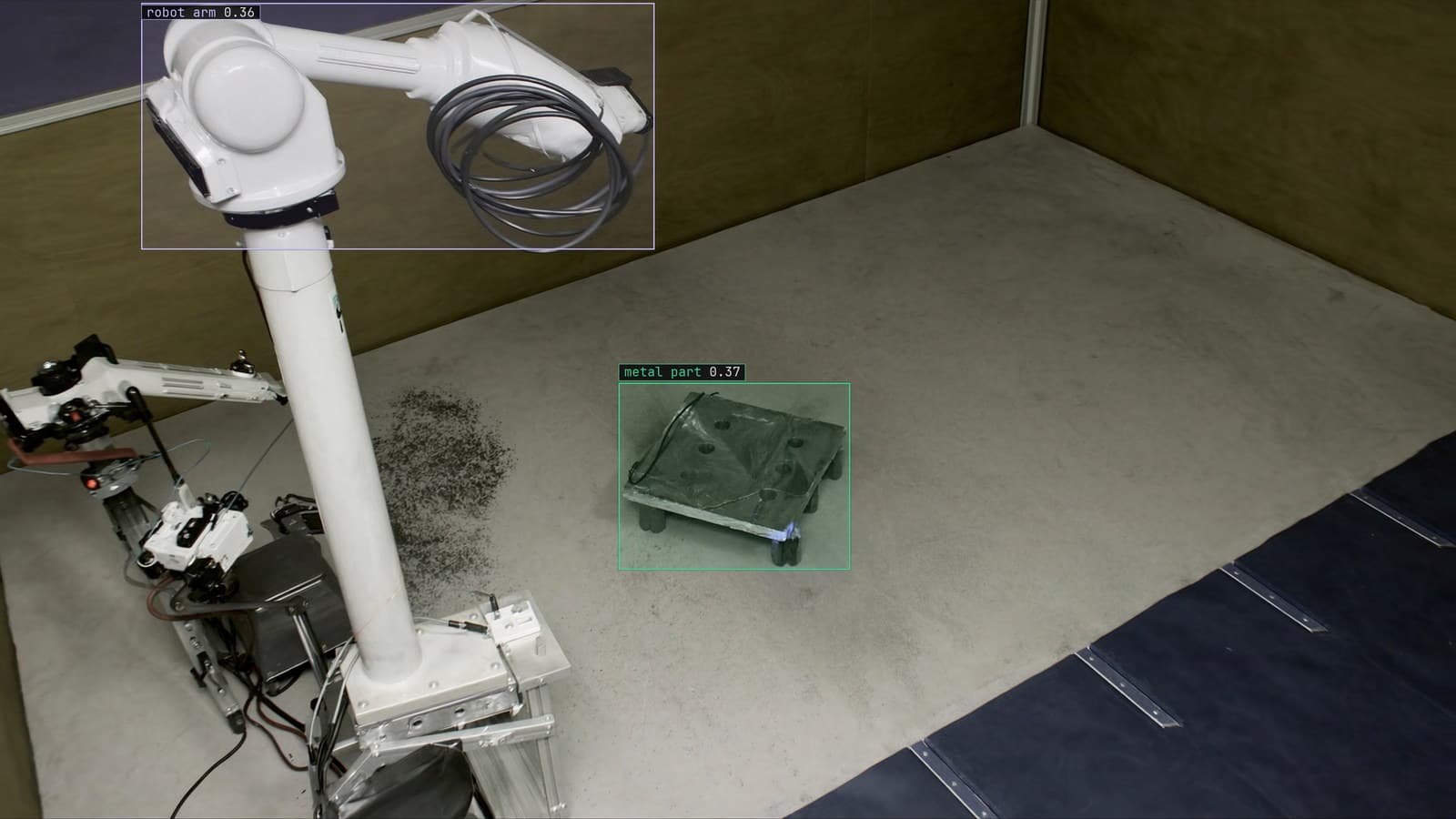
Metal part on a fixture in a robot cell, generated scene with detections from our model
The deburring station at the end of the titanium line has a lamp on an arm, a jar of acetone, a loupe and an inspector who has been tilting parts under that lamp for nine years. She finds a burr on a bone screw thread by turning the screw a quarter turn at a time and watching the highlight move. She is right almost every time, and by the last hour of a Friday shift she is a little less right, and she knows it.
A camera at the station sees every part at the same angles, at 7 am and at 4 pm, and what it gives her is a box on the frame rather than a verdict on the part.
The inspector needs to know where the defect is
A pass or fail on a whole implant is a decision with no evidence. A box on the burr at the third thread, or on a pit in the polished articulating face, is something the inspector can look at under her lamp and confirm in seconds, at 4 pm on a Friday as well as at 7 am. It is also what the disposition needs: a burr on a thread is a rework, a pit on the articulating face is a scrap, and a scratch on the unpolished shank may be nothing at all. Where the defect sits decides what happens to the part, and only a location answers it.
The surface defect detection use case makes the same argument for extent, because the length of a scratch in a cosmetic zone decides its disposition, and only an outline carries a length.
Object detection boxes the burr and the mask carries length
The classes at the station are crack, burr, pit and scratch, typed once. Lexi proposes a box on every candidate in every frame, and the inspector checks each one before the model trains on it. On machined titanium, the checking is most of the work. A machining witness mark and a scratch look alike to a model that has seen a few hundred of each by the end of September, and a polished face throws highlights that sit where a pit could be. Every box she corrects on a highlight is a highlight the next version has learned to leave alone.
For cracks and scratches the box becomes a mask, because the length is what the acceptance sheet is written in. The labeling guide describes the same verification pass on other parts: prompt, classes, and a person on every label before anything trains.
Every finish goes into the set because blasting hides pits
The line makes a bead-blasted hip stem, a polished femoral head and a passivated stainless retractor, and they do not look alike under the station's lamp. A pit on a blasted surface is a small dark hole in a matte field. A pit on a polished face is a bright point in a mirror. A model trained on the blasted stems finds pits on blasted stems and has weak evidence for the polished heads, which are the parts where a pit matters most.
So the training frames come from the station camera across all three finishes, from the Friday afternoons as well as the Monday mornings. The set is checked for how many of each finish it holds before the first training run rather than after the first miss. That is what holding 99%+ accuracy in production means on a manufacturing line: the frames cover the parts the line makes.
Borderline parts go to a person and become labels
A part the model cannot decide on should never be silently passed. The scratch that could be a witness mark, the highlight that could be a pit, come back to the inspector with the frame and the box, and her verdict becomes a label. On the lines we work with, that queue is the same screen she already uses to log dispositions, because a second screen is a queue nobody opens.
I think the borderline queue should be sized to the shift. If the inspector cannot clear it by the end of the day, the threshold is sending her too much, and the right response is to move the threshold rather than to ask her to go faster. An inspector working through a backlog at 4 pm on a Friday is the fatigue the camera was put there to remove.
Every disposition is logged against the part's serial
On a medical line the record is the product. The camera's finding for each part, the class, the box, the score and the frame, is logged against the serial etched on the part, alongside the inspector's disposition. When a lot is queried, the answer is the frames for those serials with the boxes drawn on, and the dispositions beside them.
The reject itself is a rule written as a sentence, with a severity and a cooldown, approved before it goes live: a crack on any part, critical, the part held and the frame to the inspector. A burr on a thread is routine and goes to the rework list. Nobody is paged for a burr.
LexData takes the station's model through its whole life. You type what to look for, Lexi puts a box on every frame, and a person checks each label before anything trains on it. The model then watches the station camera, in the cloud, on your servers or on a runner beside the recorder. Frames it is unsure of come back to a person, the corrections retrain it, and the new version replaces the old one with no downtime. The inspector's Friday-afternoon corrections are the Monday model's evidence.
A new finish spec is a change to label first
In October the customer for the femoral heads tightens the polish specification: a pit that was acceptable under a certain size is now a reject at any size. The parts look the same. The camera's frames look the same. The model, trained on the old sheet, keeps passing heads it was correctly taught to pass, and it does so with every appearance of health.
The drift catalog calls this a spec change, and its only early signal is the inspector overriding the model in one direction, week after week, on pits the model scored as acceptable. That override rate is worth logging even when accuracy looks fine. When it climbs, the labels on polished heads are re-checked against the new sheet, the model is retrained on the corrections, and the old labels get a date. Blaming the model for a change the acceptance sheet made is the mistake this section is here to prevent.
See it on your own footage.
Start with your footageMore in Industries
Industries · 6 min read
AI visual inspection as the nondestructive testing step a camera can take over
Visual testing is the first NDT gate, its acceptance criteria are already written, and a camera can apply them to every weld instead of one in twenty.
Rob Hickey · Sep 24, 2026
Industries · 6 min read
Appearance inspection systems that judge scratches, chips and burrs the same way on every shift
The station, the light and the written standard matter more than the model. The outlines carry the limit, and a tightened tolerance makes every label wrong.
Rajiya Sultana · Sep 24, 2026
Industries · 7 min read
Automated pallet accounting from the camera over the staging zone
A polygon on the frame, every pallet tracked so it is counted once, entries and exits as the ledger, and a wash-down that nudges the camera as the failure.
Andreas Ohrvall · Sep 24, 2026