

Operations · 6 min read
Computer vision safety triggers that stop the machine when what should be there is not
Hands off the palm buttons, a spotter missing, a person down on the belt. The trigger is an absence held past a window, and a dropped frame never stops a line.
Summary
This post describes safety triggers built on the absence of an expected object rather than the presence of an intruder, worked through on a press whose operator's hands must be in a safe zone, a walkway a forklift shares, and a fall on a belt. It concludes that the trigger is an absence held for longer than a window, that a single dropped frame must never stop a line, and that the stop signal to the PLC belongs on the plant's own path. It is for the safety and controls engineers who own the interlocks.
Rajiya Sultana · Engineering Manager · Oct 1, 2026
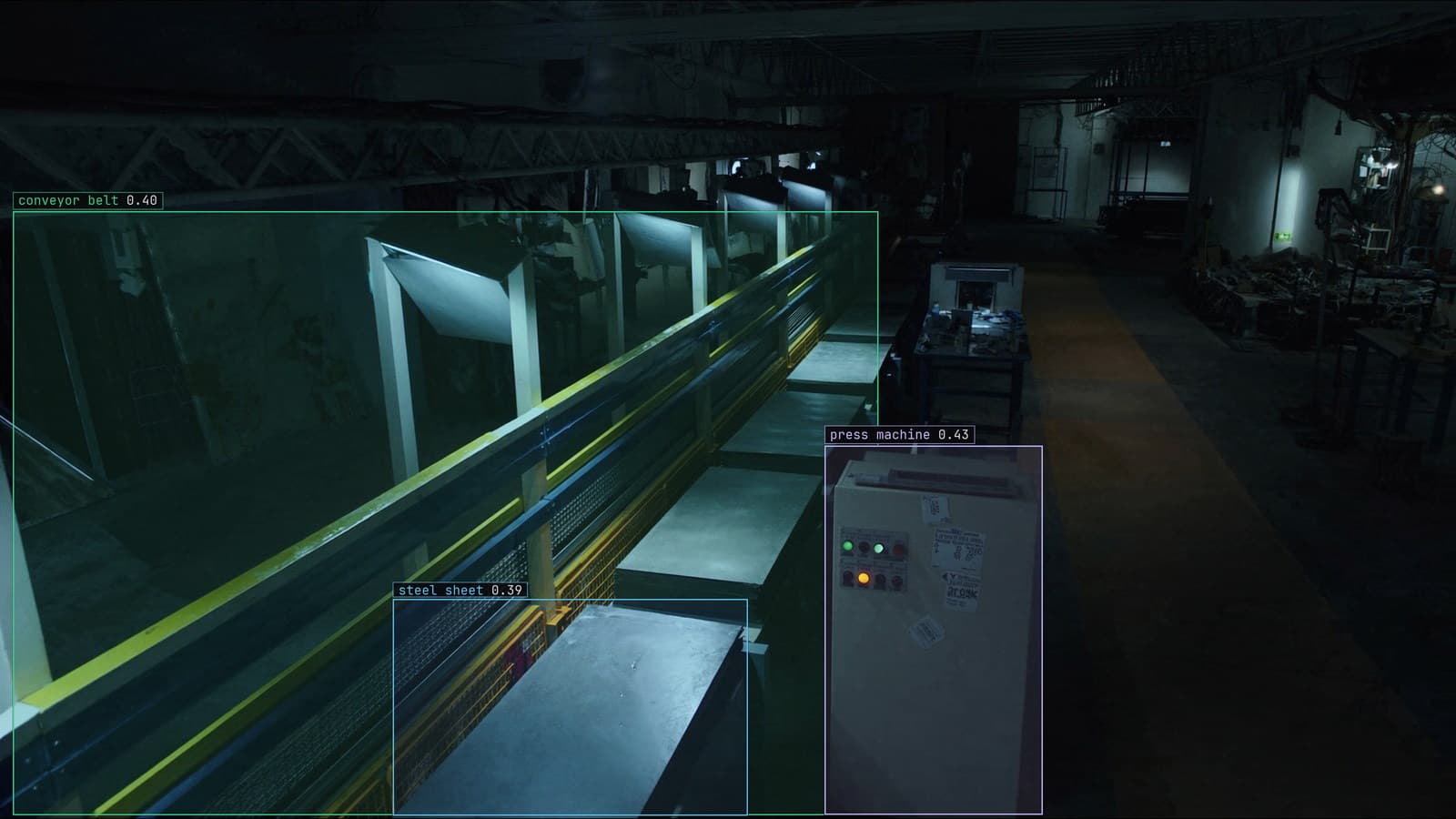
Steel panels on a stamping line passing a press, generated scene with detections from our model
The press on line 4 has a light curtain, and the light curtain has been bridged with tape twice this year because it stops the press when a scrap of steel falls through it. The operator's hands are supposed to be on the two palm buttons when the ram comes down, and they usually are. The safety lead wants a second opinion on that from the camera above the press, and she wants it to be one that does not stop the line every time a strip of steel falls.
The camera's answer is not a person in the wrong place. It is two hands that are not in the right one.
The trigger is an absence, held for longer than a window
Most camera rules fire on presence: a person in the red zone, a forklift in the walkway. The safety triggers that matter on line 4 fire on absence. The hands are not in the safe zone. The operator who should be at the belt is not standing. The spotter who should be at the corner of the walkway is not there.
Absence is harder than presence because a single frame cannot prove it. A hand hidden for one sample behind the ram's guard is absent from the frame and present in the world. So the trigger is never one frame. It is the expected object missing from every sampled frame for longer than a window the plant set, and the window is chosen from how long a real absence takes to become a hazard. For hands leaving the palm buttons that is short. For a spotter leaving a corner it is longer.
One dropped frame must never stop a line
The failure that turns a safety camera into taped-over light curtain is the false stop. A decoder hiccup drops a frame, the model sees nothing where the hands were, and the press halts mid-cycle. Do that three times in a shift and the trigger is disconnected by Friday.
So the rule treats a missing frame as unknown rather than as absence. The window counts only frames the model saw and judged. A stream that stalls is its own alert, to maintenance, on a different path from the stop. The monitoring and alerts doc describes the alert as a rule written as a sentence with a severity and a cooldown, approved before it goes live. For a safety trigger, the approval is where the safety lead and the controls engineer agree on the window, the cooldown, and what a missing frame means.
My own view is that a safety trigger which has not been deliberately fed a dropped frame in testing has not been tested, because the stream will drop one on the first hot afternoon.
The walkway a forklift shares has a spotter who should be there
The second scene is the crossing by gate 2, where the forklift route crosses the walkway from the canteen. The site rule is that a spotter stands at the corner while a forklift is moving through. The camera on the wall sees the corner, the forklift and the walkway together.
The trigger has two parts. A forklift box in the crossing, which is presence, and no person box in the spotter's marked square while it is there, which is absence. The hazard zone intrusion use case handles the first half, a box against a zone drawn once in image coordinates. It adds the warning that applies to both halves: nudge the camera and the spotter's square is on the wrong patch of floor, the detections are unchanged, and every alert is wrong.
A fall on the belt is a person who stopped being upright
The third scene is the sorting belt in hall 2, where one person works alone on the night shift. The concern is a fall or a collapse with nobody in sight. The expected object is an upright person at the belt. The trigger is that shape gone, replaced by a person box that is wide and low, or by no box at all, for longer than the window.
This is the trigger where labeling matters most, because "upright person at the belt" and "person on the floor" are classes someone has to define on frames from this hall, under the night lights. Lexi proposes the boxes, a person checks every label before the model trains, and the reviewer's attention goes to the frames that are neither: crouching to pick up a dropped part, sitting on the stool at break.
The stop signal belongs on the plant's own path
The camera's rule produces an event: hands absent for longer than the window at press 4, at 14:07. What happens next is a controls question. The event can go to Slack or a webhook as an alert, and for the spotter and the fall it does, to the shift lead's phone. For the press, the event has to reach the PLC that owns the ram, on the same wiring loom as the palm buttons and the light curtain, so that the stop does not depend on anything outside the cabinet.
LexData takes the press model through its whole life. You type what to look for, Lexi puts a box on every frame, and a person checks each label before anything trains on it. The model then watches the camera above line 4, in the cloud, on your servers, or on a runner beside the recorder. Frames it is unsure of come back to a person, the corrections retrain it, and the new version replaces the old one with no downtime. For the stop itself, the model is exported with the device preset for the box in the cabinet and runs inside the plant's own control loop, where the controls engineer can measure the path from lens to relay.
Computer vision applications for safety live or die on the false stop
Computer vision applications on the shop floor are judged by the people who work under them, and a safety camera that stops the press for a falling scrap is judged the same way the light curtain was. The taped-over curtain on line 4 is the plant telling the safety lead what it will tolerate. The window, the dropped-frame rule and the cooldown are how a trigger earns the right not to be taped over.
The tape came off the light curtain in March, once the camera had been watching the palm buttons for a month without stopping the line for a scrap. The safety lead kept the tape in her desk drawer.
See it on your own footage.
Start with your footageMore in Operations
Operations · 7 min read
AGPL-3.0 licensing risk for computer vision teams serving a model
A camera streaming to a served detector is the network interaction the licence was written for. What a legal review will ask, and why to pick the weights first.
Ayman Quadir · Oct 1, 2026
Operations · 7 min read
Cloud vs owned GPU inference for computer vision, worked out per camera hour
A plant on three shifts and a retailer with cameras spread across stores get different answers from one sum, and footage leaving the building is a cost too.
Ayman Quadir · Oct 1, 2026
Operations · 7 min read
Computer vision heatmaps drawn from the aisle cameras a store already has
Footpoints from every tracked box, aggregated over a day and mapped onto the floor plan, show where footfall goes. A camera nudged in cleaning shifts the map.
Rajiya Sultana · Oct 1, 2026