

Industries · 7 min read
Container yard management with computer vision, knowing where every box sits without a radio call
Row cameras and a hostler camera box each container and its ID panel, vote the number across a pass, and answer where the reefer went last night.
Summary
This post describes a container yard watched by cameras on the rows and on the hostler, with the container and its ID panel found as boxes, the number read from the crop and voted across every frame of a pass, and dwell per slot asked of the footage. It concludes that the number should be read from the hostler camera at the moment of the move, and that rain on the ID panels is what comes back for review. It is for yard managers and terminal operations teams.
Stephen Biswas · Engineer · Sep 24, 2026
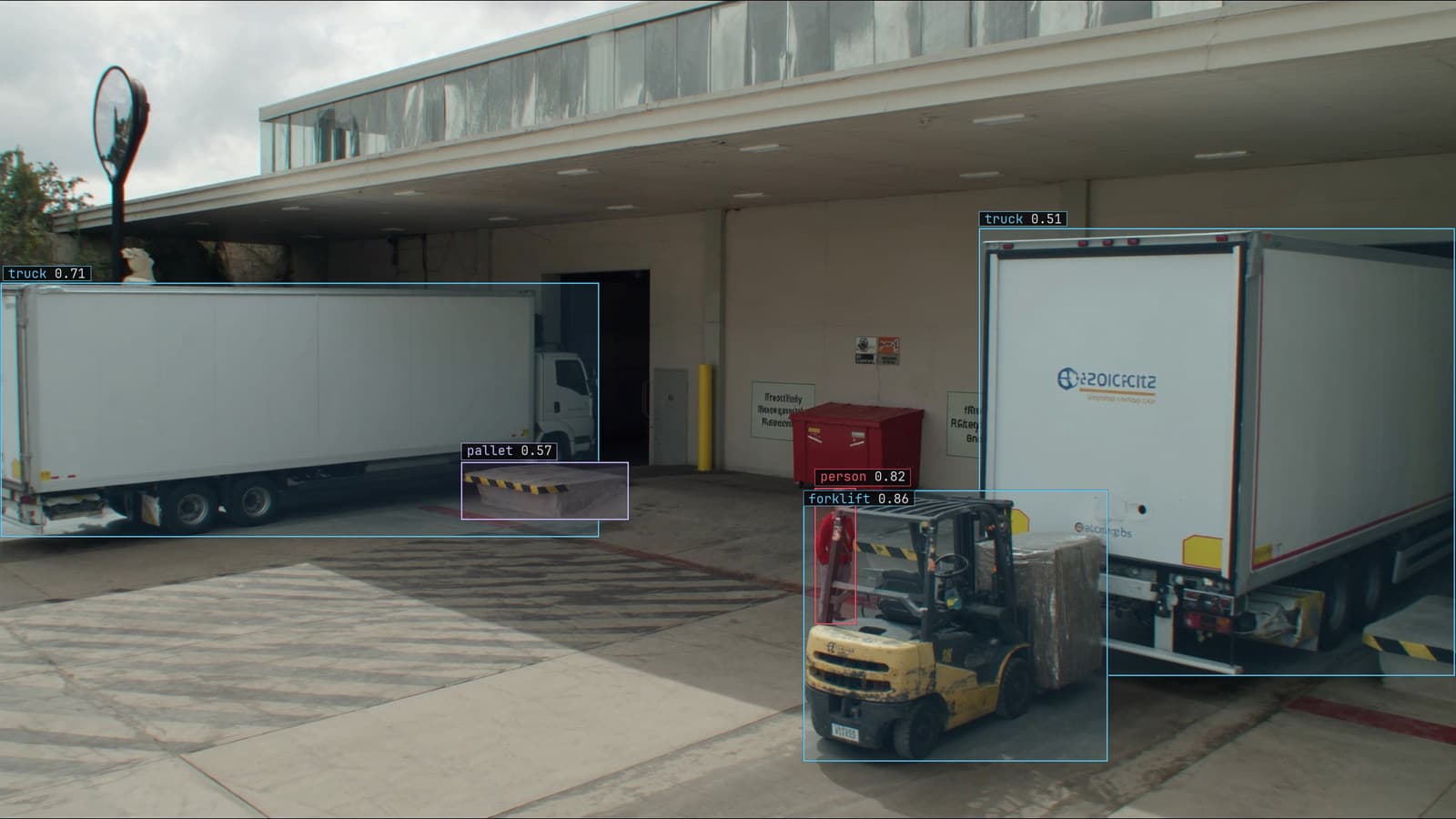
Loading dock from a mounted camera, trucks at the bays and a forklift with a pallet, generated scene with detections from our model
At the 5 am shift change the hostler driver radios the clerk to ask where the reefer for bay 12 went, and the clerk looks at a spreadsheet updated by the night driver, from memory, at the end of his shift. The box is in row C. It is in row C according to the spreadsheet, and the driver spends ten minutes finding out that it is in row D, slot nine, where the night driver put it because row C was full.
Every yard has that ten minutes, several times a shift. The cameras already on the light poles can remove it, provided the pipeline is built in the right order.
Two cameras see two different moments of the same box
The row cameras on the light poles see the stacks: which slots are full, which are empty, and roughly what is in each. They are far from the boxes, and a container number at that distance is a smear. The camera on the hostler sees one box at a time, close, at the moment it is picked up or set down, with the ID panel filling a good part of the frame.
So the row cameras answer presence and the hostler camera answers identity. Both are on the same footage the yard already records. The pipeline puts the identity read where the pixels are, and the presence map where the coverage is.
A YOLO style detector finds the container and the ID panel before anything reads
The first model is a detector with two classes, container and ID panel. A YOLO style detector suits the job because both classes are large, rectangular and distinct against a yard, and because the hostler camera needs the box found on the frame fast enough to catch the moment of the set-down. The number is never read from the whole frame. It is read from the ID panel crop, which is small, upright once the box is found, and mostly text.
You type the two classes once, Lexi proposes the boxes on frames from the hostler and the rows, and a person who works the yard checks them. The checking matters on the ID panel class, because the panel on a refrigerated box sits in a different place from the one on a dry box, and a labeler who boxes only the common position has taught the model to miss every reefer.
The number is read on every frame and voted across the pass
Reading a container number once is unreliable. Rain on the panel, a scuff through a digit, a zero read as the letter that looks like it, and the read is wrong in a way that files the box under a number that does not exist. The fix is to read it on every frame of the pass, as the hostler approaches and sets down, and to vote: the number that appears most across the frames wins.
Container numbers carry a check digit at the end, put there decades before any camera because people misread them over the radio. Each candidate read is tested against it, and a read that fails the check is dropped before the vote rather than counted. That one rule removes most of the wrong numbers on its own.
A read that fails on every frame of a pass comes back to a person with the best crop attached. On the yards we work with, the clerk clears those at the terminal before the 5 am shift change, and the clerk's correction is a label the next version learns from.
Dwell per slot is a question asked of the footage
Once the boxes have numbers and the slots have contents, the yard has a record it never had: which box went into which slot at what time, from the hostler camera, and whether it is still there, from the row cameras. That record answers the 5 am question without the radio, and it answers the ones nobody asked because they took a day to answer. Which boxes in row D have been there longer than the customer's free time. Which reefer was set down in a slot with no power. Where the box the spreadsheet says is in row C actually is.
Those questions are asked of LexInsight, in plain words, and the answer comes back with the frames behind it: the set-down frame, the box number, the slot. A misplaced box is a rule written as a sentence, with a severity and a cooldown, approved before it goes live. It goes to the clerk's Slack with the frame, so the correction happens at the next move rather than at the next count of the yard.
I would read numbers from the hostler camera only and use the row cameras for presence. A fixed camera trying to read a number across the width of the yard is a poor use of its pixels, and a yard that tries it ends up voting between two bad reads.
The hostler lane is a zone, and a person in it is an alert
The same row cameras that map the slots see the lane between the rows, and a person walking down that lane while a hostler is moving is the yard's most dangerous moment. That is a person box and a zone drawn once, the same shape as the hazard zone intrusion use case on a well pad. The rule fires with the frame to the yard supervisor's Slack, with a cooldown. Because the hostler is also a class, the rule can be written for a person in the lane while a hostler is in it, rather than a person in the lane at all.
Rain on the ID panels is what comes back for review
The first version of the pipeline is weakest on the mornings the yard is wet. Rain on a corrugated panel throws reflections across the digits, low sun in winter puts the number in the shadow of the box above it, and the row cameras lose the far stacks in fog until mid-morning. The container detector holds up, because a container is a large rectangle in any weather. The panel reads do not.
The drift catalog calls this rain, fog and dust: the conditions arrive for a week, reads fail, then recover, and the frames from the wet week are rare in the training set and worth keeping. They come back for review because the model doubts them, the clerk confirms the number from the crop, and the correction rate on wet mornings against dry ones is the signal that the next version needs them.
LexData takes the yard model through its whole life. You type what to look for, Lexi puts a box on every frame, and a person checks each label before anything trains on it. The model then watches the pole cameras and the hostler camera the yard already has, in the cloud, on your servers, or on a runner beside the recorder. Frames it is unsure of come back to a person, the corrections retrain it, and the new version replaces the old one with no downtime. The wet January mornings are what the spring version learned from.
The night driver still writes his moves on a clipboard in the cab. The clerk checks the clipboard against the frames now, rather than the other way round.
See it on your own footage.
Start with your footageMore in Industries
Industries · 6 min read
AI visual inspection as the nondestructive testing step a camera can take over
Visual testing is the first NDT gate, its acceptance criteria are already written, and a camera can apply them to every weld instead of one in twenty.
Rob Hickey · Sep 24, 2026
Industries · 6 min read
Appearance inspection systems that judge scratches, chips and burrs the same way on every shift
The station, the light and the written standard matter more than the model. The outlines carry the limit, and a tightened tolerance makes every label wrong.
Rajiya Sultana · Sep 24, 2026
Industries · 7 min read
Automated pallet accounting from the camera over the staging zone
A polygon on the frame, every pallet tracked so it is counted once, entries and exits as the ledger, and a wash-down that nudges the camera as the failure.
Andreas Ohrvall · Sep 24, 2026