

Industries · 6 min read
FDA food label compliance with a camera over the labeling station
Box the nutrition panel and the allergen statement, read them, compare them with the spec, and hold the case on a mismatch before the sealer.
Summary
This post puts a camera over the labeling station of a food packaging line and describes label compliance as detection, reading and comparison against the product's spec, with a hold on any mismatch. It concludes that a regulation or artwork change is a spec change the footage cannot show, so the rule has to read the current spec every run. It is for quality and regulatory teams in food plants.
Ayman Quadir · Head of Product · Sep 26, 2026
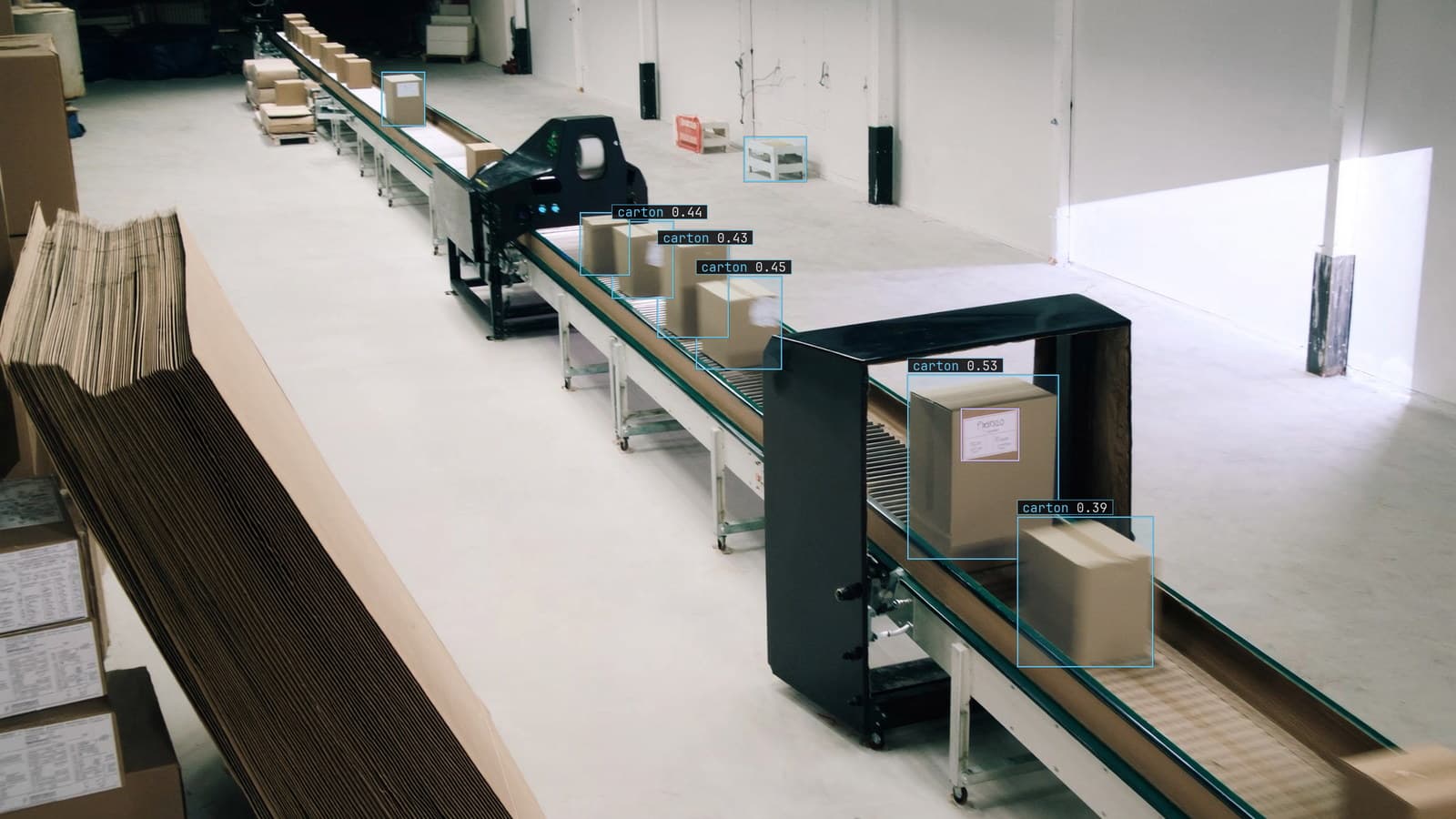
Packaging line with cartons and their labels boxed on the way to the scanner, generated scene with detections from our model
At 2 pm the granola line changes over from the almond variety to the nut-free one. The applicator gets a new roll of labels, the operator confirms the changeover on the HMI, and the line restarts. The roll that went on is the right one this time. Two runs ago it was the almond roll for the first forty cases of nut-free product, and those cases were found at the distributor, which is the expensive place to find them.
A quality specialist checks a label against the spec sheet at the start of every run and then at intervals. Between intervals, the line runs.
The camera over the applicator looks at every label on every carton. It cannot read the regulation, but it can tell whether the words on this carton are the words the spec says should be there, and it can hold the case before the sealer when they are not.
The panel and the allergen statement are boxes before they are words
The first job is finding the parts of the label that matter, and that is detection. The classes are the elements the spec cares about: the Nutrition Facts panel, the ingredient list, the allergen statement, the lot code and best-before, the net weight. Each gets a box on every carton, and the box is what the reading step is pointed at.
The training frames come from the station camera, at its mounted height, in the line's own light, with cartons at the angles the conveyor actually presents them. A person types the element names once, Lexi proposes the boxes, and a person checks them. The checking is mostly the edges: a panel that wraps a corner, a statement half under a seam, a label applied crooked enough that the box has to be crooked too.
The words inside the box are compared with the spec, field by field
A box around the allergen statement is a region of pixels. Reading it gives text, and the text is compared against the product's spec, which the plant already keeps: this product, this variety, these words in the allergen line, these values in the panel. The comparison is field by field, and the tolerance is a decision per field, made once by the QA lead and written next to the spec.
The allergen statement has a tolerance of nothing. "Contains: almonds" on a nut-free carton from the 2 pm run is a critical mismatch, and so is a statement that is missing entirely. The panel values can carry a small tolerance for a misread character, because a read of a dense panel on a moving carton will occasionally drop a digit. A plant that holds a case on every dropped digit will have a queue at the sealer by lunch.
The package and label inspection use case runs the same way for any printed element: box it, read it, compare it, and route the disagreement to a person.
A mismatch holds the case before the sealer, with the frame attached
The rule is a sentence: an allergen statement on the granola line that disagrees with the current product spec, critical, no cooldown. It is approved before it goes live, and when it fires the case is held at the sealer and the frame arrives with the statement boxed, the words the camera read, the words the spec expects, and the run it belongs to. The specialist looks at the carton rather than at a code, releases or rejects in a moment, and the same frame lands in the QA channel on Slack for the record.
The hold has to be physical and it has to be early. A mismatch found at the sealer is a carton pulled off the line. A mismatch found at the distributor is a recall.
My own view is that the specialist's binder, the printed spec with the sample label taped inside it, should stay at the station after the camera is in. It is the reference the camera is checked against, and the day the two disagree is the day something upstream changed.
A new regulation or a new artwork is a spec change the frames cannot show
Here is where label inspection differs from most camera work. On Monday the artwork team ships a revised label with the allergen line reworded to the format the regulator now asks for. The cartons look the same to the camera. The reading is correct. The comparison now fails on every carton, because the spec the rule reads is last month's.
The drift catalog calls this a spec change: the footage did not move, the correct answer did. No monitor of the frames will catch it, and the model is not wrong. What catches it is the rule reading the current spec, every run, before it compares, and a changeover step that updates the spec with the label roll. The tell, when that step is missed, is the specialist overriding a hold on every carton for an hour, and that override rate is the signal that the spec is stale.
Regulations move the other way too. A wording that was acceptable last quarter becomes a reportable deviation this quarter, and the frames still look identical. The plant that treats the spec as a controlled document, with the same version discipline as the label artwork, is the plant whose camera stays right through the change.
Glare, a wrinkle and a curved surface are the frames that come back
On a good carton the read is clean. On the ones the line produces at the edges the read is doubtful: a label wrinkled by the applicator, glare off a foil panel under the station light, a statement wrapped round a curved pouch. A doubtful read is held for a person rather than passed as a match.
LexData takes the label model through its whole life. You type what to look for, Lexi puts a box on every frame, and a person checks each label before anything trains on it. The model then watches the station camera the plant already has, in the cloud, on your servers, or on a runner beside the recorder. Frames it is unsure of come back to a person, the corrections retrain it, and the new version replaces the old one with no downtime. Across the manufacturing lines we run that is 99%+ accuracy maintained in production.
The wrinkled labels from the first month are what the second version learned from. By the third month the specialist sees fewer of them, and the ones that still arrive are the ones worth a person's look.
The line keeps its old label rolls in a locked cabinet at the end of the run, because a roll left on the bench is how the almond labels ended up on the nut-free cartons. The camera would have held the first case. The cabinet is what stops there being a first case.
See it on your own footage.
Start with your footageMore in Industries
Industries · 6 min read
AI crop analysis in the greenhouse, catching tomato disease before it spreads down the row
Lesions boxed by disease with a healthy class, a question of the footage about how far a patch spread since last week, and a model that turns with the season.
Rob Hickey · Sep 26, 2026
Industries · 6 min read
Ceramic defect detection for hairline cracks a fixed-rule camera cannot learn
Edge chips, hairline cracks and pinholes on the tile line after the kiln, masks where the area sets the grade, and the new glaze as the day to relabel.
Esdras Ntuyenabo · Sep 26, 2026
Industries · 6 min read
Chocolate box inspection with a camera over the tray line
Each piece boxed by type, a plain check against the box template, damage as its own class, and the new spring assortment as the day the labels go stale.
Stephen Biswas · Sep 26, 2026