

Industries · 6 min read
Medical device kit verification when the kit list changes every month
Each configuration is a checklist of parts, the camera boxes what is present and names what is absent, and a revision is a labeled part, not a rebuilt cell.
Summary
This post describes kit verification at a device kitting bench: every configuration held as a checklist of parts, a camera that boxes what is present and names what is absent before the kit is sealed, and a revision handled by labeling the new part. It concludes that the kit list should live where the camera can read it, and that a new part is a labeling job rather than a new cell. It is for device manufacturing and packaging operations teams.
Ayman Quadir · Head of Product · Sep 30, 2026
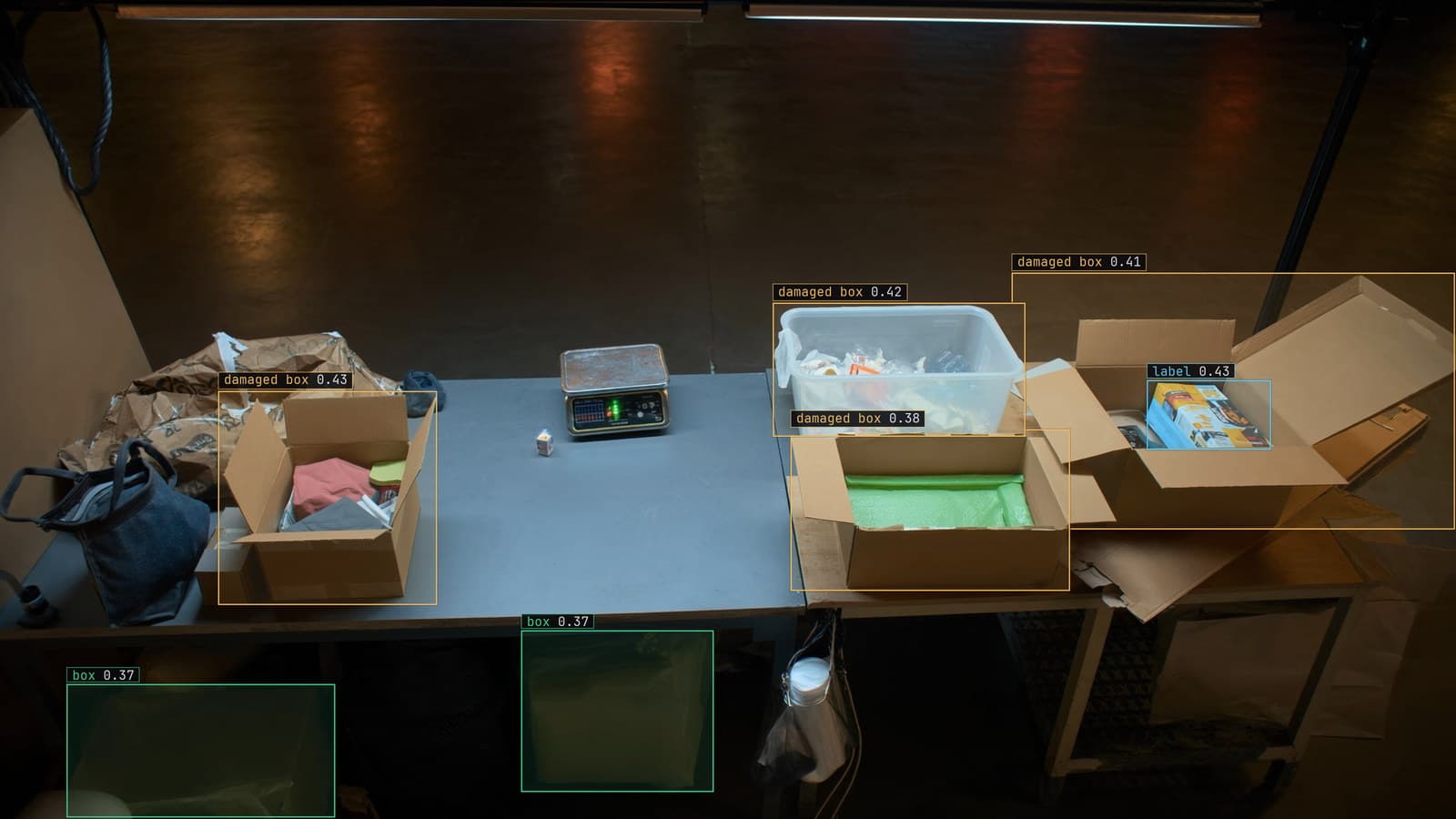
Parcel packing station from overhead, boxes and a label boxed, generated scene with detections from our model
Station 3 at a device plant kits a catheter set. A tray, three syringes of two sizes, a guidewire in its coil, two labels and a folded instruction leaflet, placed in order and sealed in a pouch. This month there are fourteen configurations of that kit for different markets and customers, and the kitter at station 3 has a laminated card for each one, clipped to the bench in the order they are scheduled. A leaflet missed at 2 pm is found at final QA, if it is found at all, and the pouch is opened and the kit rebuilt.
The camera over the bench sees the tray before the pouch is sealed. What it does with that view depends on a decision about what a kit is.
Each configuration is a checklist of parts and not a class
The first design most plants sketch is a class per configuration: kit A, kit B, and so on to fourteen. It fails within a month, because a kit is not a thing the camera can see. It is a list. Two configurations differ by one syringe size and one label, and a model asked to tell them apart as whole objects learns the tray and the bench and very little else.
So the classes are parts. Tray, small syringe, large syringe, guidewire, label, leaflet. You type the parts once, Lexi puts a box on each in every frame, and a person checks the boxes before anything trains. Which parts a given kit needs is a rule downstream of the boxes, and the rule is selected by the configuration on the work order, read from the barcode on the tray or the schedule for station 3.
The assembly verification use case names why this is hard: it is a completeness check, and the absence of a small part in a cluttered tray is the signal. A leaflet folded flat under the guidewire coil is exactly the part most often missing and the one most easily hidden.
Vision AI at the bench boxes what is present and names what is absent
With the parts boxed and the checklist selected, the comparison is arithmetic. The checklist for that kit wants two small syringes and one large, one guidewire, two labels and one leaflet. The boxes show two small syringes and one large, one guidewire and two labels, and no leaflet. The rule names the absence.
The alert is a sentence: a kit at station 3 missing a part on its checklist, high severity, no cooldown, approved before it goes live. It fires before the pouch is sealed, on a screen at the bench, and what it shows is the frame with the present parts boxed and the checklist beside it with the leaflet line marked. The kitter reaches for the leaflet and the kit goes on. Vision AI at the bench is worth exactly as much as the seconds between the frame and the seal, and nothing it says after the seal is any use.
A part the model is unsure of, a syringe on its side that could be either size, is not counted as absent. It goes to a person with the frame, and the kit waits.
The kit list changes every month and the model does not
In month two, configuration nine gains a second guidewire and loses a label. Nothing on the bench looks different: the same tray and the same parts under the same light. Every kit of configuration nine that was correct last month is now short a guidewire, and the model cannot see it, because the frames did not change.
The drift catalog files this as a spec change: the pixels are identical and every label you own is now wrong. On a kitting bench it is the most common change there is, and it has nothing to do with the model. The checklist for configuration nine changes, in the place the rule reads it from, and the same boxes now produce a different verdict.
My own view is that this is the whole argument for keeping the kit list somewhere the camera can read it rather than on a laminated card. The card at station 3 is updated by hand when the revision lands, sometimes a day late. The checklist the rule reads is updated once, and every kit after it is checked against the new list.
The kitter keeps the cards anyway. They are a better record of what changed and when than anything in the system, because the old ones go in a drawer with the date written on the back.
A new part is labeled, not a new cell built
The revision that matters more is a new part. In month four a configuration gains a sterile cap that has never been on the bench. The checklist can be updated in a minute; the model has no class for a cap, and a kit with the cap present reads as a kit with an unknown object on the tray.
The fix is a labeling job. Frames from the first shift with the new cap, the class typed once, boxes proposed and checked, folded into the next version. The bench is not rebuilt, the camera does not move, and the thirteen configurations that do not use the cap are unaffected. A plant that treats every revision as a rebuild of the inspection cell stops doing revisions, and a plant that treats them as a labeling job does them on a Tuesday.
The same shape applies when a second plant takes on the same kits. The use case's own drift is a new site coming online: a different bench height, a different camera under different light, and the same parts. The classes transfer; the frames do not, and the second plant labels a window of its own before it goes live.
Doubted frames from station 3 are the next version
LexData takes the kitting model through its whole life. You type what to look for, Lexi puts a box on every part in every frame, and a person checks each label before anything trains on it. The model then watches the camera over station 3, in the cloud, on your servers, or on a runner beside the recorder. Frames it is unsure of come back to a person, the corrections retrain it, and the new version replaces the old one with no downtime.
The frames that come back in the first month are the leaflet half under the coil, a syringe on its side, a label stuck to the kitter's glove and photographed mid-air. Each is a box corrected by a person, and when the corrections cross the project's threshold a new version trains. In manufacturing the figure we hold to is 99%+ accuracy maintained in production, and on a kitting bench it is maintained by the kitter correcting the model on the frames it sent back, one revision at a time.
See it on your own footage.
Start with your footageMore in Industries
Industries · 6 min read
Perimeter security with fixed cameras, object detection and a drone sent to look
A frame every two seconds is enough to catch a person at the fence, a CPU is enough to run it, and the drone is the second look rather than the detector.
Andreas Ohrvall · Sep 30, 2026
Industries · 7 min read
Food service QA with a camera over the tray packing line
Every component on the tray gets a box, the missing one is flagged before the sealer, and the alert count is read against the line's own history.
Ayman Quadir · Sep 30, 2026
Industries · 7 min read
Railway safety with trackside cameras, zones and a signaller who can live with the alerts
People and vehicles boxed, the track bed and crossing drawn as zones, the frame sent to the control room, and a false alarm rate a signaller will keep reading.
Rajiya Sultana · Sep 30, 2026