

Industries · 7 min read
Diabetes device inspection with a VLM and one detector across four device shapes
Four device shapes on one line: a question judges the faults nobody wrote a class for, a detector owns the count, and a new device generation is labeled first.
Summary
This post describes visual inspection on a packaging line that runs insulin pens, glucose meters, test strips and sensors in the same week, and splits the work between a question to LexInsight and a trained detector. It concludes that the question handles the faults nobody wrote a class for while the detector owns the count that stops the line, and that a new device generation has to be labeled before its first shift. It is for quality and packaging engineers on device lines.
Rob Hickey · Chief AI Officer · Sep 30, 2026
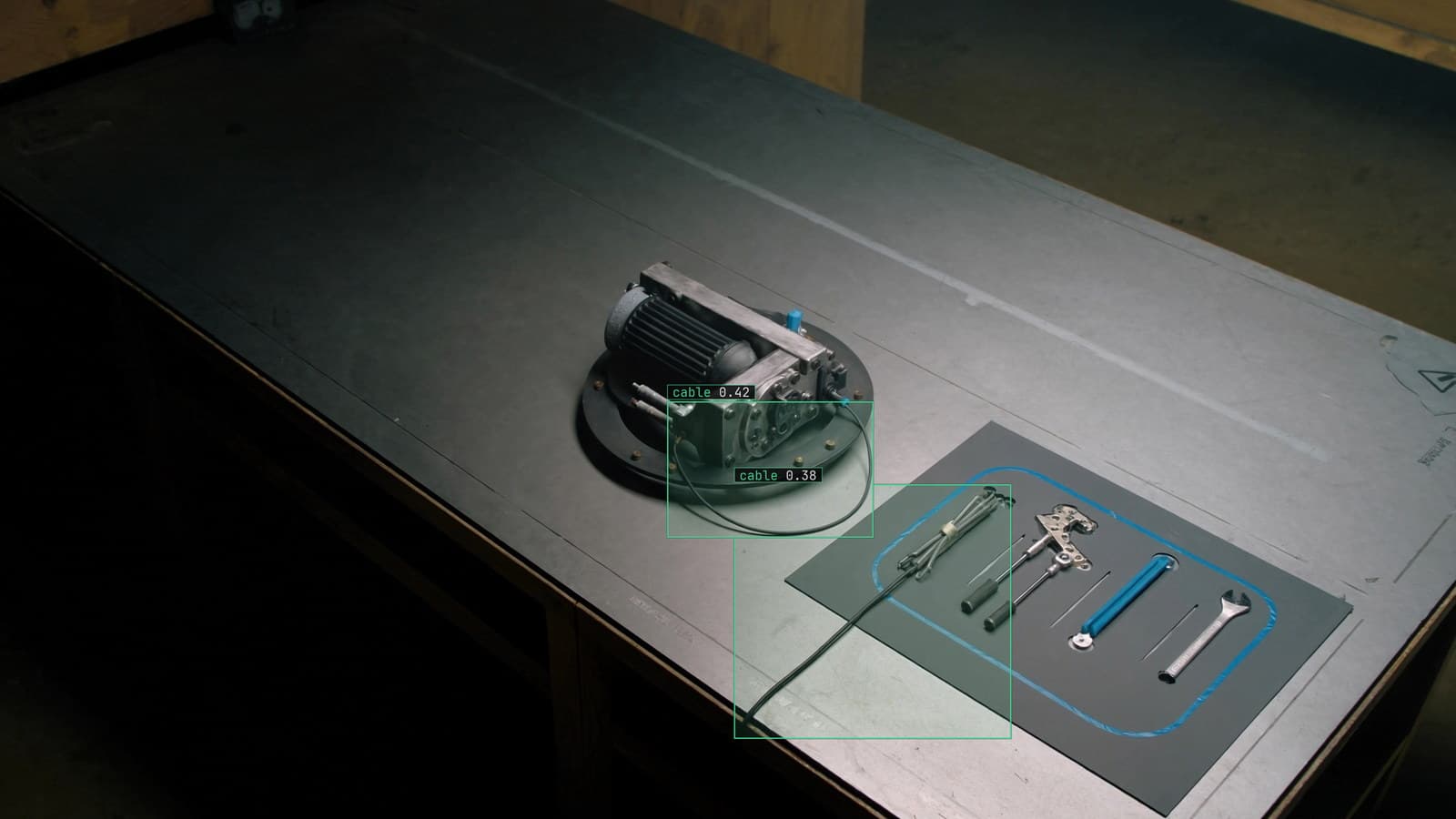
Assembly station, housing and fasteners laid out with a cable boxed, generated scene with detections from our model
Line 2 at a device plant runs insulin pens on Monday, glucose meters on Tuesday, a run of test strip vials on Wednesday, and continuous sensor applicators from Thursday. Each changeover takes the morning, and the inspection at the end of the line changes with it. A pen has a cap and a cartridge window, a meter has a screen and a strip port, a vial has a desiccant lid, an applicator has a release tab. The inspector at the end of line 2 has a laminated checklist per device and swaps it at every changeover.
The obvious camera design is a model per device, five of them, with the same changeover. The line does not need five models. It needs to decide which questions a model has to be trained for and which it can be asked.
A question to a VLM judges what nobody wrote a class for
Some faults are descriptive. Is there a smear on the cartridge window. Is the cap seated all the way down. Is the strip vial lid cracked. Is there anything on the applicator that should not be there. A VLM answers a question like that in plain words, on a frame from line 2, with the frame behind the answer. It does so on the Tuesday meter having only ever been asked about the Monday pen, because it was not trained on either.
That is what LexInsight is for on this line. The inspector, or the rule, asks a question of the footage and gets an answer with the frames that support it. It handles the long tail: the fault that shows up once a month, the contamination nobody thought to name, the changeover morning when the first units of a new run come through and no class list exists for them yet.
What a question cannot do is count. Asked the same thing about a thousand devices it will answer each one, and the answers will be honest, and they will not be a number anyone can compare with last Tuesday's.
A trained detector owns the count that stops the line
The faults that matter most on a device line are absences. A pen with no cap. A meter with no battery door. An applicator with the release tab missing. The assembly verification use case names this: it is a completeness check, the absence of a small part in a cluttered assembly is the signal, and absence is harder to score than presence. A missing part has to be found the same way on every unit, on every shift, because the rule that stops the line fires on it.
So the detector is trained on the plant's own frames with a class per part: cap, cartridge window, battery door, strip port, desiccant lid, release tab. You type the class list once, Lexi puts a box on every part in every frame, and a person checks each box before anything trains. One detector, one class list across four device shapes, since a cap is a cap on a pen and a lid is a lid on a vial. The checklist per device is a rule downstream of the boxes rather than a model of its own.
The rule is written as a sentence: a pen on line 2 with no cap detected, high severity, no cooldown, approved before it goes live. What arrives is the frame with the parts that were found boxed and the empty place where the cap should be.
The split is presence to the detector and everything else to the question
My own view, and I hold it against the instinct of most teams I talk to, is that the detector's class list should be short and boring. Parts that are either there or not. Everything descriptive goes to the question, the smear and the crack and the scuff on the housing, because a descriptive fault is hard to box consistently and the person checking the labels will spend a week arguing about where a scuff ends.
In practice the two run side by side on the same sampled frames. The detector returns its boxes and the rule checks the checklist for that device. A frame the detector is unsure of, a cap at an angle, a door half closed, goes to a person. A frame that passed the checklist can still be asked the descriptive questions, and a smear on the window comes back to the same person with the answer and the frame.
The inspector on line 2 keeps the laminated checklists in a ring binder at the station, and the detector's class list was written from them, one binder page at a time.
A new device generation is the equipment upgrade to label first
In the second year the meter is replaced with a new generation: a rounder housing, a larger screen, the strip port moved from the top to the side. From the first unit of the first Tuesday, the detector's strip port class is looking in the wrong place on a housing it has never seen. The count of meters with no strip port goes to nearly all of them, and the line lead knows within minutes that the model is wrong rather than the meters.
The drift catalog files this as the equipment changed: a new generation, a new housing, and the model has never seen the thing it is now looking at. The fix is the plain one. Frames from the first shift of the new meter, labeled with the same class list, checked by a person, folded in.
The detector catches up in a version. The old meter's frames stay in the training set for the plants still running it.
The question has a subtler failure on the same morning. Asked whether the strip port is clean on the new meter, it answers plausibly, because it answers about anything, and nobody has yet checked whether its answers on the new housing are right. On a changeover morning the question's answers go to a person for the first run, the same as the detector's doubted frames do, until someone has read enough of them to trust them.
Doubted frames from line 2 are the next version
LexData takes the inspection model through its whole life. You type what to look for, Lexi puts a box on every part in every frame, and a person checks each label before anything trains on it. The model then watches the camera over line 2, in the cloud, on your servers, or on a runner beside the recorder. Frames it is unsure of come back to a person, the corrections retrain it, and the new version replaces the old one with no downtime.
The frames that come back are the cap seated but tilted, the battery door in the shadow of the inspector's hand, the applicator lying release-tab down. Each one is a box corrected by a person, and when the corrections cross the project's threshold a new version trains. In manufacturing the figure we hold to is 99%+ accuracy maintained in production, and on a four-device line it is maintained by the inspector correcting the detector on the frames it sent back, one changeover at a time.
The ring binder stays at the station. The camera reads from it too.
See it on your own footage.
Start with your footageMore in Industries
Industries · 6 min read
Perimeter security with fixed cameras, object detection and a drone sent to look
A frame every two seconds is enough to catch a person at the fence, a CPU is enough to run it, and the drone is the second look rather than the detector.
Andreas Ohrvall · Sep 30, 2026
Industries · 7 min read
Food service QA with a camera over the tray packing line
Every component on the tray gets a box, the missing one is flagged before the sealer, and the alert count is read against the line's own history.
Ayman Quadir · Sep 30, 2026
Industries · 7 min read
Railway safety with trackside cameras, zones and a signaller who can live with the alerts
People and vehicles boxed, the track bed and crossing drawn as zones, the frame sent to the control room, and a false alarm rate a signaller will keep reading.
Rajiya Sultana · Sep 30, 2026