

Industries · 7 min read
Defect inspection in manufacturing, where on the line each kind of defect is caught
Surface, dimensional and assembly defects on one bottling line, the camera that catches each, and the review that holds the standard across shifts.
Summary
This post walks one bottling line with three cameras and sorts the defects by kind: surface defects after the blow moulder, dimensional defects at the filler, assembly defects at the capper, each caught where the bottle is worth least. It concludes that the inspector's standard moves across a shift and the review queue is what holds it still. It is for quality and production managers on packaging lines.
Ayman Quadir · Head of Product · Sep 24, 2026
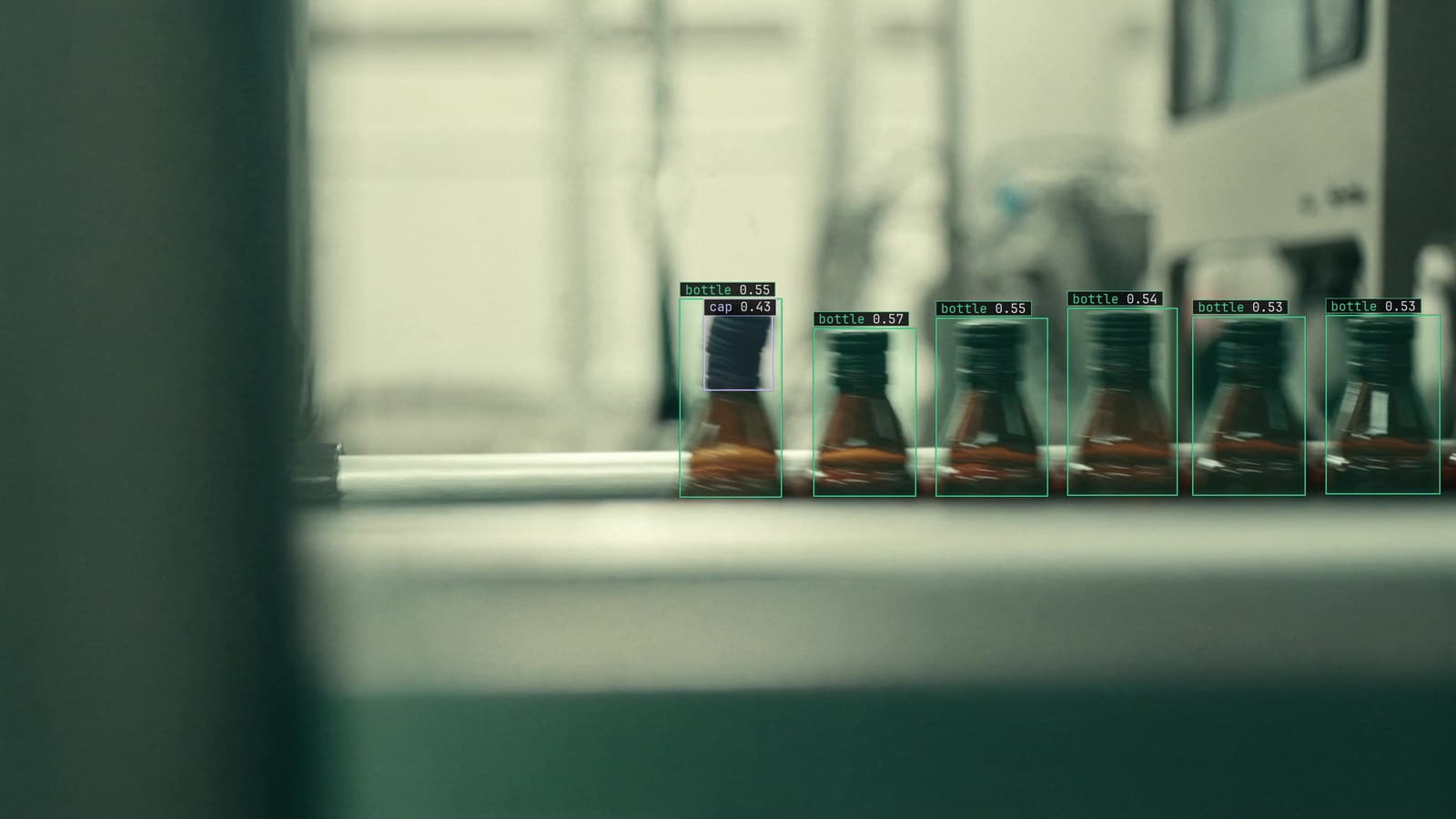
Bottling line, bottles queued under the fill head with one cap missing, generated scene with detections from our model
At 2 pm on the bottling line a bottle comes out of the blow moulder with a scuff on its shoulder, runs through the filler, gets a cap, gets a label, and goes into a case. The scuff was visible at the first station. By the time an inspector pulls the case at the end of the line, the bottle has been filled with product, capped and labeled, and the scuff has cost the plant everything that happened after the blow moulder.
Defects come in three kinds on that line, and each one has a station where it is cheapest to find. The cameras go where the kinds are.
Surface defects are caught at the first station because the bottle is worth least there
A scuff, a blemish in the plastic, a short shot where the wall is thin: these are visible the moment the 2 pm bottle leaves the moulder, and an empty bottle is the cheapest thing on the line. The camera after the moulder sees each bottle against a plain backdrop under steady light, and the model outlines the defect on the wall, because the disposition depends on how large it is and where. The surface defect detection use case is this decision: ship, rework, or scrap, on size and location.
The cost argument is arithmetic. A bottle rejected here costs a bottle. The same bottle rejected at the case packer has already been filled and capped and labeled, and it costs all of that plus the case it was pulled from and the operator's time to pull it.
Dimensional defects need a reference in the frame, and a fixed camera gives one
After the filler, at the second camera on the 2 pm run, the question changes. The bottle is fine; what may be wrong is the fill level, a few millimetres low against the shoulder, or a neck that is not straight. Those are measurements, and a measurement needs a reference. On a fixed camera the reference is the bottle itself: the shoulder line and the base are found on every frame, and the fill line is read as a fraction of the distance between them. That fraction holds whether the bottle is a little left or right on the conveyor.
A camera that moves, or a bottle that is photographed at an angle, breaks the reference, which is why dimensional checks live on the most rigid mount on the line and nowhere else.
Object detection finds the cap, and a rule scores its absence
At the capper the defect is a cap that is missing, mis-seated, or skewed. The picture at the top of this post shows the case, and so did the 2 pm run: a queue of bottles under the fill head with one bare neck among them. A missing cap is the absence of a thing, and a model scores absence less easily than presence, because the frame with the missing cap looks almost exactly like the frame beside it.
The model handles it as two classes, bottle and cap, and a rule does the rest: a bottle box with no cap box inside its top edge is a missing cap. A cap box that sits high on the neck is mis-seated. A cap box that is wider than it is tall by too much is skewed. The model finds the parts; the rule decides. On the lines we run, the rules are written as sentences and approved by the line lead before they go live.
I think the capper camera is the first one to install on any line that has none, because a missing cap is the defect a customer photographs and posts, and a scuff is the defect a customer never notices.
The frame goes to the operator with the station and the rule that fired
A rejected bottle needs a reason the operator can act on at the line, not a count on a dashboard at the end of the shift. The alert is a rule written as a sentence, with a severity and a cooldown, approved before it goes live. A run of missing caps at the capper is critical and goes to the operator's screen and the line lead's Slack with the frame, because a run means the capper has a problem. A single scuff at the moulder is routine and goes on the shift list.
The frame is what makes the alert useful. The operator at the capper sees the bare neck boxed and the two capped bottles beside it, and knows in a glance whether the capper skipped or the cap feed ran out.
Line operators call a bottle that has fallen on the conveyor a downed bottle, and the pile-up behind one is the defect no taxonomy lists. The bottle detector finds it anyway, as a bottle box lying on its side, and a rule for that is worth writing on the first day.
The inspector's standard moves across a shift, and the review queue holds it still
The person pulling cases at 2 pm and the same person at 10 pm do not apply the same standard. A borderline scuff passes at the end of a shift that it would have failed at the start, and the two inspectors on the two shifts disagree with each other on where borderline is. The labels are where the standard gets fixed. Each class is defined once, the acceptance criteria the plant already has become the label guideline, and the boxes and outlines Lexi proposes are checked by the senior inspector against that guideline before anything trains.
After launch, the frames the model doubts come back to a person with the outline and the measurement, and the person's verdict is a label the next version learns from. The queue is small, it is the interesting bottles, and it is the same across shifts because the model does not get tired at 10 pm. When the corrections start landing in a consistent direction, the standard has moved, or the line has, and either is worth knowing.
LexData takes the line's models through their whole life. You type what to look for, Lexi puts a box or an outline on every frame, and a person checks each label before anything trains on it. The models then watch the three cameras the line already has, in the cloud, on your servers, or on a runner beside the recorder. Frames they are unsure of come back to a person, the corrections retrain them, and the new version replaces the old one with no downtime. That is how 99%+ accuracy is maintained in production on the manufacturing lines behind our numbers, one station at a time.
A new bottle shape is a new station, three times over
When the plant adds a bottle shape in April, the moulder camera has a new wall to inspect, the filler camera has a new shoulder line to reference, and the capper camera has a new neck. A window of frames from each station, labeled before the changeover rather than after, is the cost of the new shape, and it is known months ahead. The line that plans for it has three models ready on the morning the new bottle runs. The line that does not spends that morning rejecting good bottles.
See it on your own footage.
Start with your footageMore in Industries
Industries · 6 min read
AI visual inspection as the nondestructive testing step a camera can take over
Visual testing is the first NDT gate, its acceptance criteria are already written, and a camera can apply them to every weld instead of one in twenty.
Rob Hickey · Sep 24, 2026
Industries · 6 min read
Appearance inspection systems that judge scratches, chips and burrs the same way on every shift
The station, the light and the written standard matter more than the model. The outlines carry the limit, and a tightened tolerance makes every label wrong.
Rajiya Sultana · Sep 24, 2026
Industries · 7 min read
Automated pallet accounting from the camera over the staging zone
A polygon on the frame, every pallet tracked so it is counted once, entries and exits as the ledger, and a wash-down that nudges the camera as the failure.
Andreas Ohrvall · Sep 24, 2026