

Industries · 6 min read
Ceramic defect detection for hairline cracks a fixed-rule camera cannot learn
Edge chips, hairline cracks and pinholes on the tile line after the kiln, masks where the area sets the grade, and the new glaze as the day to relabel.
Summary
This post puts a camera over a glazed tile line after the kiln and describes edge chips, hairline cracks and pinholes as three classes with three different shapes, boxed or masked depending on whether the area sets the grade. It concludes that a new glaze or a tightened grading tolerance is the moment to relabel, and that the patterned ranges are where the false alarms come from. It is for tile plant quality and process engineers.
Esdras Ntuyenabo · Engineer · Sep 26, 2026
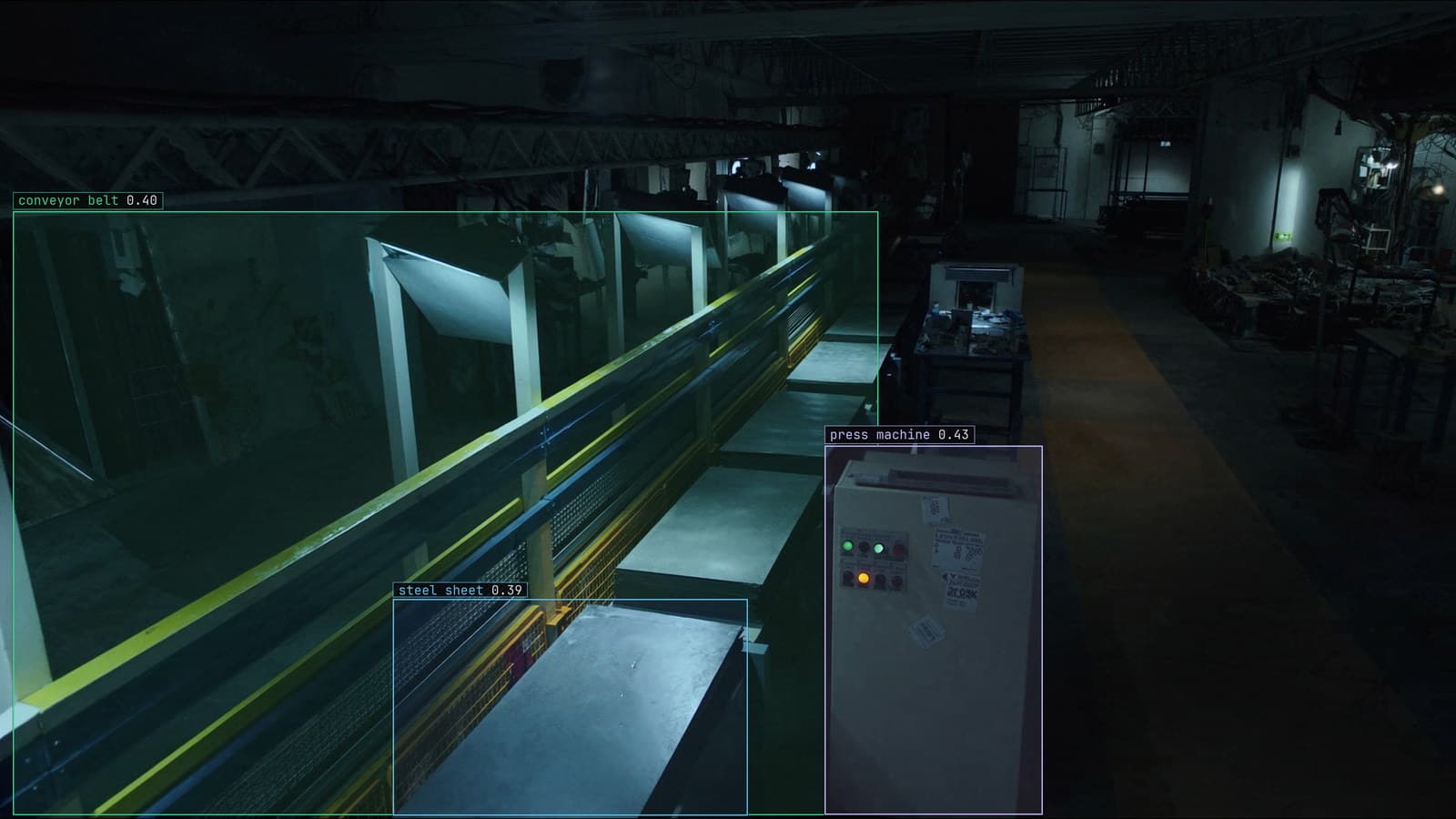
Flat panels on a conveyor passing an inspection station, generated scene with detections from our model
The tiles come out of the kiln at about one a second, still warm, and pass under a bank of lights where an inspector stands from 6 am for a two hour stint before swapping out. The inspector is good. A chip on an edge gets caught almost every time. A hairline crack across a glossy cream glaze, running with the grain of the surface, gets caught when the light is right and the tile is turned, and a tile on a belt is never turned.
The crack that gets through is found by a tiler on a bathroom wall, and the box it came from is the one the customer remembers.
A fixed-rule camera checks one thing, a trained model learns the tile
Most tile lines, lane 2 on this one included, already have a camera of the fixed-rule kind: a machine vision unit that measures the edge against a template and rejects a tile whose outline is wrong. It is fast, it is reliable, and it checks the one thing it was programmed for. Ask it about a crack in the middle of the face and it has nothing, because a crack is not a geometry.
A trained model is a different tool. It has been shown the plant's own cracks, chips and pinholes on the plant's own glazes, and it finds all of them in the same pass. When the range changes it can be shown the new range. The cost is the showing: labeled frames, a person checking them, and a review queue that keeps running after launch. For a plant with one edge check and one product, the fixed rule wins. For one with a dozen glazes and three defect types that matter, the trade goes the other way.
Edge chips, hairline cracks and pinholes are three shapes for object detection
The three classes have three different shapes and the labeling follows the shape. A chip breaks the outline and is a tight box on the corner. A pinhole is a dot, and a box is all it needs. A crack is a line, thin and long, and a box around it is mostly glaze; where the plant grades by how much of the face a defect affects, a crack gets a mask so the area means something.
My own view is that masks for pinholes are a waste of a labeler's afternoon. A pinhole is a count, and a box and a class give the count. Masks belong on the defects whose size sets the grade.
You type the three classes once, Lexi proposes the boxes and the masks on frames from the line camera, and a person checks them. The person is usually the inspector from the light bank. The disagreements at labeling are where the plant's grading decisions get written down: how long a crack is before it is a second, how many pinholes on a face before the tile is a third.
The camera has to resolve the crack before any model can
A hairline crack is a few pixels wide at best, and no amount of labeling buys back pixels the sensor never captured. The first decisions are optical. Raking light, at a low angle across the face, throws a crack into a shadow line the camera can see. Diffuse light kills the glare on a gloss glaze. The camera sits close enough that a crack occupies more than a pixel, which on the large format tiles on lane 2 means two cameras per lane rather than one.
The lesson on what a vision model can and cannot see puts a floor under all of this: if the plant's best inspector could not call it from the frame, neither can the model. The frames go in front of the inspector before the first label is drawn.
The patterned range is where the false alarms come from
A plain cream tile is the easy case. The stone-effect range that runs on lane 2 on Thursdays has veins printed into the glaze that run across the face exactly the way a crack does, and a model that has never seen the veined tile boxes every vein. The fix is the plant's own frames: a few hundred veined tiles with no defects, labeled as such, so the model learns the difference between a printed vein and a crack that breaks it.
The frames it is still unsure of on that range come back to the inspector, who can tell in a glance. Those verdicts are the labels the next version learns from, and after a few rounds the veined tiles stop coming back. The surface defect detection use case describes the same pattern for steel and for coated panels: the texture the model has to learn to ignore is the plant's own, and only the plant's frames teach it.
The kiln operator can hear a bad firing before anyone sees it. Tiles cooling on the outfeed ping, and a batch that pings wrong will crack.
A new glaze or a tightened tolerance is the moment to relabel
Two things change what the model should say, and neither looks like a failure on the day. A new glaze goes into production and the model has never seen a crack on it. Or the grading tolerance moves: cracks under a certain length that were seconds last quarter are rejects this quarter, because a customer complained, and every label the plant owns now carries last quarter's rule.
The drift catalog covers the second as a spec change: the frames did not move, the right answer did, and the first evidence is the inspector overriding the grade in a consistent direction. The first is the same story from the other side. In both cases the plant relabels a window of frames under the new rule, and the version that trains on them replaces the old one.
LexData takes the tile model through its whole life. You type what to look for, Lexi puts a box on every frame, and a person checks each label before anything trains on it. The model then watches the line camera the plant already has, in the cloud, on your servers, or on a runner beside the recorder. Frames it is unsure of come back to a person, the corrections retrain it, and the new version replaces the old one with no downtime. Across the manufacturing lines we run that is 99%+ accuracy maintained in production, on the veined range as well as the plain.
See it on your own footage.
Start with your footageMore in Industries
Industries · 6 min read
AI crop analysis in the greenhouse, catching tomato disease before it spreads down the row
Lesions boxed by disease with a healthy class, a question of the footage about how far a patch spread since last week, and a model that turns with the season.
Rob Hickey · Sep 26, 2026
Industries · 6 min read
Chocolate box inspection with a camera over the tray line
Each piece boxed by type, a plain check against the box template, damage as its own class, and the new spring assortment as the day the labels go stale.
Stephen Biswas · Sep 26, 2026
Industries · 7 min read
Computer vision inventory monitoring from a frame every few minutes
A shelf camera sampled every few minutes, each facing boxed and counted, a record per detection, and an alert when a facing stays empty past the hour.
Sheikh Srijon · Sep 26, 2026