

Industries · 6 min read
Paint defect detection after the booth, with object detection tied to the process cause
Orange peel, runs, dirt and solvent pop as classes, each tied to what the booth would change, so the alert says what to fix. A tighter standard is a relabel.
Summary
This post puts a camera at the exit of a paint booth and works through the defect classes, from orange peel to dirt inclusion, and why each class should be tied to the process cause the paint shop would change. It concludes that an alert that names the cause is worth more than one that names the defect, and that a tightened acceptance standard is a spec change that has to be relabeled. It is for paint shop and finishing quality teams.
Sheikh Srijon · GTM Lead · Sep 26, 2026
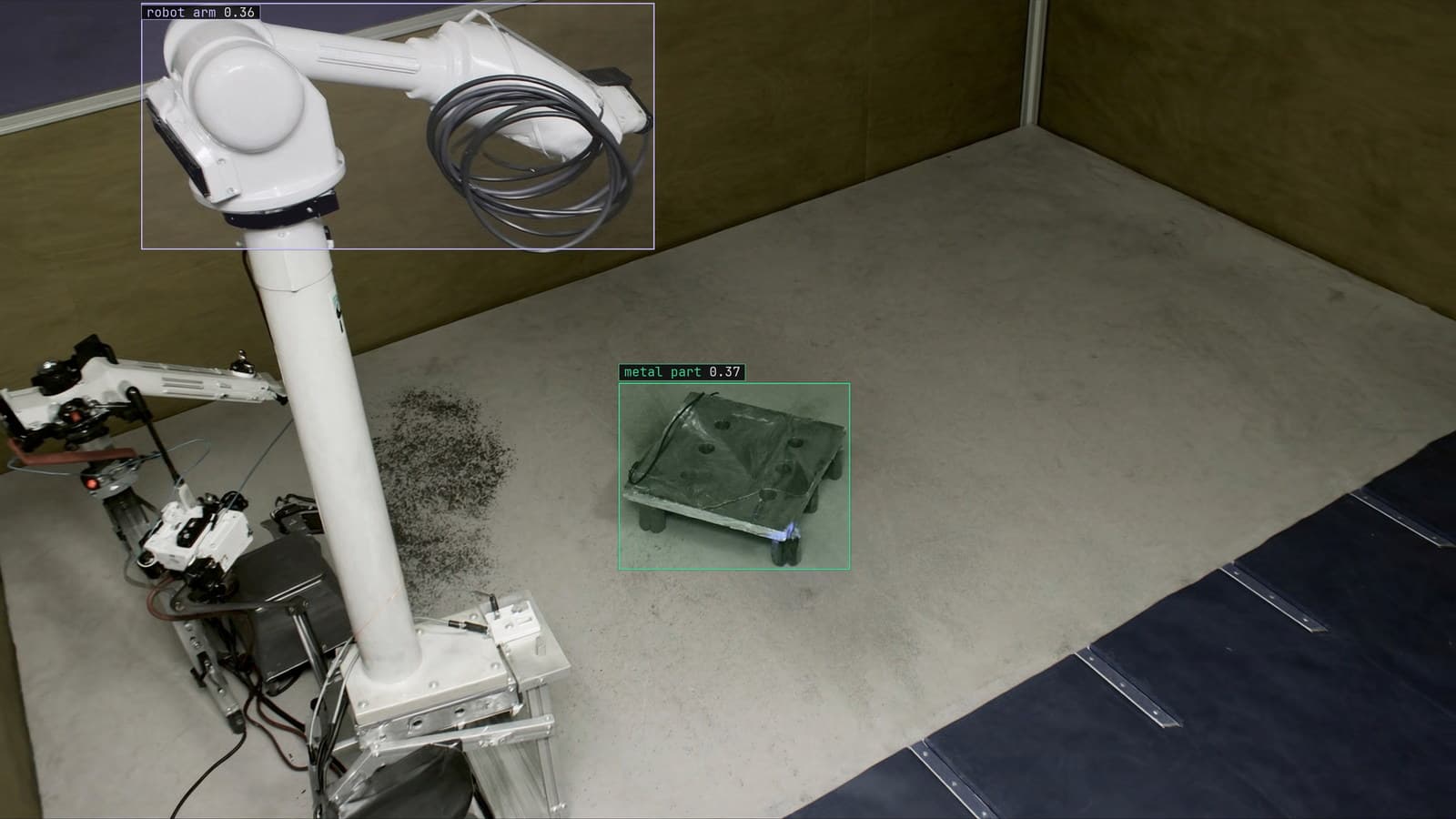
A metal part on a fixture in a robotic cell, generated scene with detections from our model
The bumper comes out of the oven at 3:15 pm under the inspection lights, and the inspector walks its length with her head tilted, watching the reflection of the strip lamp travel across the surface. Where the reflection wobbles there is orange peel. Where it breaks there is a run, or a speck of dirt under the clear coat, or a small crater where a solvent bubble popped in the oven. She marks each one with a wax pencil, and the bumper goes to polish or to strip.
Most of the paint shop's defects were decided an hour ago, in the booth. By the time the inspector sees them the gun, the flash-off and the oven have all moved on to the next bumper. The camera at the oven exit sees the same reflection she does, and the useful thing it can add is a name for what changed upstream.
Object detection puts a box on the defect and the inspector's name on the class
Each defect is a small region on a large reflective surface, and object detection is the tool for finding small regions and saying where they are. A box on the run carries its position on the bumper, which decides whether it is on a visible face or a hidden one, and its size, which decides polish or strip. The surface defect use case argues that disposition is size and location, and on a painted part the location is most of it.
The class names are the inspector's. Orange peel and runs and sags, dirt inclusions and solvent pops, fisheyes and scratches: the paint shop has been using those words for decades and the model's classes should be them. A box labeled "fisheye" then lands in the column the inspector would have ticked. You type the list, Lexi proposes the boxes, and a person checks every one under the same strip lamp the inspector uses. The checker's time goes on the difference between a dirt inclusion and a solvent pop, which look alike at a glance and come from opposite ends of the process.
Each class is tied to what the paint shop would change
This is the design decision that makes the camera worth more than the inspector's pencil. Orange peel is the gun too far from the panel, or the paint too viscous, or the booth too warm so the coat skins before it flows. A run is too much film, or the gun too slow, or a panel too cold. Dirt is the booth filtration or the air make-up. Solvent pop is too little flash-off time before the oven, or the oven ramp too fast. Fisheyes are silicone contamination, and the paint shop knows exactly which hand cream causes it.
If the classes are drawn so that each one points at a cause, the alert can say what to fix. An alert is a rule written as a sentence, with a severity and a cooldown, approved before it goes live: solvent pop on three consecutive bumpers, routine, to the booth lead's Slack. The booth lead reads "solvent pop" and checks the flash-off, without waiting for the polish bay to send the bumpers back.
My own view is that a paint shop should write its class list as a cause list first and a defect list second. Where two causes produce the same mark the class stays one class and the process engineer separates them; where one cause produces two marks, they can be one class. The labeling is cheaper that way and the alerts are more useful.
The alert goes to the booth while the next bumper is still wet
The camera's verdict on the bumper at 3:15 pm is about the bumper that was sprayed at 2:15 pm. The bumpers sprayed since are in the flash-off tunnel and the oven, and the one being sprayed now will have the same solvent pop unless the booth changes something in the next few minutes. So the alert goes to the booth, with the frame and the box, and the cooldown is short.
With a runner beside the recorder the alert is raised on the paint shop floor. The polish bay still gets its list, but the polish bay is the cost of a defect and the booth is the cause of it.
Inspectors judge orange peel by the reflection of a straight edge in the panel. A straight lamp that reflects as a wavy line is the whole measurement, and the camera reads the same line.
Borderline marks go to the inspector, and her call is the label
Light orange peel on a hidden face, a speck that might be dirt or might be a fibre in the clear coat, a scratch that could be from handling after the oven: these are the frames the model doubts, and they should say so. The rule holds the bumper, the frame goes to the inspector with the box, and her verdict is recorded against the frame.
LexData takes the paint model through its whole life. You type what to look for in the paint shop's words, Lexi puts a box on every frame, and a person checks each label before anything trains on it. The model then watches the camera at the oven exit, in the cloud, on your servers, or on a runner beside the recorder. Frames it is unsure of come back to a person, the corrections retrain it, and the new version replaces the old one with no downtime. The 99%+ accuracy maintained in production that our manufacturing work reports is held by those corrections, which on a paint line come from the inspector with the wax pencil.
A tighter acceptance standard is a spec change the frames cannot show
The plant wins a premium trim contract and the customer's acceptance standard for orange peel tightens. Every bumper looks the same as it did in August, and every label the model learned for the boundary between acceptable and not is now wrong for that customer. The drift catalog calls this a spec change, and the signal is the inspector overriding the model's pass in a consistent direction on the borderline bumpers.
The fix has no shortcut. The borderline frames are relabeled against the new standard, the model is retrained, and versions keep what they were trained on, so the old standard is still there for the customers who still use it. The rule carries the customer, since the same bumper is a pass for one and a polish for another, and the model's job is to find the orange peel and say how bad it is.
The override rate is the cheapest monitor the paint shop has. When the inspector's pencil and the model's box start disagreeing in one direction, something upstream has changed, and it is usually the standard rather than the paint.
See it on your own footage.
Start with your footageMore in Industries
Industries · 6 min read
AI crop analysis in the greenhouse, catching tomato disease before it spreads down the row
Lesions boxed by disease with a healthy class, a question of the footage about how far a patch spread since last week, and a model that turns with the season.
Rob Hickey · Sep 26, 2026
Industries · 6 min read
Ceramic defect detection for hairline cracks a fixed-rule camera cannot learn
Edge chips, hairline cracks and pinholes on the tile line after the kiln, masks where the area sets the grade, and the new glaze as the day to relabel.
Esdras Ntuyenabo · Sep 26, 2026
Industries · 6 min read
Chocolate box inspection with a camera over the tray line
Each piece boxed by type, a plain check against the box template, damage as its own class, and the new spring assortment as the day the labels go stale.
Stephen Biswas · Sep 26, 2026