

Labeling · 6 min read
Out-of-scope detection, what the model does when it sees something it was never taught
A screw detector on the phone line meets an operator's hand and calls it a screw. Null frames, a class for confusing things, a test set from the real camera.
Summary
This post starts with a screw detector on a phone assembly line and the first time an operator's hand enters the frame, and works through why a confident wrong answer is the worst outcome. It covers null labels for empty and off-target frames, a class for the things the model confuses, a test set from the real camera, and the doubted frames coming back for review as the last net. It is for engineers whose model works on the test set and is about to meet the world.
Rob Hickey · Chief AI Officer · Sep 28, 2026
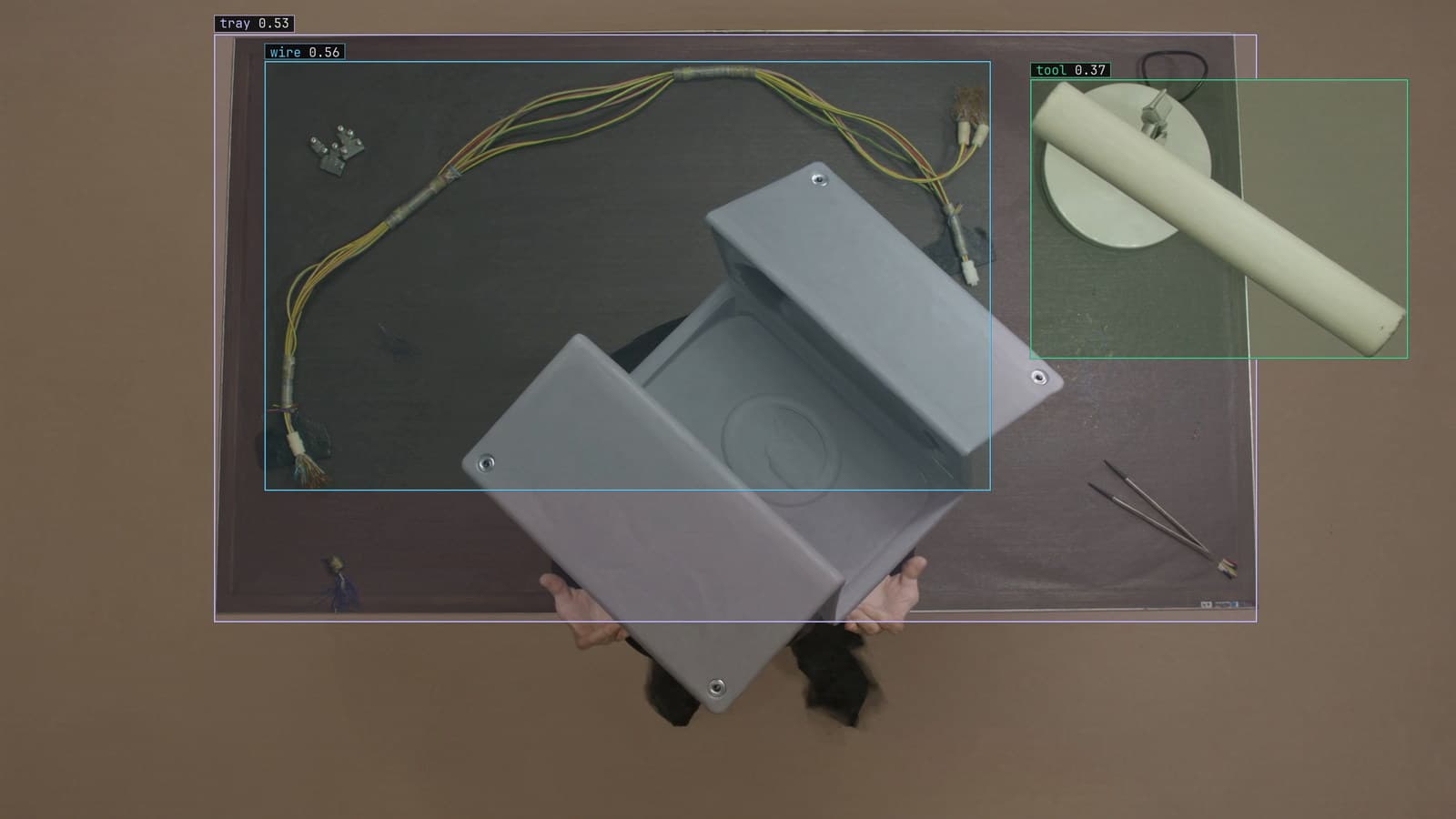
Assembly station with a housing, fasteners and a cable loom laid out, generated scene with detections from our model
The screw detector on line 5 was trained on frames of the phone housing on its fixture, four screw positions, each one either filled or empty. On the test set it is close to perfect. On the Tuesday it goes live, an operator reaches in to straighten a housing, and for eleven frames the model reports a screw on the back of her hand, with high confidence, and the count for that unit records five.
Nothing in the training set had a hand in it. The model was never taught what a hand is, so it did what a detector does with a thing it has never seen, which is to describe it in the only words it has.
A screw detector on line 5 meets an operator's hand
Every training set is narrower than the world its camera will see. The set for line 5 was built from frames of the fixture with a housing on it, because that is what the question was about. The world includes the operator's hand, the fixture with no housing, and the housing for the other phone model that runs on the same line on Thursdays. It includes the tool left on the fixture at break, and the day the overhead lamp is changed for a cooler one.
None of those are edge cases in the sense of being rare. They are the ordinary life of the line, and they were out of scope because nobody wrote them down.
An object detection model gives a confident wrong answer rather than none
An object detection model returns boxes and a score for each. What it does not return is any signal that the frame is unlike anything it trained on. A hand in the frame does not produce a message saying "hand". It produces whatever class the hand's pixels come closest to, scored by how close, and on line 5 that was a screw with a high score.
That is the failure to design against. A model that said nothing on the hand frames would have left a gap in the count, which a person would have noticed. A model that said screw with confidence filled the gap with a wrong number that looked like every right number around it. The lesson on what the number beside a detection means is worth reading with this in mind: the score ranks detections against each other on frames like the training set, and says little on frames unlike it.
Empty and off-target frames get a null label on purpose
The cheapest fix is in the training set. Frames of the empty fixture, frames with a hand in them, frames with the tool on the fixture and frames from the Thursday model all go into the set, labeled as containing no screw. A null label is a label. It tells the model that these pixels, which it would otherwise never have seen, are not the thing it is looking for.
On line 5 that meant pulling a few hundred frames from the recorder that the first labeling pass had skipped because there was nothing to box. The labeling doc covers how those frames are marked, and the mark matters: an empty frame that is deliberately labeled empty trains the model, while an empty frame that was simply never opened tells nobody anything.
A small aside from the same line: the operator whose hand it was asked to see the frames, and pointed out that she reaches in at the same point in every cycle. Those eleven frames per unit were the most predictable thing on the camera, and the set had none of them.
The things the model confuses get their own class
Null labels handle the frames where the answer is nothing. Some out-of-scope things are worse than nothing, because they look like the target and appear often. On line 5 the head of the fixture clamp looks like a screw from the camera's angle, and the detector kept finding a fifth screw position that did not exist.
The fix is a class for the clamp. Labeling the clamp head as "clamp" on every frame gives the model a place to put those pixels other than "screw", and the confusion goes away in the next version. The same is true for the operator's hand if hands are frequent enough, and for the Thursday housing, which gets its own class so the model can say which product it is looking at rather than guessing screw positions on the wrong one.
The classes are not for reporting. Nobody on line 5 wants a clamp count. They are there so the model has somewhere honest to put the things that are not screws.
The test set has to come from the camera on the line
The test set that said the model was close to perfect was drawn from the same frames as the training set: the fixture, the housing, the four positions. It could not have shown the hand problem, because the hand was not in it. A test set that is a slice of the training set measures how well the model memorised the training set, and nothing about the line.
The test set for line 5 is now a week of frames from the live camera, sampled every couple of seconds across every shift, with every hand, tool, empty fixture and Thursday housing left in. It is labeled with the same care as the training set, and it is the only number the line lead is shown. My own view is that a model with no test frames from its own camera has not been tested, whatever the report says.
The doubted frames coming back for review are the last net
No training set covers everything the camera will see. The lamp will change, a new operator will reach in differently, and a housing variant nobody mentioned will arrive in the spring. What catches those is the model returning the frames it is unsure of to a person, and the person's corrections becoming labels.
LexData takes the screw model through its whole life. You type what to look for, Lexi puts a box on every frame, and a person checks each label before anything trains on it. The model then watches the camera over line 5, in the cloud, on your servers, or on a runner beside the recorder. Frames it is unsure of come back to a person, the corrections retrain it, and the new version replaces the old one with no downtime. The accuracy you launched with is the accuracy you keep.
The signal that something new is in the frame is the correction rate. When the line lead's corrections rise on a Thursday, the model is seeing something the set never had, and the frames coming back are already the ones the next version needs. The hand on the first Tuesday came back that way too, eleven frames of it, and the null labels that fixed it were drawn from the review queue rather than found by anyone scrubbing footage.
See it on your own footage.
Start with your footageMore in Labeling
Labeling · 6 min read
AI labeled vs human labeled data, how much a model can do before a person has to look
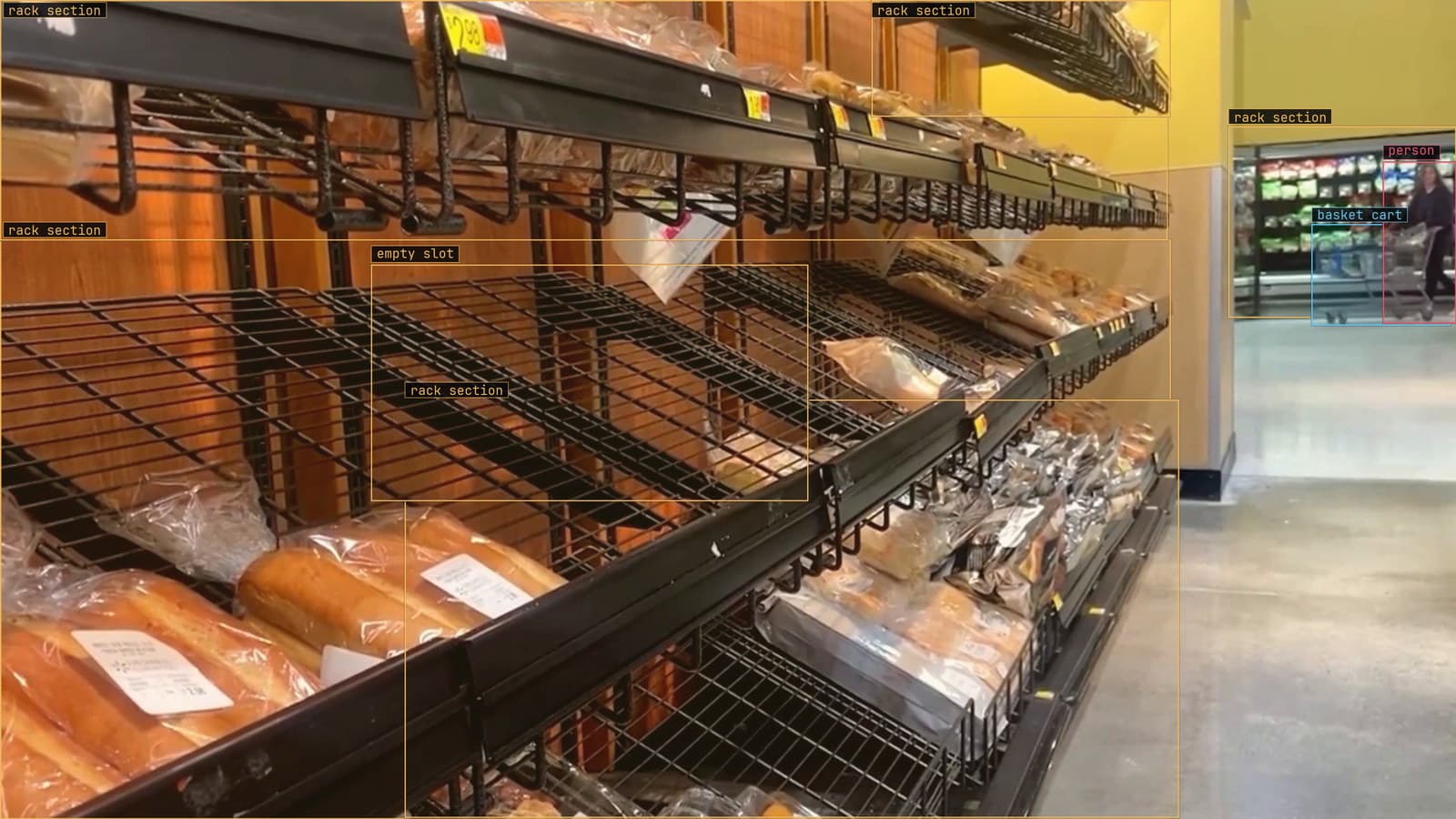
On a shelf dataset the model's proposals are mostly right. On safety cones in a yard they are mostly wrong. Measure the gap, then keep a person on every label.
Finn Ellingwood · Sep 28, 2026
Labeling · 6 min read
Bounding boxes in computer vision, what a box teaches and what it reports
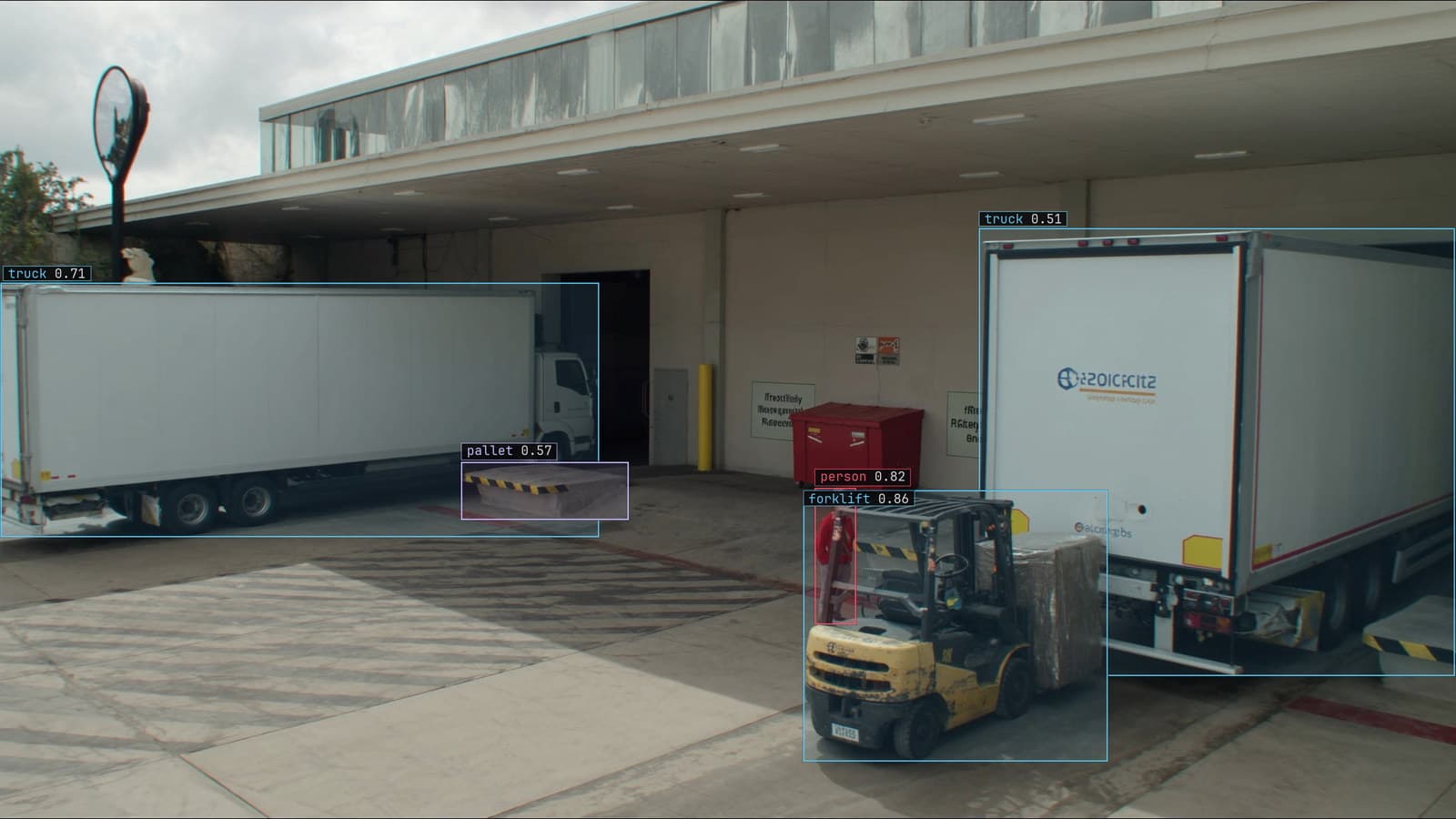
The same rectangle on a forklift is the lesson at training time and the answer at run time. Corner and centre formats, the shifted-box bug, floor in the box.
Esdras Ntuyenabo · Sep 28, 2026
Labeling · 6 min read
Which words find the forklift, measured instead of guessed
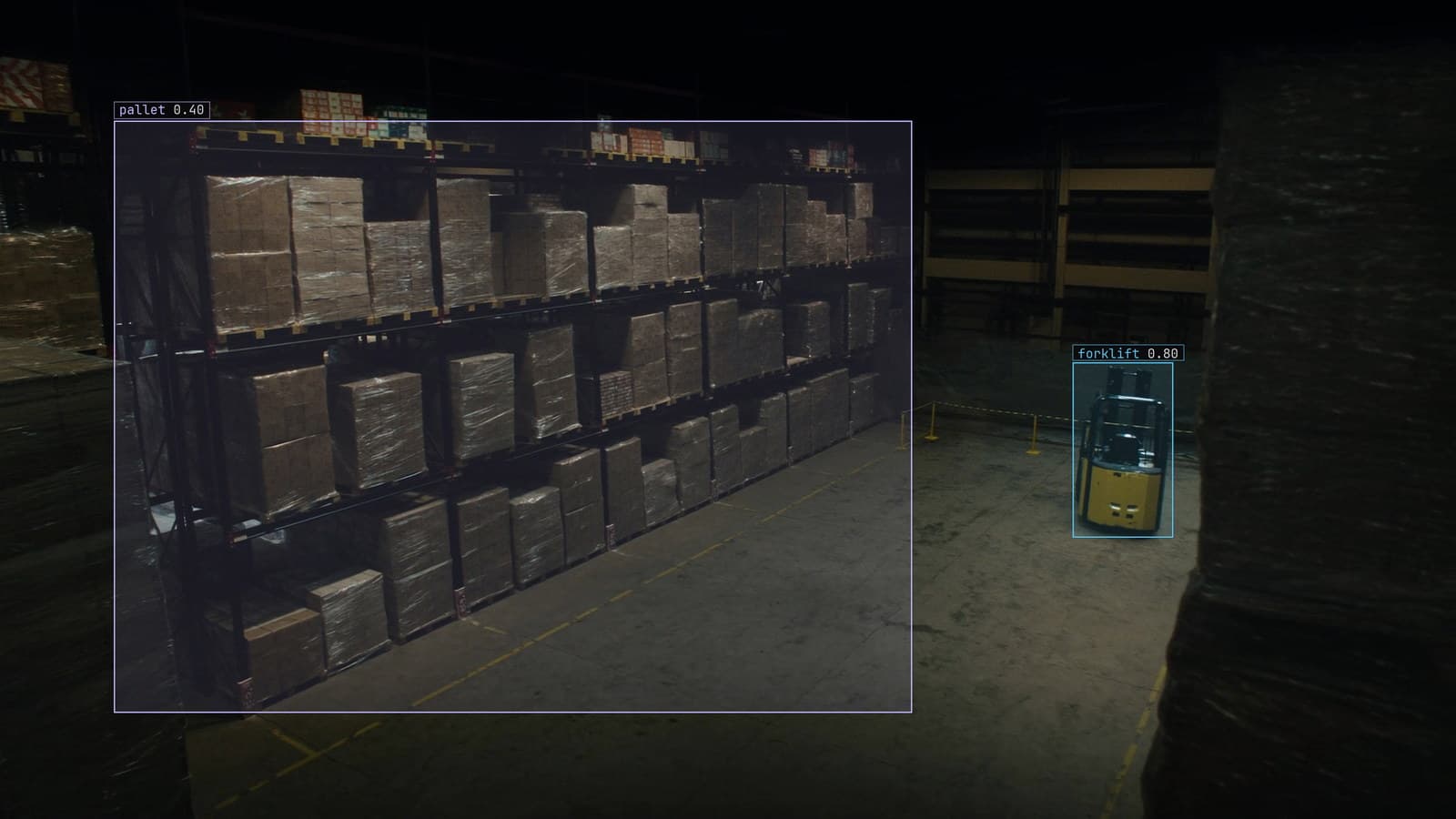
Five ways to say forklift, five sets of boxes on aisle 6. Score each phrase on a small labeled set before Lexi labels the whole archive with the winner.
Sheikh Srijon · Sep 28, 2026