
From checkout optimization to shelf monitoring to store safety — LexData powers the visual AI that helps retailers understand and improve physical operations at every location.
Changing displays, seasonal layouts, lighting variations, and customer density make every store visually unique. Models trained on one store configuration fail when the layout changes.
False door alarms, incorrect traffic counts, and phantom theft detections flood store teams with noise. Real issues get ignored because the system cries wolf too often.
What works in 10 stores breaks in 500. Every location has different cameras, angles, lighting, and foot traffic patterns. Scaling visual AI across a retail fleet requires continuous adaptation, not one-time training.
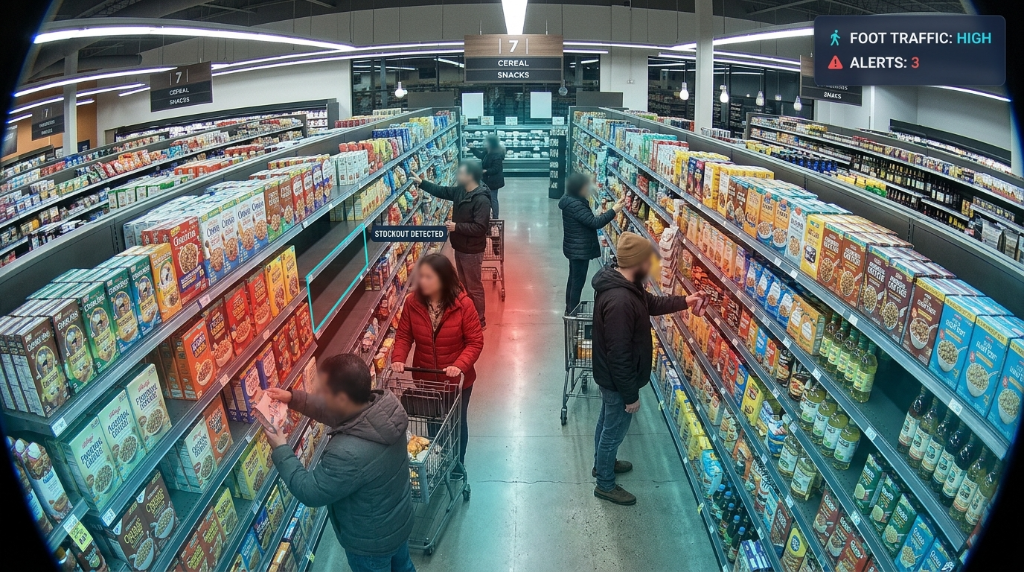
Annotate in-store video for customer detection, employee identification, door events, and product placement. Distinguish between customers, staff (by uniform), and children within each camera's region of interest.
Turn raw foot traffic data into conversion intelligence. Link visual detections to store zones, time slots, and operational events. Surface patterns that static dashboards miss.
Monitor detection accuracy across store locations. Detect when camera repositioning, seasonal displays, or lighting changes degrade model performance. Continuously improve — don't just deploy and hope.
Accurate footfall analytics filtered for staff and non-shoppers.
Real-time alerts for line length to optimize staffing.
Detect out-of-stocks and incorrect product placement automatically.
Detect spills, blocked exits, and unauthorized access.
Identify suspicious behavior patterns and "sweethearting" at checkout.
Measure staff engagement and service levels in key zones.
AI models lacked high-quality labeled data. False activity alerts. Unmonitored registers led to long checkout waits.
Labeled customer and staff positions. Validated alerts and traffic counts for accurate footfall tracking.
Faster AI training with accurate labeling. Smarter alerts for open doors and empty registers.
"Continuous model adaptation across hundreds of store locations — not one-size-fits-all."
"Human-verified annotation reduces false alerts and improves detection confidence."
"Temporal intelligence for shrink analysis — not just point-in-time theft detection."
"Privacy-first architecture. Visual processing on-premise, never in the cloud."