

Industries · 7 min read
Food service QA with a camera over the tray packing line
Every component on the tray gets a box, the missing one is flagged before the sealer, and the alert count is read against the line's own history.
Summary
This post describes a camera over a meal tray packing line, with every component boxed and a rule that flags a missing one before the tray reaches the sealer. It concludes that a trained detector has to own the count, and that the alert count only means something when it is read against the line's own history. It is for food service and ready meal operations teams.
Ayman Quadir · Head of Product · Sep 30, 2026
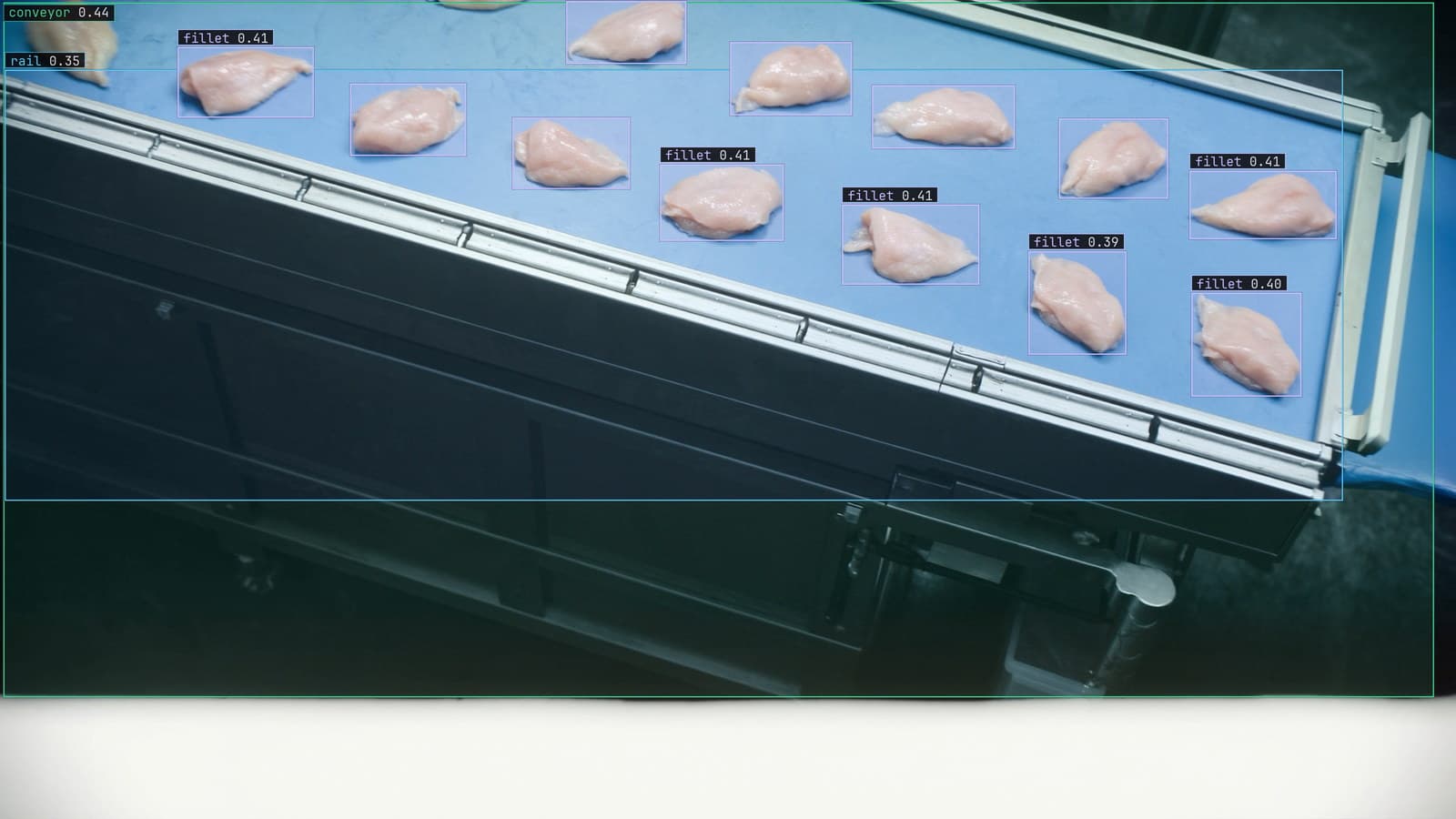
Food processing line, portions on a blue conveyor, generated scene with detections from our model
The tray line at a ready meal plant starts at 6 am with the first menu of the day. A tray comes down conveyor 2 with a compartment for rice, one for the main, one for the vegetable and a small pot of sauce in the corner, and it passes under the film sealer about every 8 seconds. Somewhere between the sauce station and the sealer, a pot is missing from one tray in a run, and nobody sees it until a customer opens the lid.
The person at the end of the line checks trays by eye, and does it well for the first hour. A camera bolted above the belt before the sealer looks at every tray, and it does the same job at 2 pm as it did at 6 am.
Every component on the tray gets its own box
The first decision is what the model looks for. The plant's instinct is to ask for "complete tray" and "incomplete tray", and that is the wrong shape for the job, because the model then has to learn what completeness means from examples of every possible combination. The better shape is one class per component: rice, main, vegetable, sauce pot, and the tray itself.
You type those five classes once, Lexi puts a box on each of them in every frame, and a person checks the boxes before anything trains. The person's attention goes to the sauce pot, because it is small, it sits in a corner, and it is the one most often hidden by a fold of film or the shadow of the operator's arm.
This is the same problem as any assembly verification job: the signal is an absence, and absence is harder to score than presence. A tray with four components boxed and a fifth missing is only a fault if the rule knows the fifth was expected.
The rule flags the missing pot before the sealer
The rule is written as a sentence: a tray with no sauce pot on conveyor 2, routine severity, with a cooldown so one tray does not fire twice. It is approved before it goes live, and what arrives when it fires is the frame with the four boxes drawn and the empty corner where the fifth should be.
The alert goes to the line lead's screen at the sealer station, since the tray is still open when it lands and the fix is to reach in and add the pot. On the plants we run, that alert is on a screen at the station rather than in anyone's phone, because the person who can act on it is standing there.
The monitoring and alerts doc covers how a model is attached to a feed and how an alert is described; the plant's part of the work is deciding which component is worth stopping for. A missing garnish is a note on the shift report. A missing allergen label is a stop.
A VLM can describe the tray but a detector has to own the count
There are two ways to ask a camera about a tray. One is a question in plain words to LexInsight: is anything missing from this tray, is the film sealed, is there sauce on the rim. A VLM answers that kind of question well, with the frames behind the answer, and it is the right tool for the questions nobody thought to write a class for.
The other is a detector trained on the plant's own frames, which returns a box per component on every tray and does it the same way each time. The count of trays with no sauce pot on the Tuesday shift has to come from the detector, because a count is only useful if it was made the same way on Monday. The question to Insight is for the shift lead who wants to know why the rim was dirty on a run; the detector is for the rule that fires before the sealer.
My own view is that plants reach for the question too early. It feels like the whole job because it answers anything, and then a month later somebody wants a trend, and there is no trend, because nothing was counted the same way twice.
The menu changes on Monday and the alert count changes with it
A ready meal plant changes menus weekly. On Monday the rice compartment holds mash, the sauce pot is a different size, and the model that was trained on last week's tray boxes the mash as rice or boxes nothing at all. The alert count jumps, and the line lead cannot tell whether the line got worse or the model did.
The drift catalog files this as a defect rate that changed: the thresholds tuned around the old rate are now wrong. On a tray line the cause is usually a menu rather than a defect, and the check is the same either way. Compare the alert count against the line's own history for the same menu, not against the fleet or the plant average, and when the count moves on a menu change day the first question is whether the model has seen the new tray.
Somebody on the line keeps a printed photo of each menu's finished tray taped to the sealer housing. The camera is the second copy of that photo, and the printed one is still the reference when the two disagree.
Frames the model doubts are the ones under the film
LexData takes the tray model through its whole life. You type what to look for, Lexi puts a box on every component in every frame, and a person checks each label before anything trains on it. The model then watches the camera over conveyor 2, in the cloud, on your servers, or on a runner beside the recorder. Frames it is unsure of come back to a person, the corrections retrain it, and the new version replaces the old one with no downtime.
The frames that come back are predictable once you have seen a week of them. A pot half under a fold of film. A main that was plated to the edge and covers the rice compartment. A tray photographed while the operator's glove was in the shot. Each one is a correction, and when the corrections cross the project's threshold a new version trains on them, with the new menu folded in from the frames the plant already recorded.
That is how the accuracy from the first week holds through a year of menus. In manufacturing the figure we hold to is 99%+ accuracy maintained in production, and on a tray line it is maintained by the person at the sealer station correcting the model on the frames it sent back, rather than by anyone retraining from scratch.
The line lead reads the count with the menu in hand
By the end of the first month the line has a number per shift: trays flagged for a missing component, by component, by menu. The number is worth something when it is read beside the menu calendar and the shift roster, and worth very little on its own.
A rise on Monday with a new menu is the model. A rise on Thursday with the same menu and a new operator at the sauce station is the line. The camera cannot tell those apart, and it does not need to, because the person reading the count can, provided the count was made the same way both days.
See it on your own footage.
Start with your footageMore in Industries
Industries · 6 min read
Perimeter security with fixed cameras, object detection and a drone sent to look
A frame every two seconds is enough to catch a person at the fence, a CPU is enough to run it, and the drone is the second look rather than the detector.
Andreas Ohrvall · Sep 30, 2026
Industries · 7 min read
Railway safety with trackside cameras, zones and a signaller who can live with the alerts
People and vehicles boxed, the track bed and crossing drawn as zones, the frame sent to the control room, and a false alarm rate a signaller will keep reading.
Rajiya Sultana · Sep 30, 2026
Industries · 6 min read
Custom vision models for industrial robots, trained on your own castings
The plant's own castings labeled from the cell's camera, defect, orientation and grasp point as the three questions, and a new variant handled by labeling it.
Andreas Ohrvall · Sep 30, 2026