

Industries · 6 min read
Object detection on a food line when no two items look alike
Seals, foreign material and portion counts from one camera over a fillet line, the skylight as the drift the corrections catch, and a new recipe labeled early.
Summary
This post follows fish fillets along a blue conveyor under one camera, with tray seals, foreign material and portion counts as the classes, on a line where no two items have the same shape. It concludes that irregular product has to be labeled from the line's own frames, that the light through the skylights is the drift the correction rate catches, and that a new recipe is labeled before its first run rather than after its first miss. It is written for quality and operations managers in food processing.
Ayman Quadir · Head of Product · Sep 24, 2026
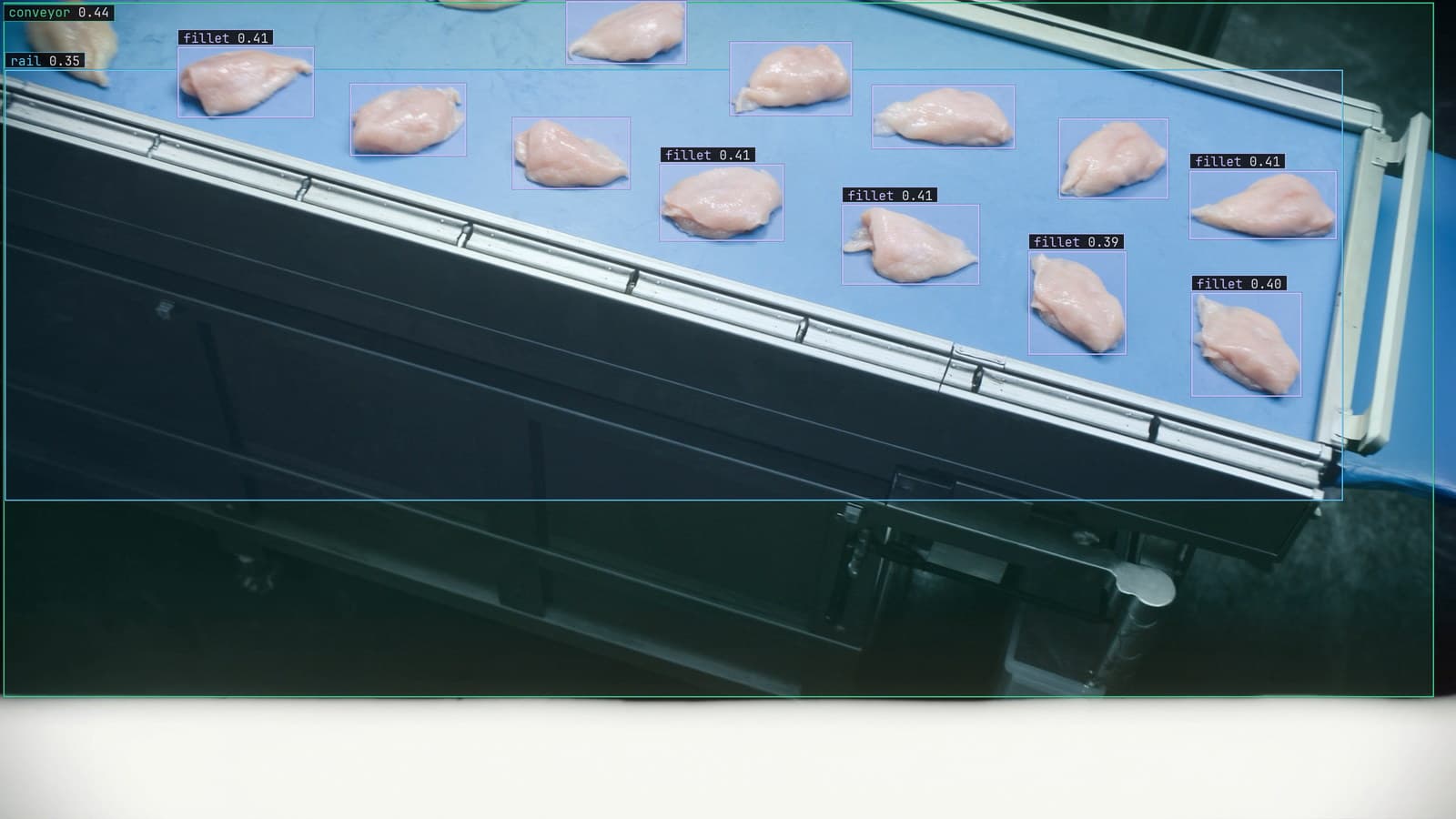
Food processing line, fillets on a blue conveyor, generated scene with detections from our model
The fillet line at the back of the plant runs from 6 am under a row of skylights and from 2 pm under LED strips, and the same conveyor looks like two different conveyors in the frames. On it, no two fillets are the same shape, the same colour or the same size. The things the line has to catch, a bone left by the trimmer, a fragment of blue glove, a tray with a wrinkled seal, are rarer than the fillets and just as varied. The quality technician walks the line twice an hour with a clipboard and a torch.
The belt is blue because nothing edible is blue, and so are the gloves, which is the oldest trick in food inspection and the reason the camera can see a glove fragment at all.
No two fillets are alike, and the model learns that
A bottle is a bottle and a machined bracket is a bracket, and a model that has seen a few hundred learns the shape. A fillet has no shape. It has a range of shapes, and the range is different for each species, each size grade and each trimmer on the line. A model trained on the 6 am shift's large fillets is unsure about the afternoon's small ones, and it has never seen the tail pieces the night shift packs into the value trays.
That means the training frames have to span the line's own variety, and the how much footage you actually need lesson is right that the unit is distinct conditions rather than hours. Ten hours from one shift on one species is one condition, sampled ten thousand times.
Object detection names the seal, the bone and the count
Three questions ride on the one camera over the line at 2 pm. Is each tray's seal continuous, or is there a wrinkle or a fold where the film meets the flange. Is there anything in the tray that is not fillet, a bone, a scale patch, a piece of glove, a fragment of trimmer blade. And how many portions are in the tray, because a four-portion tray with three portions in it is a complaint.
All three are object detection: a box on each portion for the count, a box on the foreign object with its class, a box on the seal defect. Lexi proposes the boxes from the class names typed once, and the quality technician checks each one before the model trains. Her attention goes to the boundary cases, a piece of skin that could be a scale patch, two portions overlapping that could count as one, because those are the frames the model will be unsure of and the labels have to be sure there.
The surface defect detection use case describes the same imbalance, good parts vastly outnumbering bad, and the same answer: the rare classes are kept in the set on purpose, and recall on foreign material is measured on its own.
Irregular product is labeled from the line's own frames
There is no reference image of a fillet. The supplier's product sheet shows a fillet on a white plate under studio light, and a model trained on that finds nothing on a wet blue belt at 2 pm. The frames that teach the model what a fillet, a bone and a glove fragment look like on this line are the frames this line's camera recorded, across both shifts, across species, across the trimmers.
I would rather a food line trained its first model on one Tuesday's frames from its own camera than on a thousand images from anywhere else. A morning's frames from the line contain the belt, the light, the trays and the trimmers' habits, and none of that transfers from another plant, however good the other plant's model is.
The reject and the count go to different places
Foreign material is a reject and a record. The rule is written as a sentence, with a severity and a cooldown, approved before it goes live: a bone or a foreign object in any tray, critical, the tray diverted and the frame to the quality technician's phone. She sees the box on the fragment and can judge in one look whether the trimmer needs stopping. Manufacturing inspection run this way holds 99%+ accuracy in production, and on a food line the diverted tray's frame is what the complaint log needs if a customer ever finds one that got through.
The count is a different kind of finding. Nobody is paged for a three-portion tray. The short trays are logged per shift and per trimmer, and LexInsight answers "which trimmer short-packs on Friday afternoons" with the frames behind the answer, which is a conversation for the line lead rather than an alarm.
Light through the skylights is the drift the corrections catch
The skylights are the slow problem. In June the morning shift runs under bright, high sun and the belt reads pale blue. In November the same shift starts in the dark, the LEDs come on, and by 10 am there is low sun slanting across the belt from the side, throwing every fillet's shadow onto the next one. Nobody changed anything, which is exactly why nobody looks.
The drift catalog calls this the season turned, the slowest and most predictable form of the input moving, and on the fillet line the first signal is the technician's corrections. Frames come back in the review queue with the model unsure whether a shadow is a bone, she corrects them, and the correction rate on the morning shift climbs over the weeks as the sun drops. The corrections retrain the model on November's light. The lesson for the first year is to keep the frames from every month, because the model trained in June will always be at its weakest in its first November.
A new recipe is labeled before its first run
The line adds a marinated variant in spring: the same fillets, coated red, in a black tray instead of a clear one. To the model this is a new product. Portions in a red coating do not count like plain fillets, a bone under marinade does not look like a bone on white flesh, and a black tray's seal reads differently from a clear one's. Detections on the first run will not be wrong so much as absent.
LexData takes the fillet line model through its whole life. You type what to look for, Lexi puts a box on every frame, and a person checks each label before anything trains on it. The model then watches the line camera, in the cloud, on your servers or on a runner beside the recorder. Frames it is unsure of come back to a person, the corrections retrain it, and the new version replaces the old one with no downtime. The marinated variant runs a trial batch two weeks before launch, the camera records it, the technician labels a window of trays, and the version that watches the first real run has seen the product it is watching.
See it on your own footage.
Start with your footageMore in Industries
Industries · 6 min read
AI visual inspection as the nondestructive testing step a camera can take over
Visual testing is the first NDT gate, its acceptance criteria are already written, and a camera can apply them to every weld instead of one in twenty.
Rob Hickey · Sep 24, 2026
Industries · 6 min read
Appearance inspection systems that judge scratches, chips and burrs the same way on every shift
The station, the light and the written standard matter more than the model. The outlines carry the limit, and a tightened tolerance makes every label wrong.
Rajiya Sultana · Sep 24, 2026
Industries · 7 min read
Automated pallet accounting from the camera over the staging zone
A polygon on the frame, every pallet tracked so it is counted once, entries and exits as the ledger, and a wash-down that nudges the camera as the failure.
Andreas Ohrvall · Sep 24, 2026