

Industries · 7 min read
Cycle time measured per part by the camera over the cell
One camera over a machining cell gives every housing its own clock, shows where it waited, and a nudged bracket is what quietly moves every zone.
Summary
This post follows one aluminium housing through a machining cell under a fixed camera, from the fixture to the outfeed rack, with a timestamp at every zone boundary. It concludes that the waiting between zones is the number worth reporting, and that a camera nudged during a wash-down is the failure that moves every zone at once. It is written for production engineers and plant managers who still plan from a stopwatch study.
Ayman Quadir · Head of Product · Sep 24, 2026
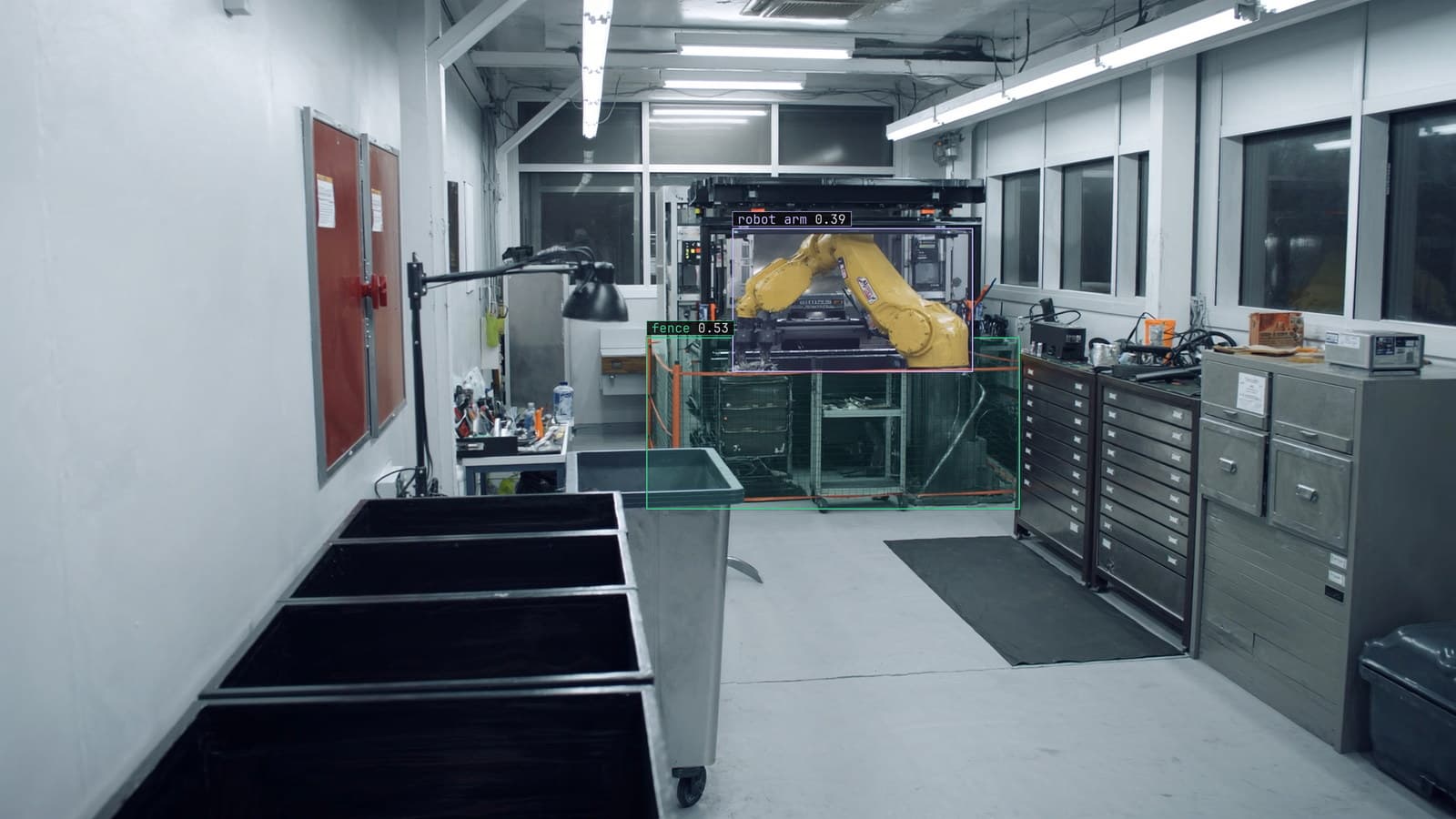
Machining cell, a robot loading the CNC behind the fence, generated scene with detections from our model
The stopwatch study on the housing cell was done in March by the newest engineer on the floor, because nobody else wanted to stand beside the deburr bench for a shift. She timed forty housings, averaged them, and the number went into the planning spreadsheet as the cell's cycle time. It is still there. The cell has had a new fixture, a new operator on nights and a coolant change since then, and the spreadsheet knows about none of it.
A camera over the cell measures the same thing on every housing, every shift, and what it produces is a clock per part rather than an average.
Cycle time is one housing's clock, and averages hide it
The word gets used for three different numbers. Takt time is what the customer's demand allows per part. Throughput is how many parts left the cell in the hour. Cycle time is how long one housing took from the moment it was clamped in the fixture to the moment it was set on the outfeed rack. That is the number a stopwatch study approximates and a PLC log never holds, because the PLC sees the spindle and the door and nothing in between.
An average of forty housings can be exactly right and still useless. If half the parts took four minutes and half took nine, the mean says six and a half and describes no housing that ever passed through the cell. The distribution is where the problem lives, and a distribution needs every part measured.
Zones drawn on the frame make the camera a timer
The camera sits on the fence post above the cell and sees the fixture, the machine door, the deburr bench, the gauge station and the rack. On that frame someone draws five polygons, one per station, once. A housing is boxed by the model on every sampled frame and tracked as the same housing from frame to frame, and each time its box crosses a polygon edge the crossing is stamped with the time.
That is the whole measurement. Entry into the fixture zone starts the clock, exit from the rack zone stops it, and the four crossings in between split the cycle into stations. Labeling is one class, housing, typed once, with Lexi proposing the boxes and a person checking them. The person's attention goes to the frames where the operator's arm covers the part at the bench, because a track that breaks there produces two short housings instead of one long one.
The assembly verification use case reads the same boxes for a different question, is every part present and the right way round, and the two can share a camera.
Waiting between zones is where the shift goes
The first week of timestamps on the housing cell shows a shape the stopwatch study could not. Machining takes the same three minutes on every part, day and night. The deburr bench takes ninety seconds when the operator is at it. Between the machine door and the bench, housings sit on the tray for anything from ten seconds to eleven minutes, and the eleven-minute waits cluster around 10 am and 2 pm, when the same operator is also running the gauge station.
Nothing in that finding is about the machine. The spindle is not the bottleneck and never was; the operator's split attention is, and the fix is a second pair of hands at the bench for two hours a day rather than a faster tool.
My own view is that waiting time, not cycle time, is the number a plant manager should ask for on Monday morning. Cycle time is what people request because it is what they have always been given. Waiting is where the hours go, and it is invisible to every instrument except a camera that watches the part rather than the machine.
Rework shows as a housing entering the deburr zone twice
A housing that fails at the gauge station goes back to the bench. On the timeline that is a track re-entering the deburr polygon after it has already left the gauge polygon, and it is countable. The cell that reported a rework rate of about one part in fifty from the scrap tickets turns out, on the tracks, to send one housing in twelve back to the bench, most of them for a burr on the same bore. The scrap tickets only counted the ones that failed twice.
The per-part record is also what ties the timeline to the rest of the plant. Each track carries its shift, its operator and, where the cell scans the traveller, its lot. LexInsight answers the question "which lots had the most second passes at the bench" with the frames behind the answer, and the answer points at a batch of castings rather than at the operator. That is the accuracy this kind of manufacturing work has to hold in production, 99%+ maintained, because a count that drifts is a count nobody plans from.
A nudged camera moves every zone by a few degrees
The polygons live in the frame, not in the cell. A wash-down on a Saturday, a bracket re-tightened by the electrician who was up the post for the light, a housing swap after a forklift clips the fence. The camera now points a few degrees left of where it did when the zones were drawn. The housing detector still boxes housings, because a housing looks like a housing from any angle. The fixture polygon now covers half the fixture and a strip of floor.
The symptom is a step. Cycle times on Monday morning are all three seconds shorter than Friday's, because the fixture crossing now fires late. The drift catalog calls this a camera moved, and the diagnosis is the maintenance date lining up with the change. The fix is cheap: redraw the zones from the new framing, re-label a short window of frames, retrain on footage the cell already recorded.
Somebody on the housing cell keeps a photo of the camera's original view taped inside the fence gate, so the next person up the post can line the picture up before they leave.
The night shift is compared with its own history first
The housing cell runs a night shift with one operator instead of two, and the night timeline is slower everywhere. The mistake is to compare nights with days and conclude the night operator is slow. Compared with its own last four weeks, the night shift is flat, and the day shift is the one drifting, because the day shift's second operator has been borrowed by the next cell twice a week since April.
LexData takes the cell's model through its whole life. You type what to look for, Lexi puts a box on every housing in every frame, and a person checks each label before anything trains on it. The model then watches the camera over the cell, in the cloud, on your servers or on a runner beside the recorder. Frames it is unsure of come back to a person, the corrections retrain it, and the new version replaces the old one with no downtime. The March stopwatch number, meanwhile, can finally come out of the spreadsheet.
See it on your own footage.
Start with your footageMore in Industries
Industries · 6 min read
AI visual inspection as the nondestructive testing step a camera can take over
Visual testing is the first NDT gate, its acceptance criteria are already written, and a camera can apply them to every weld instead of one in twenty.
Rob Hickey · Sep 24, 2026
Industries · 6 min read
Appearance inspection systems that judge scratches, chips and burrs the same way on every shift
The station, the light and the written standard matter more than the model. The outlines carry the limit, and a tightened tolerance makes every label wrong.
Rajiya Sultana · Sep 24, 2026
Industries · 7 min read
Automated pallet accounting from the camera over the staging zone
A polygon on the frame, every pallet tracked so it is counted once, entries and exits as the ledger, and a wash-down that nudges the camera as the failure.
Andreas Ohrvall · Sep 24, 2026