

Industries · 7 min read
Injection molding defect detection on syringe barrels at the mold outfeed
Cracks, short shots, flash and black specks boxed on every barrel as it leaves the press, logged to the lot, and a resin change is what dates the labels.
Summary
This post follows syringe barrels from a thirty-two cavity mold past a camera at the outfeed, with cracks and short shots as the classes that matter first and flash and contamination behind them. It concludes that every result has to be logged against the lot before the tray closes, and that a resin or tooling change is the moment every label in the set acquires a date. It is written for quality engineers in medical molding who are asked to inspect every part rather than a sample.
Ayman Quadir · Head of Product · Sep 24, 2026
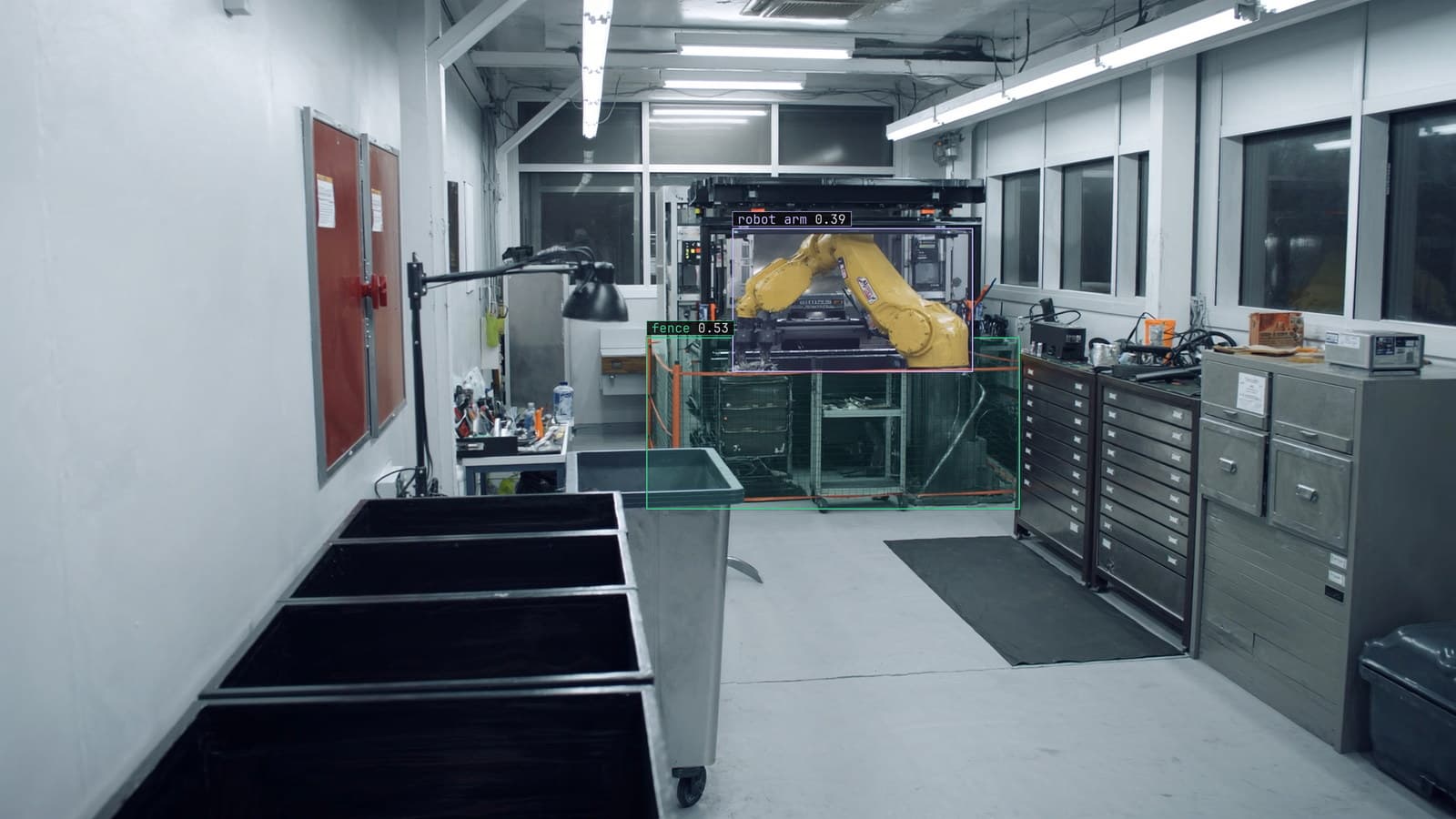
Robot loading cell behind a safety fence, generated scene with detections from our model
The thirty-two cavity mold on press four drops a shot of syringe barrels every eleven seconds, and the robot sets them on the outfeed conveyor in the order the cavities filled. The QC technician pulls a tray every hour, takes six barrels to the bench, and checks them under a magnifier against the defect sheet pinned to the wall. Between trays, roughly two thousand barrels pass without anyone looking at them, and a cavity that started cracking at 2:15 pm is discovered at 3 pm.
A camera over the outfeed looks at every barrel in every shot. What it looks for has to be decided before the first frame is labeled.
The structural classes come first and the cosmetic ones wait
The defect sheet on the wall lists eleven things. Four of them matter for a camera at the outfeed. A hairline crack along the barrel wall means a barrel that can fail under plunger pressure. A short shot, where the cavity did not fill and the flange or the tip is incomplete, means a barrel that will not seat. Flash is excess resin along the parting line, mostly cosmetic and sometimes a leak path. Contamination is a black speck or a streak in the clear resin, and on a medical part any speck is a reject.
The molding technicians call short shots "shorts" and the QC office calls them "incomplete fill", and the class list had to pick one word, because a label written two ways is two classes.
My view is that the crack and short shot classes should be trained and running before flash and specks are even labeled, even though the cosmetic complaints are the louder ones. A cracked barrel that ships is a recall. A flashed barrel that ships is a customer note.
Object detection puts a box where the technician would point
The question at the outfeed is where on the barrel the defect is, not only whether the barrel has one. A crack near the flange and a crack at the tip come from different cavity problems, and a speck in the fluid path is a different finding from a speck on the outside of the flange. That is why the task is object detection rather than a pass or fail on the whole image: a box on the crack tells the molding technician which end of the cavity to look at when they pull the tool at the 3 pm changeover.
Labeling starts with the four class names typed once. Lexi proposes a box on every candidate in every frame, and a technician who knows the defect sheet checks each one before anything trains. On a clear barrel under the outfeed light, the checking is where the accuracy comes from; a box that hugs the crack teaches the model a crack, and a loose box teaches it a region of barrel that sometimes has one. The surface defect detection use case says the same about scratches on metal, where the mask carries the length and the length decides the disposition.
The training frames come from the outfeed camera only
The bench has a magnifier, a white background and a lamp at forty-five degrees. The outfeed has a conveyor belt, an overhead light that flickers when the press heaters cycle, and barrels lying at whatever angle the robot set them down. A model trained on bench photographs and run on the outfeed will be confident on the bench and wrong on the line.
So the frames come from the outfeed camera at its mounted position, across shifts and across the heater cycle, with barrels from every cavity. A cavity that is slightly out of balance fills last and shorts first, and if the training frames never included a shot from that cavity the model has weak evidence for exactly the barrels it most needs to catch. The 99%+ accuracy that manufacturing inspection has to maintain in production is a property of the frames, and the frames have to be the line's own.
Every result is logged to the lot before packing
On a medical line the inspection has to be written down. The camera's result for each barrel, the class, the box, the score, the shot number and the cavity, goes into the lot record with the frame behind it. When an auditor asks what happened to one lot at 2:15 pm on a Tuesday, the answer is the frames from 2:15 pm with the boxes on them, and the reject signal that pulled the shot before the tray was closed.
The reject itself is a rule written as a sentence, with a severity and a cooldown, approved before it goes live: a crack or a short shot on any barrel in the shot, critical, the shot diverted and the frame to the technician's phone. A speck or flash on a barrel is routine and goes to the shift's list. Two rules, two paths, and neither wakes anyone for flash.
On the manufacturing lines we work with, the technician usually reads the frame before the shot reaches the diverter, because eleven seconds is a long time.
Uncertain barrels go to a person rather than the bin
The barrel the model cannot decide on, a scuff that could be a crack, a shadow along the parting line that could be flash, is the one that should not be silently passed or silently rejected. It comes back to a person with the frame, the person's verdict is a label, and the next version has learned that scuff.
LexData takes the outfeed model through its whole life. You type what to look for, Lexi puts a box on every frame, and a person checks each label before anything trains on it. The model then watches the outfeed camera, in the cloud, on your servers or on a runner beside the recorder. Frames it is unsure of come back to a person, the corrections retrain it, and the new version replaces the old one with no downtime. The doubted frames from the first month are where the second version's accuracy on flash comes from.
A resin or tooling change dates every label
Press four gets a new resin lot from a second supplier in November, slightly less clear, and the tool goes out for a polish in January and comes back with a different parting line. The barrels look different in ways a person barely notices and the model notices completely. Worse, in March quality tightens the flash limit after a customer complaint, and now barrels the model was taught to pass are reportable, and the frames have not changed at all.
The drift catalog calls that last one a spec change, and it is the expensive one, because there is no signal in the footage. What there is instead is the technician overriding the model on flash, in one direction, week after week. That override rate is the number to watch; when it climbs, the labels are re-checked against the new limit and the model is retrained on the corrections. The resin change and the tool polish announce themselves the same way, through the frames that come back for review, and the fix is the same: label the new barrels from the outfeed camera, and give the old labels a date.
See it on your own footage.
Start with your footageMore in Industries
Industries · 6 min read
AI visual inspection as the nondestructive testing step a camera can take over
Visual testing is the first NDT gate, its acceptance criteria are already written, and a camera can apply them to every weld instead of one in twenty.
Rob Hickey · Sep 24, 2026
Industries · 6 min read
Appearance inspection systems that judge scratches, chips and burrs the same way on every shift
The station, the light and the written standard matter more than the model. The outlines carry the limit, and a tightened tolerance makes every label wrong.
Rajiya Sultana · Sep 24, 2026
Industries · 7 min read
Automated pallet accounting from the camera over the staging zone
A polygon on the frame, every pallet tracked so it is counted once, entries and exits as the ledger, and a wash-down that nudges the camera as the failure.
Andreas Ohrvall · Sep 24, 2026