

Industries · 7 min read
Lights-out manufacturing with a camera on the chip pile and the part seat
An unattended machining cell from 10 pm to 6 am, three cameras where an operator's eyes used to be, and the frame that reaches the on-call phone in time.
Summary
This post walks through one overnight window on a machining cell with no operator present, with cameras on the chip pile, the part seat and the spindle, a rule in plain words that reaches the on-call phone with the frame attached, and a runner on site that fires the alert before the cloud does. It concludes that the doubted frames can wait for the morning shift but a new machine generation cannot wait for its first night. It is written for plant engineers planning their first unattended shift.
Andreas Ohrvall · CTO · Sep 24, 2026
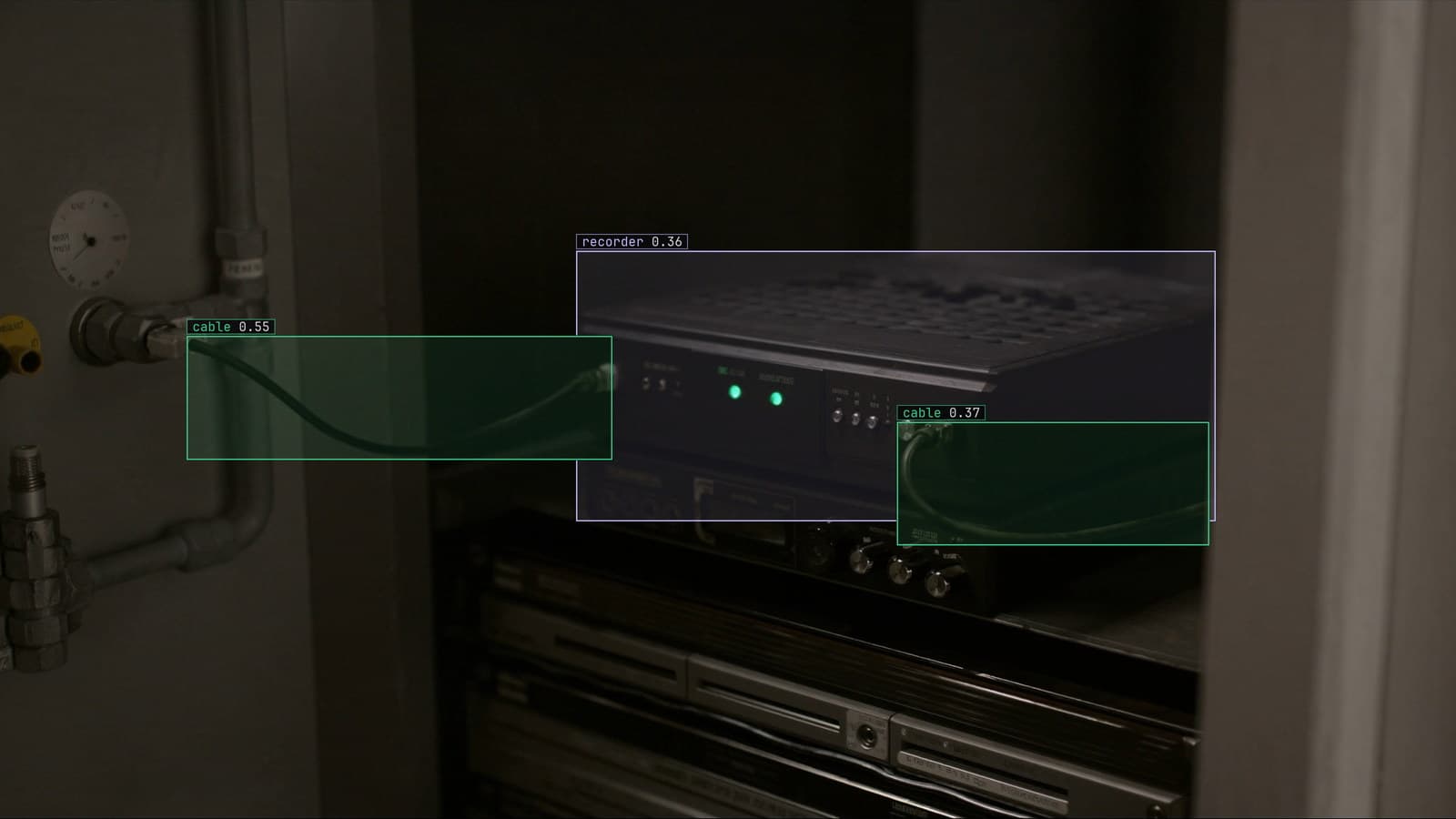
Edge box beside a recorder in a plant cabinet, generated scene with detections from our model
The last operator on the machining cell clocks out at 10 pm, and the two horizontal mills run the same aluminium bracket until the day shift arrives at 6 am. That is the plan. What happened on a Tuesday in February was that a chip wrapped around the tool on the second mill at 11:40 pm and the next bracket seated on top of it. The probe passed, because the probe checks the fixture and not the part, and by 6 am there were two hundred brackets in the bin with a face milled a quarter of a millimetre proud.
Nobody was there to see the chip. An operator would have seen it in a minute, because an operator looks at the chip pile without being told to.
A small failure compounds for eight hours when nobody watches
A lights-out window like the February one does not fail because the machine stops. Machines that stop are easy; the controller reports it and the cell sits idle until morning, which costs a shift's production and nothing more. The window fails because something small keeps going. A dulling tool that produces a bin of out-of-tolerance parts. A coolant line weeping onto the floor under the mill. A part that seated a degree off and was machined that way for four hours.
Every one of those was caught on the day shift by a person glancing at the cell on the way past. The unattended window removes the glance, and what replaces it has to look at the same things a person looked at.
Three cameras watch the chip pile, part seat and spindle
The cell gets three cameras before its next 10 pm handover, all of them the kind already fitted around the plant for security. One looks down at the chip conveyor and the pile at the discharge end. One looks through the mill window at the fixture, where a bracket should sit flat against two datum faces. One looks at the spindle from the side, where a wrapped chip or a bird's nest of swarf shows as a shape that should not be there.
Each camera gets its own classes, typed once and labeled from frames the cell recorded on staffed shifts. Chip pile above the conveyor lip. Bracket lifted off the datum. Swarf on the tool. A person checks every box before anything trains, and on the fixture camera that person is the setter, because only the setter knows what seated looks like from that window.
The predictive maintenance use case reads the same three views over weeks rather than hours, for the slow signals: coolant staining spreading, a belt cover wearing, the chip pile building faster than it did last month.
Vision AI covers what the machine's sensors do not
The mills already have spindle load, vibration and coolant temperature on the controller, and those catch a broken tool in seconds. They did not catch the February chip, because the spindle load barely moved, and they do not catch a part seated proud, because the probe reads the fixture. Vision AI on the cell is the layer for the things a person would have seen: shapes in the wrong place, in three views, sampled about every two seconds.
The distinction matters when someone asks why the cell needs cameras when it already has sensors. The sensors watch the machine. The cameras watch the work.
The rule is a sentence, the frame reaches the phone
The alert for the fixture camera reads the way the setter would brief a colleague: a bracket lifted off the datum on either mill, critical, the machine held and the frame to the on-call phone. The chip camera's rule is routine, a pile above the lip, sent to the night channel with a cooldown so it does not fire every two seconds while the pile is high. Both are approved before they go live, and the monitoring and alerts guide describes the same rule written against a different camera.
What arrives on the phone at 11:40 pm is the frame with the box on it. A person half awake can judge a frame in one look, from a phone, without logging in, and decide whether to hold the mill remotely or let it run to the next probe cycle. A text saying "fixture alarm, second mill" gives that person nothing to decide with.
The on-call phone on the February cell lives in a drawer with the spare spindle key, which is a sentence that tells you how the cell was run before the cameras.
The runner beside the recorder fires the alert first
My view, and it is a view about where things run rather than about models, is that a lights-out cell should have the model on a runner on the plant network, beside the recorder, rather than in the cloud alone. The Sunday night the plant's internet link drops is a night like any other for the mills, and an alert that has to leave the building to be raised is an alert that does not fire on that night. With the runner on site the alert fires locally first, the footage stays where it was recorded, and only the frames the model doubts leave the plant.
That is also the deployment the IT department will accept for a cell that runs while the building is locked, and the deployment guide says what leaves and what does not.
The doubted frames wait for the morning shift
Not every frame gets a verdict at night. The chip camera will see a shape it cannot place, a rag left on the conveyor lip, a reflection off the coolant, and those frames come back for a person to look at. There is no person at 3 am, and there does not need to be. The doubted frames queue, the day shift reviews them at 6:30 am with coffee, and each verdict is a label.
LexData takes the cell's models through their whole life. You type what to look for, Lexi puts a box on every frame, and a person checks each label before anything trains on it. The model then watches the three cameras, in the cloud, on your servers or on a runner beside the recorder. Frames it is unsure of come back to a person, the corrections retrain it, and the new version replaces the old one with no downtime. The rag on the conveyor lip is a label by 7 am and a non-event by the next version, and manufacturing work run this way holds 99%+ accuracy in production because the night's doubts are answered every morning.
A new machine generation is labeled before its first night
The cell's third mill arrives in August, a newer generation with a different window, a different fixture and a chip conveyor on the other side. The model trained on the first two mills has no opinion about it. Detections on the new mill will not be wrong; they will be absent, and absence raises no alert.
The drift catalog calls this the equipment changed, and it is the one condition on the list with a known date months in advance. The new mill runs staffed shifts for two weeks before its first night, the three cameras record it, the setter labels a window of frames from each view, and the version that watches its first unattended window has seen the machine it is watching.
See it on your own footage.
Start with your footageMore in Industries
Industries · 6 min read
AI visual inspection as the nondestructive testing step a camera can take over
Visual testing is the first NDT gate, its acceptance criteria are already written, and a camera can apply them to every weld instead of one in twenty.
Rob Hickey · Sep 24, 2026
Industries · 6 min read
Appearance inspection systems that judge scratches, chips and burrs the same way on every shift
The station, the light and the written standard matter more than the model. The outlines carry the limit, and a tightened tolerance makes every label wrong.
Rajiya Sultana · Sep 24, 2026
Industries · 7 min read
Automated pallet accounting from the camera over the staging zone
A polygon on the frame, every pallet tracked so it is counted once, entries and exits as the ledger, and a wash-down that nudges the camera as the failure.
Andreas Ohrvall · Sep 24, 2026