

Industries · 6 min read
Vision AI and the eQMS, so the quality record starts with a frame instead of a typed note
The nonconformance module knows what an operator typed at the end of the shift. A line camera raises it with the frame, the lot and the time attached.
Summary
This post looks at what an electronic quality management system holds, a record of what a person typed, and what changes when a line camera raises the nonconformance itself with the frame attached by webhook. It covers taking the defect classes from the plant's own NCR codes, per-lot defect rates asked of the footage, and the quality engineer's review of doubted frames feeding retraining. It is for quality managers and manufacturing engineers who own the eQMS.
Rajiya Sultana · Engineering Manager · Sep 24, 2026
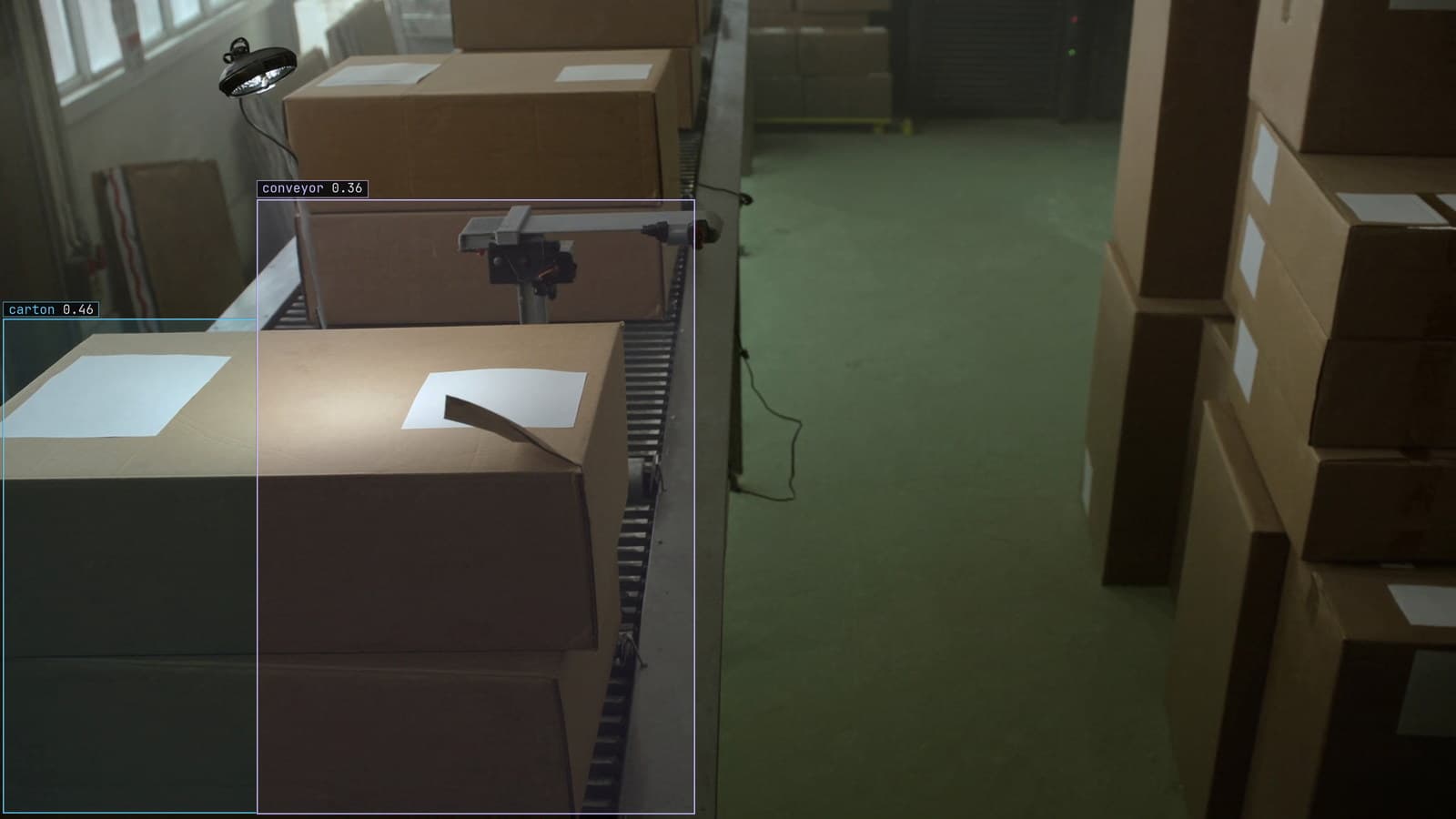
Packaging line outfeed, cartons passing a scanner, generated scene with detections from our model
At about 2 pm on the packaging line an operator notices a scuffed carton on the outfeed, pulls it, sets it on the reject shelf and keeps the line running. At 5:40 pm, at the terminal by the door, she raises a nonconformance: scuff, carton, line 3, approximately 2 pm, one unit. The lot number is the one on the pallet ticket she can see from the terminal, which may or may not be the lot the carton came from.
That record is now the truth. The CAPA that is opened against it, the supplier review that cites it, the trend chart in the monthly quality meeting: all of them rest on what was typed from memory three hours after the event.
The quality system records what was typed, and only that
An electronic quality management system is a system of record. The nonconformance module holds the NCRs, the CAPA module holds the corrective actions and their owners, supplier quality holds the scorecards, document control holds the procedures the auditors ask for. It is good at all of that, and it detects nothing. Every record in it began as a person seeing something and deciding to write it down.
Two things follow. The first is that the record is a sample, because an inspector looks at some parts and not all of them. The second is that the record is late and approximate, because the typing happens at the terminal, after the fact, by someone with a line to run.
The manufacturing work on this site starts from the same observation: the model that hit its number in the pilot has to keep hitting it on the floor, and the floor is where the sample was always thinnest.
Vision AI raises the nonconformance with the frame attached
Put a camera on the outfeed where the operator stood at 2 pm. The model finds the scuff on the carton as it passes, and the rule, written as a sentence with a severity and a cooldown and approved before it goes live, fires a webhook to the eQMS. The webhook creates the NCR. It carries the frame with the scuff boxed, the timestamp to the second, the line, and the lot that was running at that second according to the line controller, rather than the one on the nearest pallet ticket.
The alert written as a sentence is the same mechanism whether it lands in Slack or in a quality system; the webhook is just the address. What changes for the quality team is that the NCR exists before anyone walks to a terminal, and it opens with a picture.
Vision AI does the seeing. The eQMS still does everything it did before: the disposition, the CAPA, the supplier scorecard. The camera has added a first line to the record that used to start with a memory.
The defect classes come from the NCR codes the plant already uses
The class list is the quality manual's defect taxonomy, in the quality manual's words. If the NCR codes say scuff, crush, tear and print defect, those are the four classes, because the CAPA owner reading the alert should recognise the word on the first glance. A model that reports "surface damage" against a system that files "scuff" and "crush" separately has created a translation step, and the translation step is where records go wrong.
You type those four classes once, Lexi proposes a box on every carton frame, and the line's own inspector checks them against the acceptance criteria before anything trains. That check is where the manual's definition of a scuff, which was always a paragraph and a photograph, becomes a boundary the model can hold.
The NCR form on most lines still has a time field with no seconds in it. Nobody typing from memory ever knew the seconds.
Every part inspected changes what supplier quality can say
The record used to be a sample. With a camera on the outfeed it is every carton on the line, and the supplier quality module can be asked questions it could never answer from typed NCRs. Which supplier lot produced the most crushed cartons this week. Whether the scuff rate on the Tuesday lot was higher than the same supplier's lot from the week before. What the crushed cartons from that lot actually looked like.
Those questions are asked of LexInsight, and the answer comes back with the frames behind it, so the supplier review carries pictures of the parts rather than a count someone tallied at the terminal. Asking a question of the footage does not change the model; it reads what the model already found. The supplier conversation changes, though, because the evidence is now a set of frames with a lot number on each.
The doubted frames go to the quality engineer, and the decision is a label
The model is not sure about every carton. A scuff at the edge of the frame, a shadow that looks like a crush, a print defect on a new artwork: these come back to a person with the frame, and the person's verdict is a label. On the lines we run, that queue lives with the quality engineer, because the decision it asks for is the same one the NCR process already trusts that person to make.
LexData takes the outfeed model through its whole life. You type what to look for, Lexi puts a box on every frame, and a person checks each label before anything trains on it. The model then watches the line camera the plant already has, in the cloud, on your servers, or on a runner beside the recorder. Frames it is unsure of come back to a person, the corrections retrain it, and the new version replaces the old one with no downtime. That is how 99%+ accuracy is maintained in production on the manufacturing lines behind our numbers: the review the quality team was already doing became the training set.
My own view is that the webhook should create the NCR in a held state that a person releases, for the first month at least. A quality team will not trust a queue that fills itself, and a month of releasing good records by hand is what earns the switch to automatic.
The camera does not decide the disposition
The frame says a scuff is on the carton. Whether the carton ships, is reworked or is scrapped is still the disposition the quality engineer signs, and the root cause in the CAPA is still an investigation a person runs, with the frames as the first exhibit. The certified inspector on the line has the same job as before with a different starting point. The day begins with a queue of frames the model doubted, instead of a walk down the line at 2 pm hoping to be looking at the right carton when it goes past.
See it on your own footage.
Start with your footageMore in Industries
Industries · 6 min read
AI visual inspection as the nondestructive testing step a camera can take over
Visual testing is the first NDT gate, its acceptance criteria are already written, and a camera can apply them to every weld instead of one in twenty.
Rob Hickey · Sep 24, 2026
Industries · 6 min read
Appearance inspection systems that judge scratches, chips and burrs the same way on every shift
The station, the light and the written standard matter more than the model. The outlines carry the limit, and a tightened tolerance makes every label wrong.
Rajiya Sultana · Sep 24, 2026
Industries · 7 min read
Automated pallet accounting from the camera over the staging zone
A polygon on the frame, every pallet tracked so it is counted once, entries and exits as the ledger, and a wash-down that nudges the camera as the failure.
Andreas Ohrvall · Sep 24, 2026