

Industries · 7 min read
PCB defect detection on bare boards, with a severity on every box
Opens, shorts and mouse bites boxed on the bare panel, critical ones rejected, repairable ones sent to rework with the frame, a new revision labeled early.
Summary
This post follows a bare panel under a high resolution camera after etch, from a box on every open, short, mouse bite and spur to a rule that rejects, reworks or passes the board by the severity of what was found. It concludes that severity lives in the rule, that the borderline board goes to a person with the box, and that a new board revision has to be labeled from its first panels. It is for PCB fabrication quality and process teams.
Esdras Ntuyenabo · Engineer · Sep 26, 2026
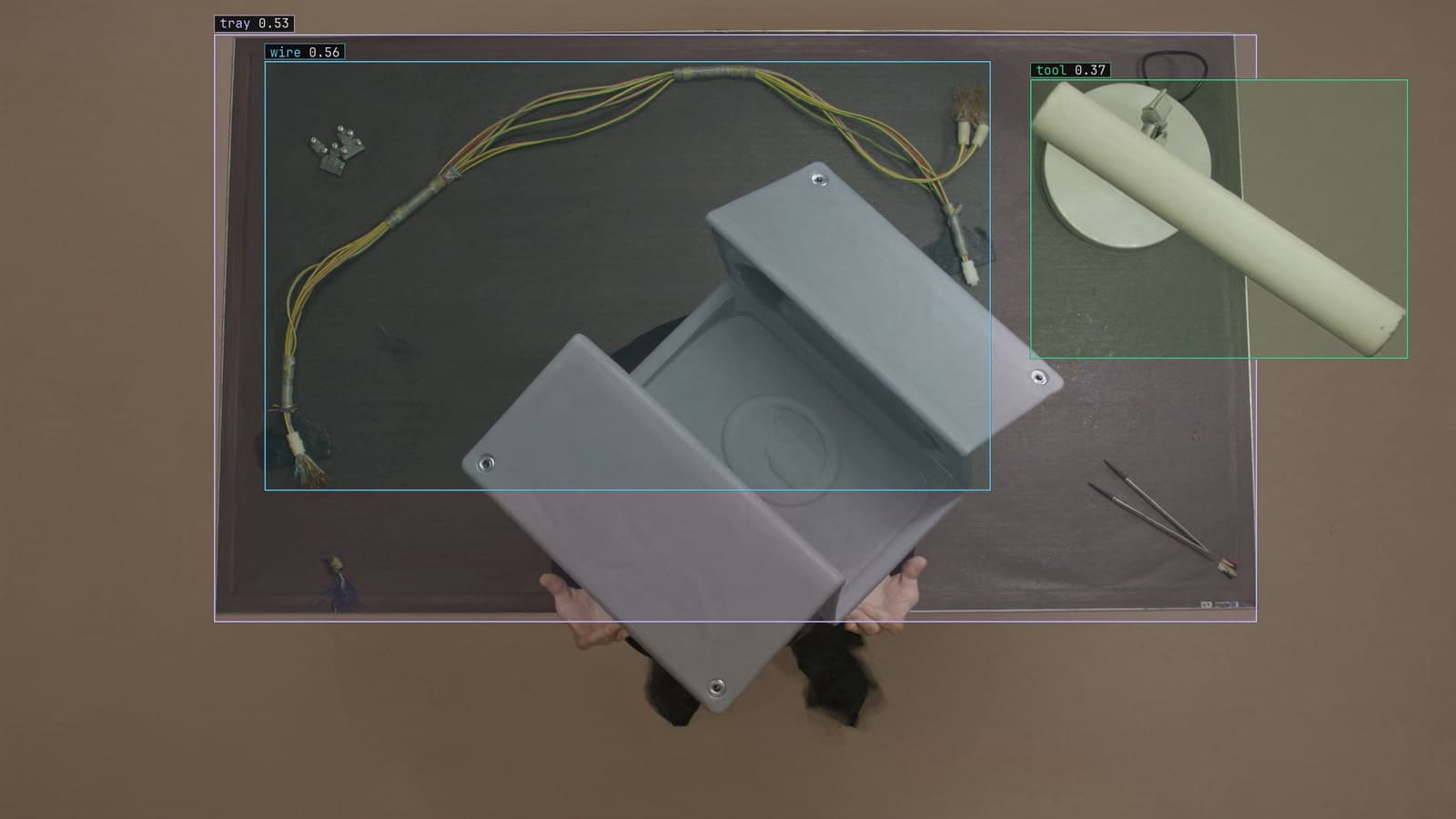
Assembly station with a housing, a tray and a wire boxed, generated scene with detections from our model
The panel comes out of the etch line at 9:40 pm as a sheet of eight bare boards, copper traces on green laminate, no components yet. An operator holds it under the bench lamp with a loupe and looks for the things that will make a board dead a week from now, after it has been through solder mask, silkscreen, drilling and assembly and has become expensive. A break in a trace the width of a hair. A bridge of copper between two pads. He finds most of them. He finds fewer at 9:40 pm than he did at 2 pm.
The camera over the outfeed conveyor sees the same panel at the same resolution all night. What it does with the hairline break is the design.
Object detection on the bare panel finds the open before it becomes a dead board
An open is a gap in a trace where copper should be continuous. A short is copper where there should be none, joining two traces or two pads. Both are small, both have a location, and object detection puts a box on each with the position on the panel, which is what the rework technician needs and what the reject log records. The board is worth almost nothing at this stage and a great deal after assembly, so the place to find the open is here, at 9:40 pm, on the bare panel.
Resolution decides whether it can be found at all. A trace is a fraction of a millimetre wide, so the camera has to resolve a gap smaller than that, and the frames for labeling have to come from that camera at that mount rather than from a microscope in the lab. A model trained on microscope frames has weak evidence for the conveyor camera it will run on.
Opens, shorts and mouse bites are classes, and severity rides on the class
The class list comes from the fab's own defect codes. Open and short are the two that kill a board. A mouse bite, where the edge of a trace looks nibbled, narrows the trace without breaking it. A spur is a thin whisker of copper left behind by the etch. Spurious copper is a splash of it where nothing should be. A pinhole is a tiny void in a pad, and a missing hole is a drill that did not happen.
Each is a box with its class. What the class carries is the severity, and the severity is what routes the board. Nobody knows who first called the nibbled edge a mouse bite, and the name has outlived every other term for it because it is exactly what the defect looks like under a loupe.
Lexi proposes the boxes from the class names, and a person checks them in LexAnnotate before anything trains. The labeling doc covers writing the prompt in the fab's own words, and here the fab's words are the defect codes on the rework sheet.
The rule routes the board, and the rule is where severity lives
A panel leaves the camera as a list of boxes with classes, and the rule reads the list. Any open or short and the board is rejected. A mouse bite narrower than the spec allows and the board goes to rework with the frame and the box, so the technician walks to the right trace rather than searching the panel. A spur or a pinhole within the customer's acceptance class and the board passes, with the box kept in the record.
The thresholds sit in the rule. A customer whose acceptance class tightens changes one line of the rule and touches nothing in the model. On the manufacturing lines we run, this is what lets the 99%+ accuracy maintained in production hold across customers with different specs: the model finds the same defects for all of them, and the rule is where the customers differ.
The surface defect use case argues that disposition is a severity call. On a bare panel the severity is mostly in the class, which is why boxes are enough and a mask on every mouse bite would be labeling time spent on nothing the rule reads.
The borderline board goes to a person, with the box on the frame
A trace that has thinned to the point where the model cannot say mouse bite or open. A mark on the laminate that might be spurious copper or might be a fibre. A pad the etch has eaten into on one side. These are the frames the model doubts, and it should say so. The rule holds the board, the frame goes to the operator at the bench at 9:45 pm with the box drawn on it, and his call is recorded against the frame.
That queue is the fab's best labeled set. It is exactly the cases the model found hardest, on the fab's own panels, decided by the person who would have decided them anyway. My own view is that the rework technician is the best labeler in the building, because she has already seen where every one of these boxes led once the board was populated, and her corrections carry that.
A new revision is labeled from its first panels, before the run
A customer sends a new revision. The layout has changed, the trace widths may have changed, and the model has strong evidence for the old board and almost none for this one. The first panels of the new revision go through the camera, Lexi proposes the boxes, a person checks them, and the model is retrained before the run rather than after the first rejects. Versions keep what they were trained on, so the old revision's evidence is not lost when the new one is added.
LexData takes the inspection model through its whole life. You type what to look for in the fab's defect codes, Lexi puts a box on every panel, and a person checks each label before anything trains on it. The model then watches the outfeed camera, in the cloud, on your servers, or on a runner beside the recorder. Frames it is unsure of come back to a person, the corrections retrain it, and the new version replaces the old one with no downtime.
A new etch bath moves the defect rate, and the rule feels it first
The subtler change looks like nothing. The fab replaces an etch bath, the rate of mouse bites on every panel rises, and per box the model is still right. What breaks is the rework queue, which fills with boards the rule now sends because the review limit was tuned to a quarter when mouse bites were rare. The drift catalog calls this a change in the defect rate, and its advice is to retune the thresholds against the current rate before touching the model.
The cheap signal is the rework queue against its own history, by shift. When Tuesday's night shift sends twice what Monday's did and nothing else changed, the bath is the first thing to look at, the rule is the second, and the model is the last. A fab that reads that count every morning finds out about the bath from the queue rather than from the customer.
See it on your own footage.
Start with your footageMore in Industries
Industries · 6 min read
AI crop analysis in the greenhouse, catching tomato disease before it spreads down the row
Lesions boxed by disease with a healthy class, a question of the footage about how far a patch spread since last week, and a model that turns with the season.
Rob Hickey · Sep 26, 2026
Industries · 6 min read
Ceramic defect detection for hairline cracks a fixed-rule camera cannot learn
Edge chips, hairline cracks and pinholes on the tile line after the kiln, masks where the area sets the grade, and the new glaze as the day to relabel.
Esdras Ntuyenabo · Sep 26, 2026
Industries · 6 min read
Chocolate box inspection with a camera over the tray line
Each piece boxed by type, a plain check against the box template, damage as its own class, and the new spring assortment as the day the labels go stale.
Stephen Biswas · Sep 26, 2026