

Industries · 7 min read
Rebar counting from one photo of the bundle end, with a bounding box on every bar and a record for the ticket
A camera over the saw end of the bundle, a box on every bar, the count checked against the delivery ticket, and a re-mounted camera as the drift to expect.
Summary
This post describes counting rebar in a bundle from one photo of its cut end, with a box on every bar end and the count checked against the delivery ticket before the bundle is booked in. It covers why the bundle has to be square to the camera and cut flush, the touching bars a person checks, and a re-mounted camera after a yard move as the drift to expect. It is for fabrication yards and site stores.
Finn Ellingwood · Engineer · Sep 26, 2026
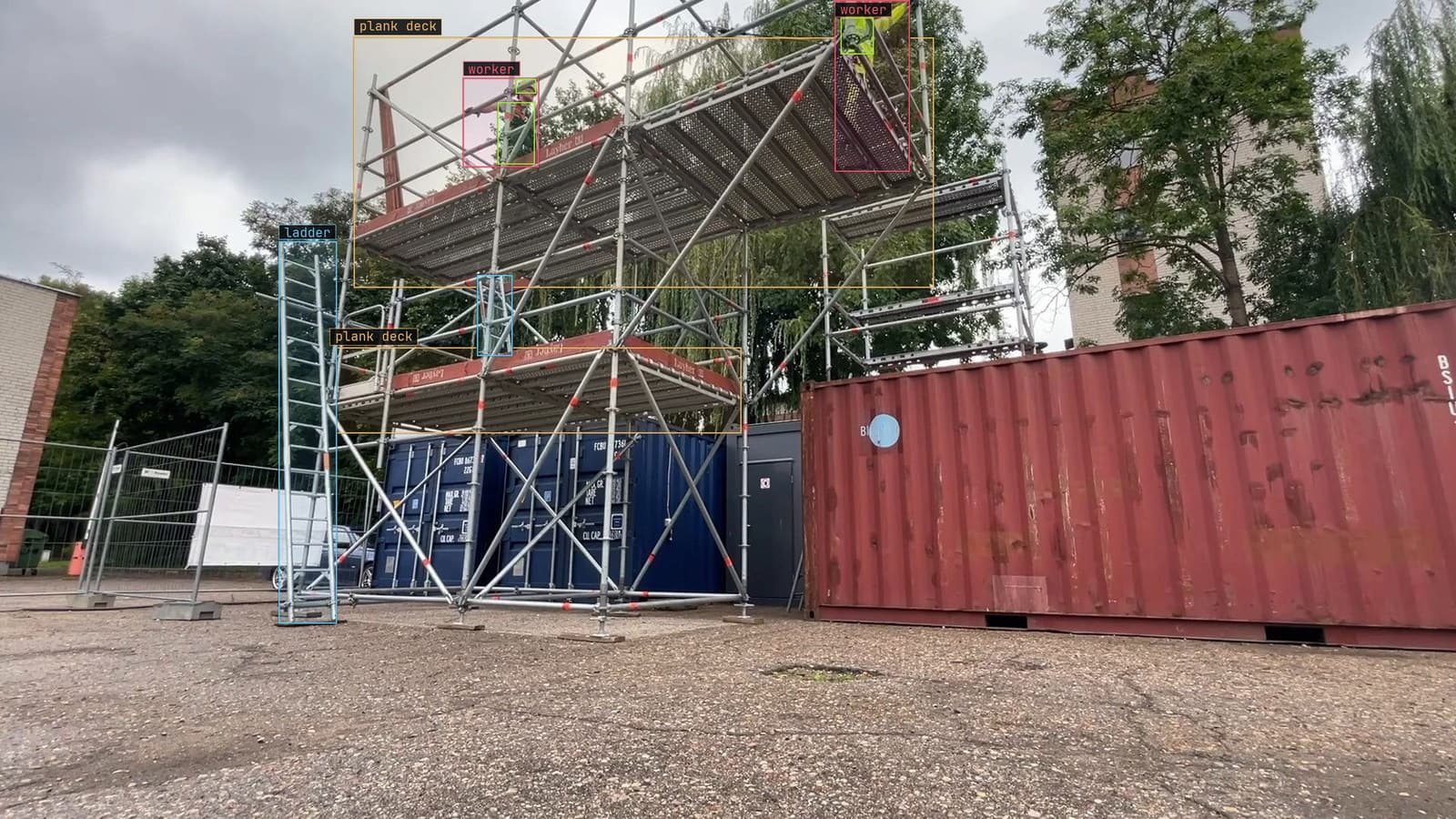
A site yard with a scaffold tower beside containers, workers and ladders boxed, from a customer site camera
The delivery arrives at the fabrication yard at 7 am, a flatbed with bundles of bar tied with wire, and the yard hand climbs up with a piece of chalk. He counts the bar ends in fives, marking each five with a stroke, and gets a number. The ticket has a number too. When they disagree he counts again, gets a third number, and the yard foreman signs for the ticket's number because the truck has to leave. Whatever the bundle actually holds, the yard now believes the ticket.
The bundle end is a photograph waiting to be taken. It is round, it is flat where the saw cut it, and every bar in it shows as a small dark circle with a bright rim. That is one of the easier things a model can be asked to count, and the parts of the job that go wrong are the camera and the tie wire.
A bounding box on every bar end turns the photo into a count
A bar end is a small object with a clear outline, and a bounding box on each one is the whole label. The count is the number of boxes. There is nothing to measure and no severity to decide, and a mask on every bar would cost labeling time for no change to the number. What the box carries beyond the count is the position, which is what lets a person check the model's work on the bundle rather than take the number on trust.
You type "bar end" once, Lexi proposes a box on every bar in every photo, and a person checks them. On the first pass the checking is the job, because a model that misses one bar in a bundle at every delivery is a model that will be wrong on every ticket in the same direction. The labeling doc covers the verification pass, and for a counting job the pass is the product.
The bundle end has to be square to the camera and cut flush
The bars in a bundle on the 7 am flatbed are never all the same length. The saw end is close to flush, and the tied end is a staircase of bars that stopped wherever the shear left them, some of them set back so far that their ends are in shadow behind the others. Photograph the tied end and the model boxes the front bars and doubts the rest, and the count is short by however many were set back.
So the camera looks at the saw end, and it looks at it square. A camera at an angle sees a bar end as an ellipse and sees the far side of the bundle smaller than the near side, and the boxes shrink across the frame in a way the model has to learn or get wrong. A fixed mount over a bundle station at the yard's unloading bay, with the bundle pushed against a stop, gives every photo the same distance and the same angle.
My own view is that a yard should count only from the saw end and only from the fixed mount, and that a count from a phone on the flatbed is a check on the yard hand rather than a replacement for him.
Bar sizes are named by number in some yards and by millimetre in others, and the same bundle is two things depending on who is reading the ticket.
Touching and overlapping bars are the boxes a person checks
Bars in a tight bundle touch, and at 7 am under the bay's sodium lamp two bar ends touching read as one oblong shape to a model that has not seen enough of them. A bar pushed back from the saw end by a hand's width sits in shadow and reads as a gap. Rust on one bar and mill scale on the next give the ends different colours in the same photo. These are the frames the model doubts, and on a counting job the honest thing for it to do is send them to a person with the boxes drawn rather than round the count.
The labeling guide for the yard says what a box is on a touching pair, which is two boxes overlapping rather than one wide one, and what to do with a bar end that is only half in shadow. The person checking spends their time on the pairs. Once the guide has been applied to a few hundred bundles the pairs are the frames the model gets right, because they are the ones that were checked hardest.
The count is checked against the ticket, and a disagreement holds the bundle
A photo becomes a count, and the count is compared with the ticket before the bundle is booked in. A match books the bundle by 7:15 am. A disagreement beyond the tolerance the yard chose holds it, and the photo with the boxes goes to the foreman on the unloading bay with the ticket's number beside the model's. He can see which bars were boxed and which were missed, and the argument with the supplier is a photograph rather than two chalk counts.
An alert is a rule written as a sentence, with a severity and a cooldown, approved before it goes live: a bundle count on the unloading bay that disagrees with the ticket, routine, to the foreman's phone. With a runner beside the recorder the alert is raised in the yard. The photo with its boxes, the count and the ticket are kept together for every bundle the yard has ever received.
A re-mounted camera after a yard move is the drift to expect
The unloading bay moves in the spring to make room for a new saw, and the camera is re-mounted over the new bundle station by whoever had a ladder. It sits a few degrees off and a few centimetres higher than it did. Every bundle still gets a photo and the photo still looks fine to the foreman, and every bar end is now smaller in the frame and slightly elliptical, which is the framing the model has the least evidence for.
The drift catalog covers this as a camera moved. The signature is one station diverging from its own history on a date that matches a maintenance job, and on a counting station it shows as the count going short on every bundle by roughly the same amount. The fix is the cheapest on the list: re-label a short window of photos from the new mount and retrain on frames the yard already has.
LexData takes the counting model through its whole life. You type what to look for, Lexi puts a box on every bar end in every photo, and a person checks each label before anything trains on it. The model then watches the camera on the bundle station, in the cloud, on your servers, or on a runner beside the recorder. Frames it is unsure of come back to a person, the corrections retrain it, and the new version replaces the old one with no downtime.
The wider manufacturing work is built the same way, one fixed camera and one rule at a time, and the yard hand with the chalk keeps his job as the person the model is checked against.
See it on your own footage.
Start with your footageMore in Industries
Industries · 6 min read
AI crop analysis in the greenhouse, catching tomato disease before it spreads down the row
Lesions boxed by disease with a healthy class, a question of the footage about how far a patch spread since last week, and a model that turns with the season.
Rob Hickey · Sep 26, 2026
Industries · 6 min read
Ceramic defect detection for hairline cracks a fixed-rule camera cannot learn
Edge chips, hairline cracks and pinholes on the tile line after the kiln, masks where the area sets the grade, and the new glaze as the day to relabel.
Esdras Ntuyenabo · Sep 26, 2026
Industries · 6 min read
Chocolate box inspection with a camera over the tray line
Each piece boxed by type, a plain check against the box template, damage as its own class, and the new spring assortment as the day the labels go stale.
Stephen Biswas · Sep 26, 2026