

Industries · 6 min read
Wood defect detection on the grading line, with a bounding box on every knot
Knots live or dead, checks kept apart from splits, resin pockets counted, and the board routed by a rule the mill can read. The grader keeps the borderline.
Summary
This post follows a board down a sawmill grading line under a fixed camera, from a box on every knot, check, split and resin pocket to a grade rule that routes the board. It concludes that the grade thresholds belong in the rule rather than the model, that the grader keeps the borderline boards, and that a new species or a new grade book is a relabel. It is for sawmill and planer mill operations teams.
Ayman Quadir · Head of Product · Sep 26, 2026
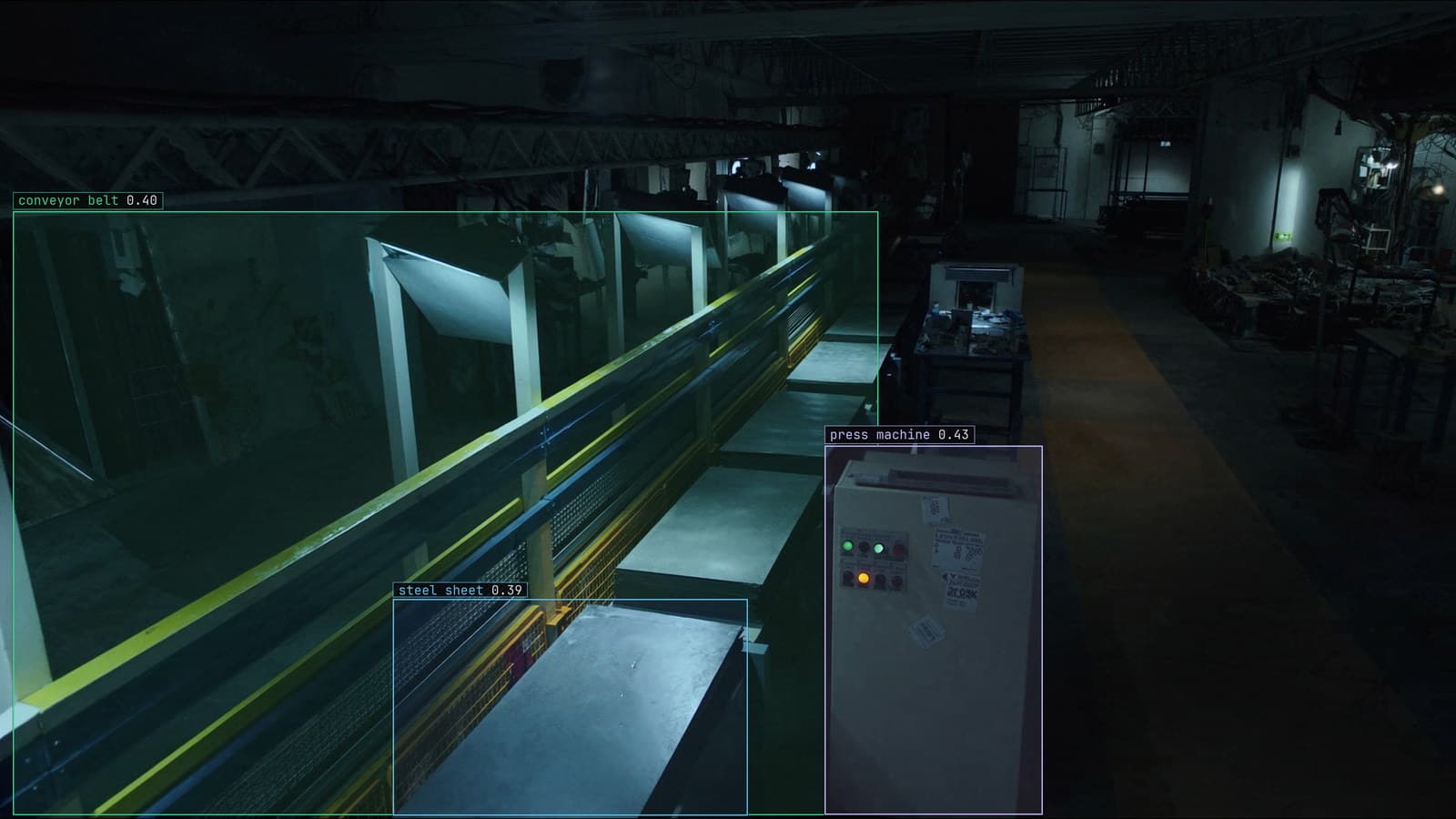
A conveyor passing an inspection station, generated scene with detections from our model
The grader sits on a stool at the chain after the planer, and every board that passes gets a glance and, sometimes, a crayon mark. At 7 am the glance is good. By 2:30 pm, on the eleventh hour of a shift that started with a jammed infeed, the glance is a habit. The boards that go into the wrong bundle are the ones on the edge between two grades, which are the ones the customer notices.
A camera over the chain looks at every board the same way at 2:30 pm as it did at 7 am. The work is in deciding what it should look for and what to do when it is unsure.
A knot is live or dead, and the bounding box says which
Knots are the first thing a grader sees and the first class the model learns. The distinction that matters to the grade is whether the knot is live, grown into the surrounding wood with a tight edge, or dead, encased in a dark ring and liable to fall out when the board is machined. Both are round, both are countable, and each sits comfortably inside a bounding box that carries its size.
Size is why a box is enough here. The grade rules for most softwood say how large a knot may be for a given board width, and a box's width is that measurement. Nothing in the rule needs the knot's outline, so a polygon would cost labeling time and change no grade.
The mill's own boards are the training frames. You type the two classes once, Lexi proposes a box on every knot on every board, and a person checks them. On the first pass the checker spends most of the time on the dark ring, because a live knot with a shadow across it and a dead knot look alike from directly above, and the guide has to say which one the box is.
A check is not a split, and the labels have to keep them apart
Checks are the shallow cracks that open along the grain as a board dries. Splits go through. A board covered in fine checking may still make its grade, while a single split running from the end grain downgrades it or sends it to the trim saw, so the two have to be separate classes even though both are long, thin and dark.
The surface defect use case argues that disposition is a severity call, and severity is size and location. On the grading line at 2:30 pm the location is the end of the board: a split within the trim allowance is a shorter board, and the same split in the middle is a lower grade. The rule reads the box's position along the board's length and decides, and the model only has to find the crack.
Resin pockets and wane get boxes because the grade book counts them
Resin pockets are the small dark slots of pitch that show up on pine and spruce and ruin a paint finish. Wane is the bark edge left where the log's curve met the saw. Pith is the soft centre. Each has a line in the grade book, each is a class in LexAnnotate, and each gets its own box, since a rule that counts "defects" cannot apply a table that treats a resin pocket and a knot differently.
On the manufacturing lines we run, the class list is the grade book's own vocabulary. A model whose classes the grader has to translate is a model the grader will argue with.
The grade is a rule over the boxes, and the rule routes the board
A board passes under the camera and comes out the other side as a list: the boxes, their classes, their sizes and where along the length they sit. The grade is a rule over that list. So many knots of such a size per metre of board, no dead knot over the limit, no split past the trim line, and the board is the top grade. The drop sorter downstream gets the grade and sends the board to its bundle.
The thresholds live in the rule and never in the model. When the mill cuts for a furniture customer whose spec allows smaller knots, the rule changes and the model does not. That is what lets a line hold the 99%+ accuracy maintained in production that our manufacturing work reports: the model finds the same things it always found, and the rule is the part the mill edits.
Graders mark with a lumber crayon, and the crayon's colour is the grade. The box does not wear off under the next planer.
Borderline boards go to the grader, and the grader's call trains the next version
A board with a knot right at the size limit, or a crack the model cannot call a check or a split, is a board the model doubts. It should say so. The rule holds the board's grade, the frame goes to the grader on the stool, and the grader's call is recorded against the frame.
LexData takes the grading model through its whole life. You type what to look for, Lexi puts a box on every frame, and a person checks each label before anything trains on it. The model then watches the camera over the chain, in the cloud, on your servers, or on a runner beside the recorder. Frames it is unsure of come back to a person, the corrections retrain it, and the new version replaces the old one with no downtime.
My own view is that the grader stays on the stool. Grading is a judgment the mill sells, and the borderline boards are the judgment. What the camera removes is the eleventh hour of glances at boards that were never in doubt, and what it adds is a record of the grader's calls on the ones that were, which is the record the next version learns from.
A new species is a relabel, and so is a new grade book
Spruce knots and pine knots are different colours on a different background, and a model that graded spruce for a year will doubt most of the first pine shift on line 2. That is a covariate change and the fix is the usual one: a window of frames from the first day of pine, labeled and folded in.
The harder case looks like nothing at all. The mill signs a customer whose grade book tightens the knot limit, the boards are unchanged, and every label the model learned is now wrong for that order. The drift catalog calls that a spec change, and the first evidence of it is the grader overriding the model's grade in a consistent direction on the borderline boards. The override rate is the signal; the grader's crayon on a bundle that the model passed is the same signal on wood. The wider manufacturing picture is built from lines like this one, where the rule is the mill's and the model finds the knots.
See it on your own footage.
Start with your footageMore in Industries
Industries · 6 min read
AI crop analysis in the greenhouse, catching tomato disease before it spreads down the row
Lesions boxed by disease with a healthy class, a question of the footage about how far a patch spread since last week, and a model that turns with the season.
Rob Hickey · Sep 26, 2026
Industries · 6 min read
Ceramic defect detection for hairline cracks a fixed-rule camera cannot learn
Edge chips, hairline cracks and pinholes on the tile line after the kiln, masks where the area sets the grade, and the new glaze as the day to relabel.
Esdras Ntuyenabo · Sep 26, 2026
Industries · 6 min read
Chocolate box inspection with a camera over the tray line
Each piece boxed by type, a plain check against the box template, damage as its own class, and the new spring assortment as the day the labels go stale.
Stephen Biswas · Sep 26, 2026