

Industries · 7 min read
Computer vision in logistics, from the dock door to the sorter
A distribution centre's cameras already see the dock, the sorter and the aisles. Packaging refreshes, new SKUs and moved cameras are the part to plan for.
Summary
This post walks a distribution centre's existing cameras from the dock, where pallets are counted off trailers, through the sorter, where package type and damage are read at induction, to the aisles, where rack occupancy is mapped. It concludes that the models are the easy part and that packaging refreshes, new SKUs and moved cameras are what a site has to plan to absorb. It is for operations and engineering leads in distribution centres.
Ayman Quadir · Head of Product · Sep 25, 2026
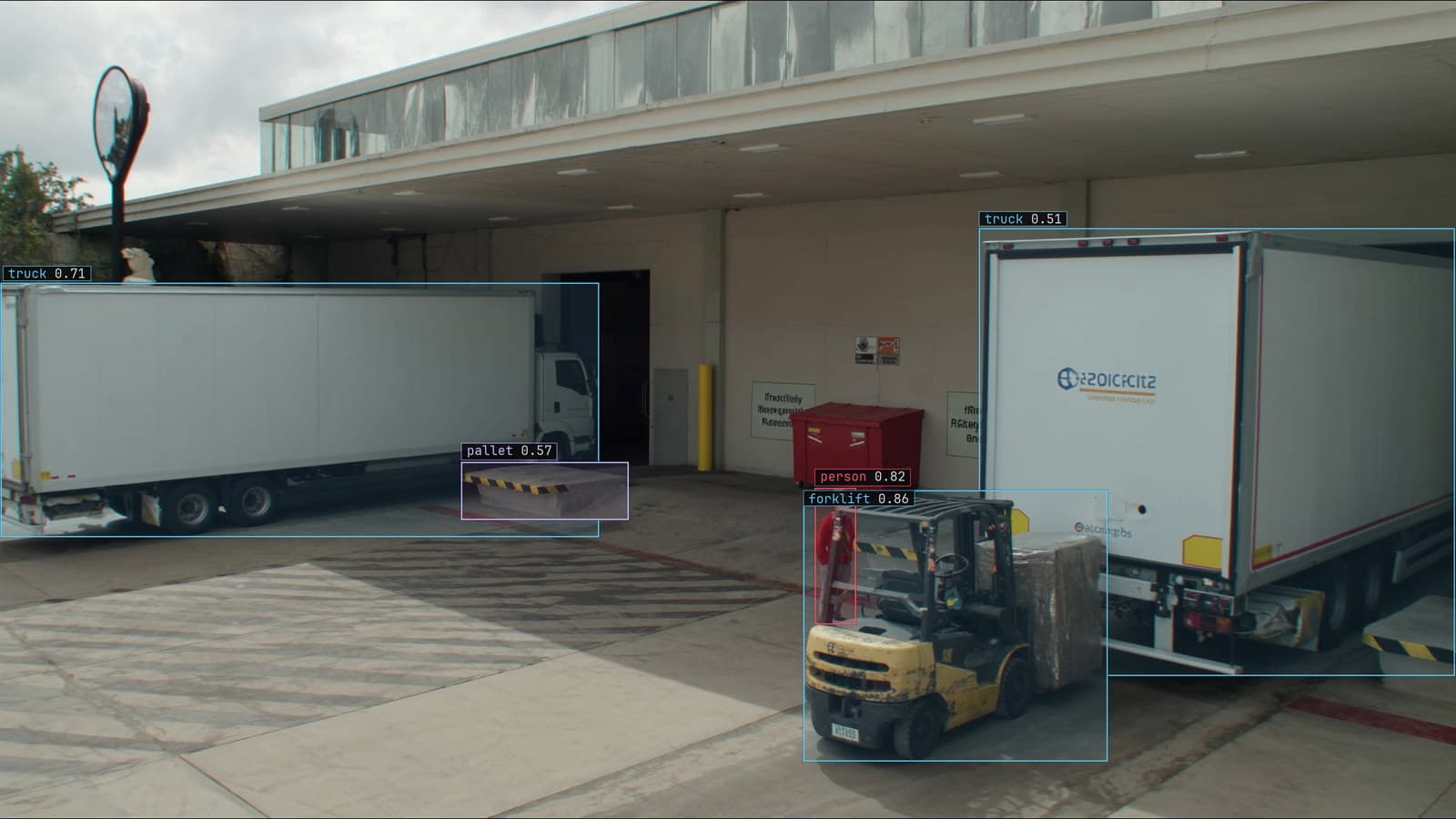
Loading dock with trucks at the bays and a forklift carrying a pallet, generated scene with detections from our model
The distribution centre on the ring road has cameras on every dock door, over every induction point on the sorter and down every aisle of the racking, and they were all installed for security. The recorder keeps thirty days of footage that nobody watches unless a pallet goes missing. Meanwhile a clerk at dock 6 counts pallets off a trailer with a clicker, a packer at induction eyeballs each carton for damage, and a supervisor walks the aisles twice a shift to see which bays are empty.
Every one of those jobs is a question the cameras could answer from the frames they already take.
Object detection counts pallets off the trailer at the dock
The camera over dock 6 sees the trailer's open doors, the forklift, and each pallet as it comes down the ramp. The question is how many came off, and whether the count matches the manifest. Object detection puts a box on each pallet in each frame, and a track across frames turns the boxes into a count as they cross the line where the ramp meets the floor.
The labeling is boxes on pallets, from the dock camera at its mounted height, with the forklift mast in the way on half the frames. You type the class once, Lexi proposes a box on every pallet in every frame, and a person checks them, with most of the attention on the pallets half hidden by the mast. A partial view is decided by a written rule before labeling starts, since a pallet with the forklift in front of it is still a pallet, and the model counts the way its labels counted.
A count that disagrees with the manifest is a rule written as a sentence, with a severity and a cooldown, approved before it goes live. Pallets off the trailer at dock 6 short of the manifest, routine, to the dock office in Slack, with the frames from the unload attached. The clerk with the clicker gets the frames rather than a number, and settles the difference in a minute.
The induction camera reads package type and damage before the sorter
At induction a carton passes under the camera on its way onto the sorter, and there are two questions: what kind of package is it, and is it damaged. Package type decides where the sorter sends it. Damage decides whether it goes at all, because a crushed carton on the sorter is a jam, and a jam stops every lane behind it.
Both are classes on the same frame. Carton, poly bag, tote and pallet-in-a-box for the type; crushed, torn and wet for the damage, each boxed where it shows. Labels come back at up to 99.9% accuracy when a person checks each one, and the checking is the point here. A torn flap that one labeler called damage and another called normal is a class the model will call both ways at line speed.
The package and label inspection use case is the same camera asked a third question, whether the label is where the scanner can read it, and the honest thing to say about induction is that every check there is a region and a rule. The box localises the region, the rule decides.
The aisle camera maps rack occupancy without a walk
The aisle cameras look down the racking from the end of each aisle, and the supervisor's question at aisle 12 is which bays are empty and which are blocked. A bay is a fixed rectangle in the frame, drawn once when the camera is set up, and the model's job is to say whether there is a pallet in it. The warehouse spatial mapping use case wants more than this, a metric map the fleet can plan through, and for a site with robots that is the right target. For a site with forklifts and a supervisor, occupancy per bay from a fixed camera is most of the value at a fraction of the labeling.
The failure to plan for is the view that is quietly gone. A pallet left in the aisle, a new rack end guard, a banner hung for a safety week: each of these sits between the camera and the bays behind it, and the model reports the bays it cannot see as whatever it last saw. The frames that come back for review are the tell, because a bay the model is unsure of is usually a bay something is in front of.
One aside. The supervisor at the site described here still walks the aisles once a shift, down from twice, and says the walk is for the things the camera was never asked about: a leaking drum, a pallet wrap coming loose, a light out.
A packaging refresh arrives on a marketing schedule nobody told the model about
The cartons for the biggest customer change in the autumn. New artwork, a slightly different size, a different tape. The induction model has never seen the new carton, and on the morning of the changeover a correct carton reads as an unknown type, or worse, the new artwork's dark band across the middle reads as a crush.
The packer at induction overrides the damage flag on every one of them, and the override rate is the signal. Corrections at review retrain the model on the new carton, and the next version goes out with no downtime. What a site can do ahead of time is ask the customer for a few of the new cartons before the changeover and put them under the induction camera for an afternoon. That way the frames are labeled and folded in before the first truckload arrives.
New SKUs are the same event on a smaller scale, every week. A site that adds products constantly needs the review queue to be somebody's job, an hour a day, rather than a thing that is looked at when the sorter jams.
A second site is a new site, however similar it looks on paper
LexData takes each of these models through its whole life. You type what to look for, Lexi puts a box on every frame, and a person checks each label before anything trains on it. The model then watches the cameras the site already has, in the cloud, on your servers, or on a runner beside the recorder. Frames it is unsure of come back to a person, the corrections retrain it, and the new version replaces the old one with no downtime.
The second distribution centre has the same racking supplier, the same sorter and the same customer's cartons, and the dock cameras are mounted a metre higher because the doors are taller. The drift catalog calls this a new site came online: the model was trained at one site and deployed at another, and the second site does not look like the first. Every site gets its own window of frames, labeled before it goes live, and is compared with its own history rather than with the fleet average, because the good sites carry the bad one in an average and hide it.
My view, which the engineering side of LexData does not always share, is that a logistics rollout should start with the dock count and nothing else. It is the simplest question, the clerk's clicker gives it a ground truth on day one, and the site learns how the review queue works on a model where a miss costs a recount rather than a jam. Where the models run, on the site's own servers or on a runner beside the recorder, is covered in the deployment doc.
See it on your own footage.
Start with your footageMore in Industries
Industries · 7 min read
Counting the screws in a kit with object detection over the bench
A camera over the kitting bench counts every screw and bottle one box at a time. Exact for kits, a band for cases, and a half-hidden item is a written rule.
Rajiya Sultana · Sep 25, 2026
Industries · 7 min read
Automated water meter reading with a camera in the vault
Ten digit classes in a fixed row turn a truck roll into a frame. A rolling digit and condensation on the glass are the frames that come back to a person.
Stephen Biswas · Sep 25, 2026
Industries · 7 min read
Body-in-white inspection with a station camera on unpainted steel
Dents on a bare body shell hide in the reflections. Masks give the extent, a second pass decides reportable, and a tightened tolerance is a spec change.
Finn Ellingwood · Sep 25, 2026