

Industries · 6 min read
Pallet scanning with a camera portal that reads the label from whichever side it landed on
Cameras on four sides of the dock door find the label wherever the wrapper left it, decode the barcode, read the text, and log every scan with its frame.
Summary
This post describes a camera portal at a receiving dock, where the pallet label is found on whichever face the wrapper left it, the barcode is decoded, the printed text is read into fields, and every scan is logged with the frame behind it. It concludes that stretch wrap over the label is the occlusion to plan for and that it is a physical fix rather than a retraining job, and that the portal should decide on site beside the recorder. It is written for warehouse operations and systems teams.
Andreas Ohrvall · CTO · Sep 25, 2026
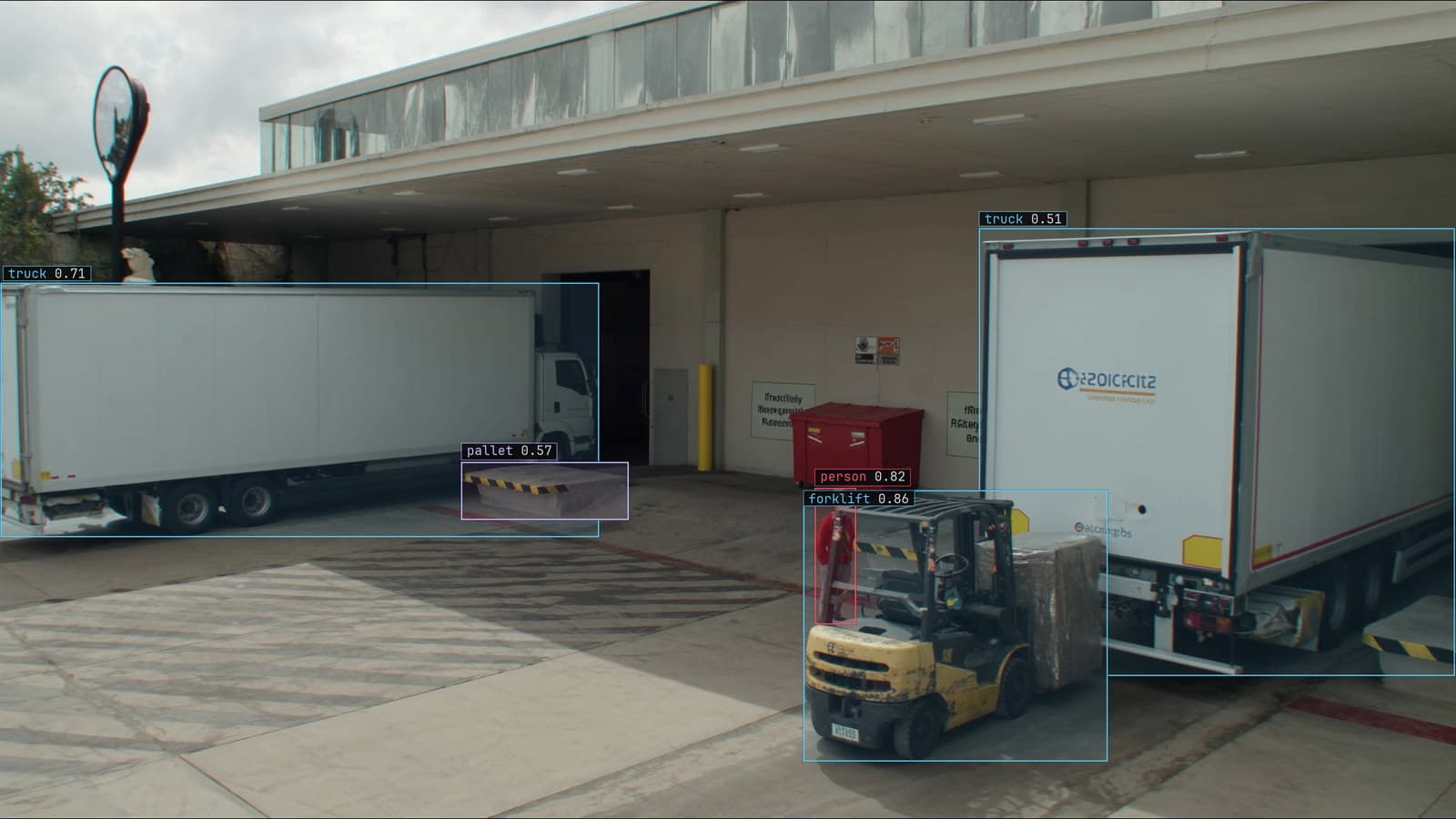
Loading dock with a forklift and a pallet boxed, generated scene with detections from our model
Dock door 3 receives about forty pallets an hour on a Monday morning, and every one of them stops while the receiving clerk walks round it with a handheld scanner looking for the label. The shipper's dock crew put the label where it fitted, the wrapper wound two turns of film over it, and the forklift driver set the pallet down with that face against the wall. The clerk finds it eventually. Forty times an hour, eventually adds up to a forklift idling at the door for most of the shift.
The dock cameras were installed for the insurance claims. They already see every face of every pallet that comes through the door.
The label lands wherever the wrapper left it
There is no standard face at door 3. A pallet built at one supplier carries its label on the short side at chest height, and a pallet from another has it low on the long side under the film. A mixed pallet from a cross-dock carries three labels from three legs of its journey, and only one of them is the one this dock needs. A rule that says "the label is here" is wrong on the next pallet through the door.
The package and label inspection use case describes the same problem on a packing line, where every check is a region and a rule: find the label, then decide about it. At the dock the finding is the hard part, because the region can be anywhere on four faces.
A portal of cameras sees every face at once
The portal is the dock's existing cameras plus two more, one each side of the door at label height, so that a pallet passing through is seen on all four faces in the same few seconds. On every frame a model boxes the labels, all of them, whichever face they are on and whatever angle the film has pulled them to. The class is typed once, label, and Lexi proposes the boxes on frames the dock has already recorded. The receiving clerk checks them, and his attention goes to the labels seen through film, at a slant, half in shadow, because those are the ones the handheld scanner could not read either.
A second class, wrapped label, is boxed separately for the labels the film has crossed, because what happens next is different for those.
The barcode is decoded and the printed text becomes fields
Inside each box is a barcode and a block of printed text: the shipper, the purchase order, the item count, the destination. The barcode is decoded from the frame, and where the film has crossed it and the decode fails, the printed order number beside it is read instead and matched against the expected receipts for the day. LexInsight takes the reading and turns it into fields the warehouse system can match, and the question "which pallets arrived against purchase orders we were not expecting" has an answer with the frames behind it.
Reading text through two turns of stretch film is not reliable, and the system should say so rather than guess. A label the reader cannot make out goes to the clerk with the frame, and the clerk types the number from the screen, which is faster than walking round the pallet and is still the exception rather than the rule.
Every scan is logged with the frame the portal saw
Each pallet through door 3 leaves a record: the label boxes and the decoded barcode, the fields that were read, the time, and the frames from all four cameras. When the shipper disputes a short delivery in three weeks, the record has the frames of the pallet as it came through the door, with the label the clerk would have been asked to find.
On the docks we work with, that record replaces the photograph the clerk used to take with a phone when something looked wrong, and it exists for every pallet rather than the ones that looked wrong at the time.
Stretch wrap over the label needs a physical fix
The failure to plan for at door 3 is film. A wrapper that winds one more turn than usual puts a fold of film across the barcode, and the frame is fine, the label is found, and the code will not decode. The drift catalog calls this something is now in the way, and its advice is the right one at the dock: check the frame before you retrain. A model retrained on frames of wrapped labels learns to expect the fold, and no amount of training reads a barcode through it.
The fix is at the shipper. The wrapped label class exists so the dock can count how many pallets from each supplier arrive with the label under film, and that count, per supplier per week, is a conversation with the supplier's dock crew rather than a model problem. The suppliers who are told usually stop within a month.
The portal decides on site, beside the dock's recorder
My view, which comes from where things run rather than from the model, is that a dock portal should run on a runner on the warehouse network, beside the recorder the cameras already feed, rather than in the cloud alone. A pallet at the door waits for the decode, and a decode that has to leave the building and come back is a forklift idling on the network's schedule. On the runner the label is found and decoded on site, the footage stays where it was recorded, and only the frames the model doubts leave the building. The deployment guide describes what leaves and what does not.
LexData takes the portal's model through its whole life. You type what to look for, Lexi puts a box on every label in every frame, and a person checks each label before anything trains on it. The model then watches the dock cameras, in the cloud, on your servers or on a runner beside the recorder. Frames it is unsure of come back to a person, the corrections retrain it, and the new version replaces the old one with no downtime. The slanted, shadowed labels the clerk typed by hand in the first month are the second version's evidence, and the forklift at door 3 stops idling.
See it on your own footage.
Start with your footageMore in Industries
Industries · 7 min read
Counting the screws in a kit with object detection over the bench
A camera over the kitting bench counts every screw and bottle one box at a time. Exact for kits, a band for cases, and a half-hidden item is a written rule.
Rajiya Sultana · Sep 25, 2026
Industries · 7 min read
Automated water meter reading with a camera in the vault
Ten digit classes in a fixed row turn a truck roll into a frame. A rolling digit and condensation on the glass are the frames that come back to a person.
Stephen Biswas · Sep 25, 2026
Industries · 7 min read
Body-in-white inspection with a station camera on unpainted steel
Dents on a bare body shell hide in the reflections. Masks give the extent, a second pass decides reportable, and a tightened tolerance is a spec change.
Finn Ellingwood · Sep 25, 2026