

Industries · 6 min read
Dock door utilization tracking from the yard camera
Trailers boxed, each tied to a door, occupied or empty with a dwell time per door, and the rainy mornings when the door numbers go unread.
Summary
This post builds dock door tracking from one yard camera: a box on every trailer, a rule that ties each trailer to a door, an occupancy state that has to hold across frames, and a dwell time per door as the record. It concludes that rain and glare are what break the door number reads, and that those frames should be collected rather than dismissed. It is for dock managers and warehouse systems teams.
Rajiya Sultana · Engineering Manager · Sep 26, 2026
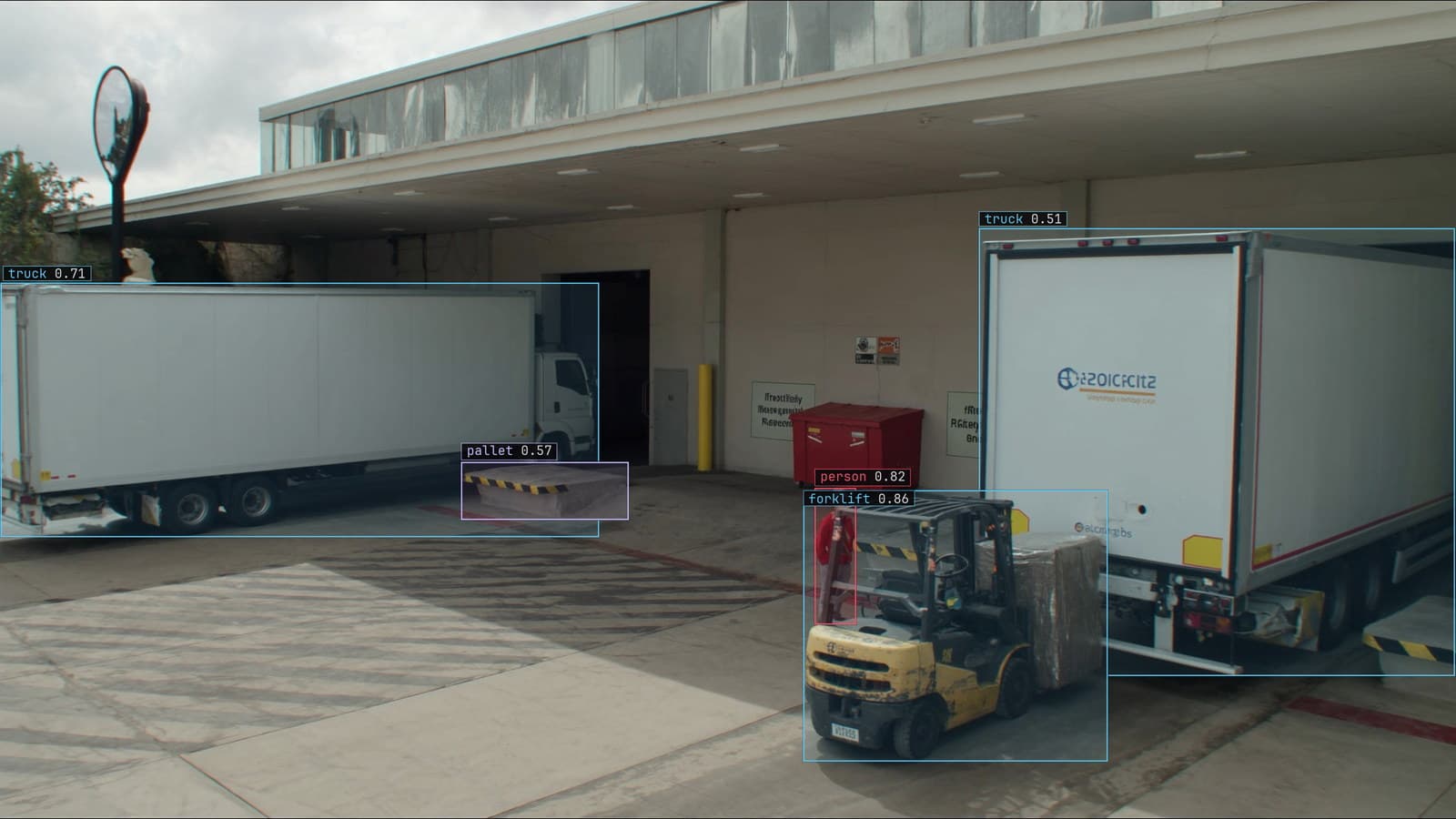
Loading dock with trucks at the bays and a forklift on the apron, generated scene with detections from our model
At 6 am the yard has twelve doors and a clipboard. The gatehouse writes down which trailer went to which door and when, the dock lead walks the apron twice a shift and updates it, and by mid-afternoon the sheet and the yard disagree about at least two doors. A carrier phones to ask how long their trailer sat at door 9 on Tuesday, and the honest answer is that nobody knows within an hour.
The yard camera on the corner of the building has been looking at all twelve doors the whole time.
Object detection finds the trailer, the geometry finds the door
The model's job is smaller than it sounds. It boxes trailers, and it boxes the door number markers painted above each door. Trailers are large and distinct and a detector handles them from the first version, on all twelve doors including door 12 at the far end of the frame. Door numbers are small, sometimes in shadow, sometimes behind the corner of a trailer, and they are the part that takes a person's attention at labeling time, because a door number the model never boxes is a door that can never be reported.
Tying a trailer to a door is geometry, on a fixed camera. Each door number box is widened sideways by a margin the dock lead sets once, and a trailer whose box overlaps that widened region belongs to that door. Object detection supplies the boxes and the rule supplies the meaning, and the rule is written down where somebody can change it when the yard is repainted.
The warehouse spatial mapping use case is the same idea at floor scale: fixed cameras, boxes on the things that move, and a rule that turns position into a state.
Occupied is a state that has to hold across frames
A single frame with a trailer over door 9 does not make door 9 occupied. A truck backing in crosses three door regions on its way to the fourth. A yard tug passes along the apron. A trailer parked at an angle overlaps two markers at once. If every frame flips the state, the record is noise.
So the state persists. The camera is sampled about every two seconds, and a door becomes occupied when the overlap has held for long enough that a truck could not still be manoeuvring, and empty when the trailer has been gone for the same span. What gets recorded is the change, with its time: door 9, occupied, 6:42. Door 9, empty, 9:15.
That is the whole ledger. Everything the dock manager wants is a query over those rows.
Dwell time per door is what the dock manager actually reads
The record of changes gives a dwell per visit, and dwell per door over a week is the number the yard has never had. Door 9 averages three hours because it serves the slowest pick area. Door 2 is empty for most of the afternoon while trucks wait at the gate. Neither is visible from the clipboard, and both are visible from the first week of frames.
The question is asked of LexInsight in plain words: which door had the longest dwell this week, and what was at it. The answer comes back with the times and the frames, which is the part that settles the argument with the carrier. A dwell figure with the picture of the trailer behind it is a different conversation from a dwell figure on its own.
The dock lead still walks the apron. What changes is that the walk is to fix what the camera showed, and not to find out what is there.
The door number is read from the frame, and checked against the list
The marker box gives a region, and the number inside it has to become text so that the report names door 9 rather than a marker at the left of the frame. That read is a question asked of the frame, and the answer is checked against the list of doors the yard actually has. A read that comes back as a door that does not exist is held for review, and a read that flips between two neighbouring numbers on a door that has not changed is held too.
Door 7's number is painted on the tarmac in front of the door as well as above it, and the tarmac copy is covered by the trailer the moment the trailer arrives. The marker above the door is the one the rule uses.
Rain and glare are the mornings the numbers go unread
The failure that arrives on its own schedule is weather. A November morning with rain on the lens, low sun off the wet apron, or fog that sits until ten, and the trailer boxes hold while the door number reads fall away for a few hours. The frames from those hours come back to a person as doubted, which is the right behaviour, and the wrong response is to dismiss them as a bad morning.
The drift catalog treats this as rain, fog and dust: a transient shift that arrives and leaves, and is dismissed as noise precisely because it leaves. My own view is that the rainy frames are the most valuable labeling window the yard will get all year. A few dozen of them, boxed by the dock lead on a quiet afternoon, and the next version reads the markers through the next front.
LexData takes the dock model through its whole life. You type what to look for, Lexi puts a box on every frame, and a person checks each label before anything trains on it. The model then watches the yard camera the warehouse already has, in the cloud, on your servers, or on a runner beside the recorder. Frames it is unsure of come back to a person, the corrections retrain it, and the new version replaces the old one with no downtime.
The alert is a trailer at a door past the dock's tolerance
Once the state and the dwell exist, the alert is a sentence: a trailer at any door for longer than the tolerance the dock sets, routine, to the dock lead's channel, one message per door per visit. It is approved before it goes live and it arrives with the frame, the door and the time the trailer landed. The alert written as a sentence is what gets a stalled door in front of someone who can send a forklift, and the ledger underneath it is what tells the carrier, to the minute, how long their trailer sat at door 9 on Tuesday.
See it on your own footage.
Start with your footageMore in Industries
Industries · 6 min read
AI crop analysis in the greenhouse, catching tomato disease before it spreads down the row
Lesions boxed by disease with a healthy class, a question of the footage about how far a patch spread since last week, and a model that turns with the season.
Rob Hickey · Sep 26, 2026
Industries · 6 min read
Ceramic defect detection for hairline cracks a fixed-rule camera cannot learn
Edge chips, hairline cracks and pinholes on the tile line after the kiln, masks where the area sets the grade, and the new glaze as the day to relabel.
Esdras Ntuyenabo · Sep 26, 2026
Industries · 6 min read
Chocolate box inspection with a camera over the tray line
Each piece boxed by type, a plain check against the box template, damage as its own class, and the new spring assortment as the day the labels go stale.
Stephen Biswas · Sep 26, 2026