

Industries · 6 min read
First pass yield from a station camera, and the hidden factory it exposes
Final yield says nearly everything shipped. The rework bench says otherwise. A pass, review or fail on every part at every station makes the gap visible.
Summary
This post explains first pass yield through a machining cell whose final yield looks fine while a rework bench absorbs a couple of hundred units a month. It shows how a camera's pass, review or fail record at each station gives a first pass yield per station, makes rework loops visible when a serial passes twice, and why a falling yield is a threshold question before it is a model question. It is for production and quality managers.
Rajiya Sultana · Engineering Manager · Sep 26, 2026
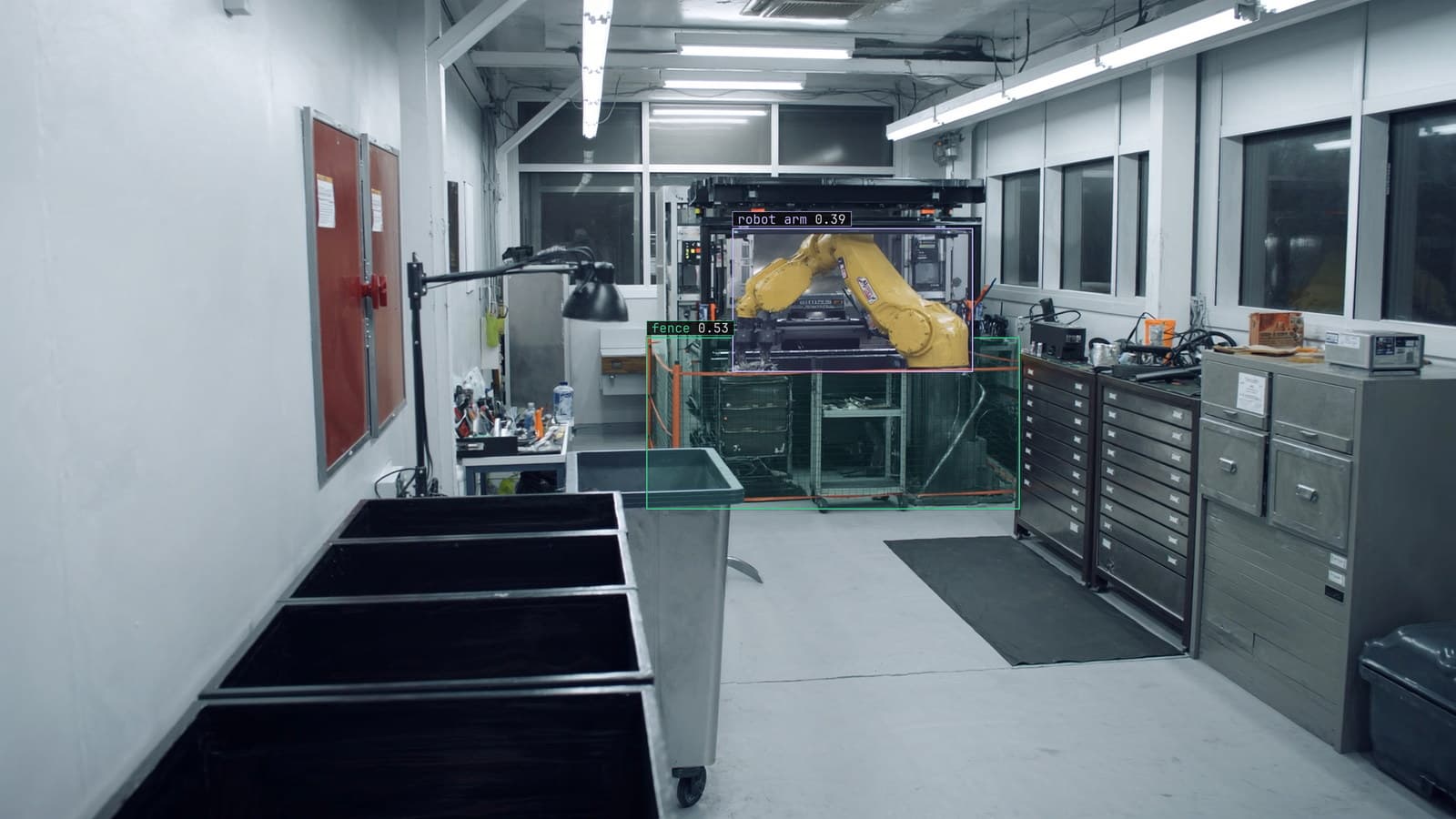
A robot arm loading a CNC machine in a machining cell, generated scene with detections from our model
The yield board outside the machining cell says nearly everything the cell made in August shipped. It is true. What it does not say is that a couple of hundred of those units went round twice, through a rework bench beside station 3 where a fitter deburrs, re-taps and re-measures parts that failed the first time. The bench is staffed on every shift. The board counts what left. It never counted what came back.
First pass yield is the number that would have. It is the share of parts that were right the first time, with no rework and no second pass, and a cell that measures only final yield can run for years with a hidden factory inside it doing a fifth of the work.
First pass yield counts the parts that were right the first time
A part that passes final inspection after a trip to the bench beside station 3 is a good part and a first-pass failure, and the two facts have to be kept apart. Final yield answers the customer's question: how many good parts. First pass yield answers the plant's: how much of the cell's capacity is being spent making parts twice.
The reason it is rarely measured is that it needs a verdict at the moment each part leaves each station, before the rework bench has had a chance to fix anything. The fitter at the bench does not write down what she reworked. The rework is in the fitter's hands and the coffee machine is beside the bench, which is where the count went.
The camera at each station gives every part a pass, a review or a fail
A camera at the outfeed of station 3 sees every part as it leaves, and a model trained on the cell's own frames gives each one a verdict. A burr on the bore, a missing chamfer, a thread that did not cut: each is a box, and a rule over the boxes returns pass, review or fail for that part at that station. The assembly verification use case reads presence and position the same way, from a box and its shape, and the verdict is the record first pass yield is built from.
The record is per station, which is the part the yield board never had. Station 3's first pass yield is the share of parts it passed on the first look, and station 5's is its own number, and the cell's first pass yield is the product of them. A cell that only measured the end could see the total fall and had no way to know which station was the reason.
You type what to look for in the words the cell uses, Lexi proposes a box on every frame, and a person checks each label before anything trains. On the manufacturing lines we run, the classes are the rework bench's own tally sheet, once someone has written one.
A rework loop becomes visible when the same serial passes the camera twice
The rework bench feeds parts back into station 3, and the camera sees them again. A serial read on the way out at 10:20 am and again at 2:40 pm is a part that went round twice, and the count of such serials per shift is the size of the hidden factory in units rather than in an argument. Some parts go round three times.
That count is the thing to put on the board next to final yield. It tells the cell manager what the rework bench is costing in station time. It tells the fitter which failure she is fixing most, because the frame from the first pass is kept with the box on it and the box says burr or chamfer or thread.
A falling first pass yield is a threshold question before it is a model question
A new batch of bar stock arrives harder than the last and the burr rate at station 3 doubles. The model boxes every burr correctly. First pass yield falls, the review queue fills, and the first instinct on the floor is that the camera has gone wrong. It has not. The base rate moved, and every threshold tuned to the old rate is now sending the wrong number of parts to review.
The drift catalog calls this a change in the defect rate, and its order of operations is the right one: retune the review threshold against the current rate, then ask why the rate moved, and only then look at the model. On the floor the answer is the bar stock, and the camera found it in a shift.
My own view is that a part sent to review should count as a first-pass failure for yield purposes even when the reviewer passes it. It cost a person's time.
Rolled yield across the stations says where to spend the fortnight
First pass yield per station multiplies through the cell. A cell of five stations each passing most of what it sees on the first look can still have a rolled yield that surprises everyone in the Monday meeting, because the losses compound. The station camera makes that arithmetic visible and points at the station with the most to give.
Usually it is not the one the floor expected. The station with the loudest failures is often fine, because loud failures were already being fixed. The quiet one, where a small share of parts has been going to the bench every shift for years without anybody counting, is where the fortnight of engineering time goes.
The review verdicts are also the corrections the next version trains on
LexData takes the station model through its whole life. You type what to look for, Lexi puts a box on every part on every frame, and a person checks each label before anything trains on it. The model then watches the outfeed cameras, in the cloud, on your servers, or on a runner beside the recorder. Frames it is unsure of come back to a person, the corrections retrain it, and the new version replaces the old one with no downtime. The 99%+ accuracy maintained in production that our manufacturing work reports is held by those corrections, and on a machining cell the corrections come from the same fitter who used to do the rework.
The board outside the cell now carries two numbers. The wider manufacturing work is built on cells like this one, where the second number is the one the plant did not know it was paying for.
See it on your own footage.
Start with your footageMore in Industries
Industries · 6 min read
AI crop analysis in the greenhouse, catching tomato disease before it spreads down the row
Lesions boxed by disease with a healthy class, a question of the footage about how far a patch spread since last week, and a model that turns with the season.
Rob Hickey · Sep 26, 2026
Industries · 6 min read
Ceramic defect detection for hairline cracks a fixed-rule camera cannot learn
Edge chips, hairline cracks and pinholes on the tile line after the kiln, masks where the area sets the grade, and the new glaze as the day to relabel.
Esdras Ntuyenabo · Sep 26, 2026
Industries · 6 min read
Chocolate box inspection with a camera over the tray line
Each piece boxed by type, a plain check against the box template, damage as its own class, and the new spring assortment as the day the labels go stale.
Stephen Biswas · Sep 26, 2026