

Industries · 6 min read
Reducing manufacturing scrap with a camera on the line, because scrap is a timing problem
A torch drifts at 9 am and the shift finds out at 2 pm. Scrap scales with that lag, and the camera flags the first bad bead rather than the hundredth.
Summary
This post follows a welding torch that drifts out of alignment at 9 am on a cell where nobody finds out until the end of the shift, and shows how a camera at the outfeed flags the first bad bead instead of the hundredth. It argues that scrap scales with the lag between the first bad part and the first person who knows, that a rising reject rate is the earliest signal, and that a threshold tuned to last quarter's rate is wrong this quarter. It is for production and quality managers.
Rob Hickey · Chief AI Officer · Sep 23, 2026
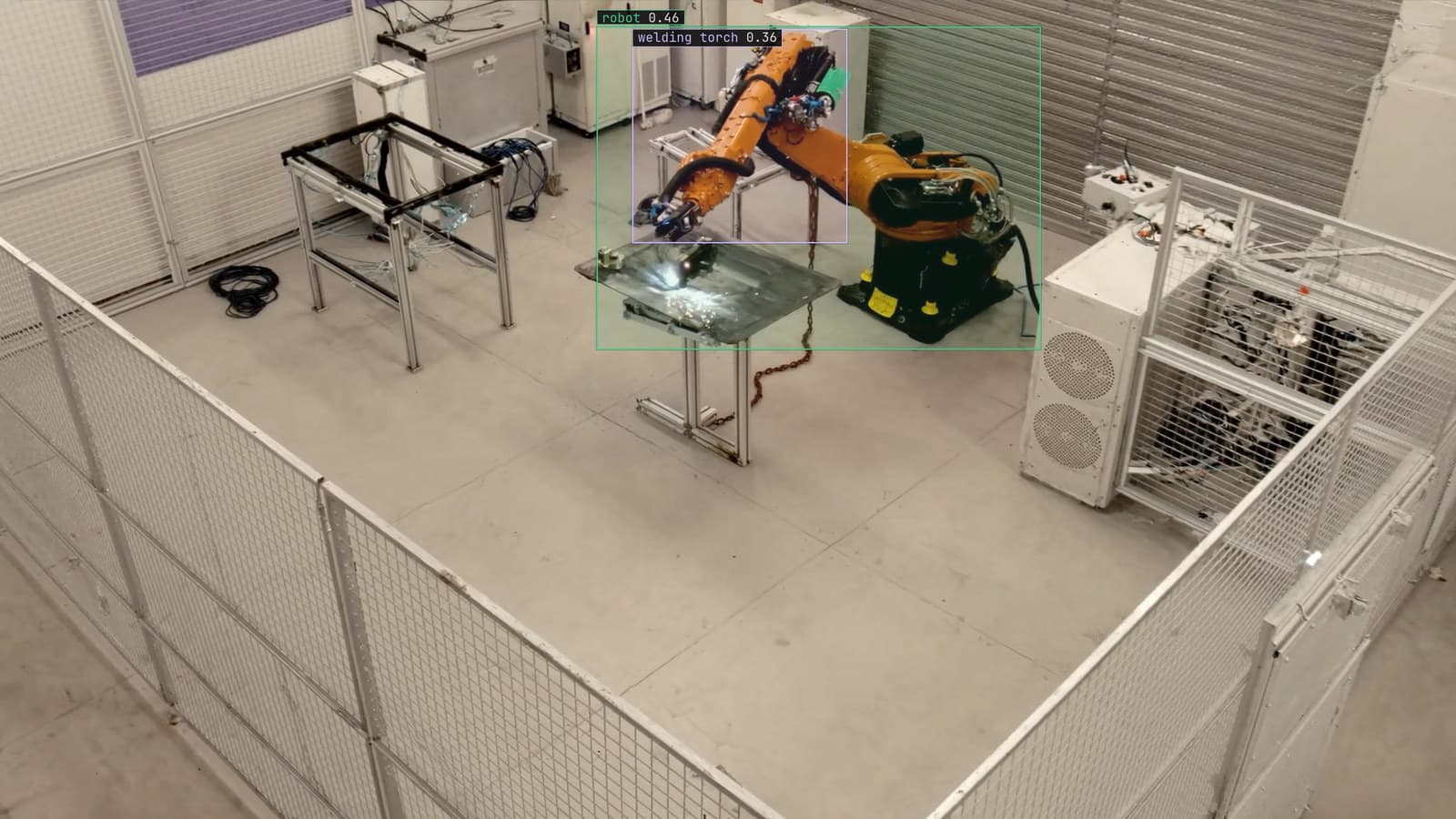
Robotic welding cell with the torch and the robot boxed over the fixture, generated scene with detections from our model
At 9 am on cell 3 the welding torch is a millimetre off the seam. Nothing dramatic happened. A wire feed hiccup, a fixture pin worn a little further, and the bead now sits to one side of where it should. The cell keeps producing a part a minute. Each one looks fine from across the aisle, each one fails the pull test, and the pull test is done on a sample at the end of the shift. At 2 pm the quality technician finds a bad part, then another, and the cell's whole morning goes to a scrap bin.
Scrap is usually described as a quality problem. On this cell it is a timing problem. The first bad part cost as much as any other. The next three hundred cost the morning.
Scrap scales with the lag before anyone knows
Every station adds value to the part. A bracket scrapped at the press on cell 3 cost a blank. The same bracket scrapped after welding cost the blank and the weld and the cell's time, and scrapped after paint it cost the paint line too. So the cost of a defect is set by how far it travels before somebody stops it, and how far it travels is set by how long it takes anybody to know.
The three ways plants find scrap all find it late. End-of-line inspection finds it after every station has added its value. Sampling finds it when the sample happens to include it, which on a one-in-fifty sample is after fifty parts on average. The spreadsheet that logs rejects finds it at the end of the shift, when the operator fills it in. None of them is wrong. All of them are slow, and the scrap bin is the measure of how slow.
The camera flags the first bad bead with the frame
A camera at the cell's outfeed sees every bead for a few seconds. The model has been trained on the plant's own frames, with good beads and the plant's own catalogue of bad ones such as offset and undercut and porosity, labeled by the welding engineer who knows what each looks like on this part. At 9 am the first offset bead reaches the outfeed and the model doubts it. The second one it is sure about.
An alert in LexAlert is a rule written as a sentence, with a severity and a cooldown, approved before it goes live: two offset beads within five minutes on cell 3, to the line lead's phone, with the frame. The line lead sees the bead with the box drawn on it, walks to the cell, and finds the fixture pin. The morning's scrap is two parts. The surface defect detection use case is the same shape on a machined face, a severity call made while the part is still at the station that produced it.
Sampled every couple of seconds, the camera is slower than the cell and much faster than 2 pm, and that gap is the whole return.
A rising reject rate is the earliest signal
The offset bead is the sharp case. The slow case is a tool wearing over a fortnight, where each bead is slightly worse than the last and no single one is bad enough to alert on. Tool wear is a slope. A broken insert is a step. The slope is invisible one part at a time and obvious as a rate.
So the number to watch is the reject rate per hour on each cell against its own history. LexInsight is where that question gets asked: how many offset beads on cell 3 since Monday, and the answer comes back with the frames behind it. A rate creeping up over a week on one cell while its neighbours hold is the fixture or the tooling, and it is visible days before the first alert would fire. On the manufacturing lines we run, 99%+ accuracy maintained in production is what makes the rate worth trusting.
My own view is that the reject rate per cell per hour, against its own history, is the one chart worth putting on the wall. Every other chart on that wall is downstream of it.
A threshold tuned to last quarter's rate is wrong now
The plant replaces the fixture pins across all four cells in March, and the offset rate falls to a fraction of what it was. The alert threshold, two beads in five minutes, was tuned when offsets were common, and it now fires on the rare coincidence of two doubtful beads and mostly stays silent. Silence gets read as everything being fine, which on a cell that used to alert twice a shift is itself a change nobody looks at.
The drift catalog calls this the defect rate changed, and it is the condition most often mistaken for a model problem when it is a threshold problem. Per-detection accuracy holds and the counts swing. The fix is to re-tune the threshold against the current rate before anybody touches the model, and alert volume against its own history is the cheapest place to see that it needs doing.
The line lead's replies are the other check. A model that is right about every bead and wrong about how many to expect produces alerts the line lead stops answering, and an unanswered alert is scrap that travelled.
The line lead's corrections keep the model on the seam
The line lead who walks to cell 3 at 9:05 am and finds a good bead the model doubted is making a correction, and so is the one who finds a bad bead it passed. Those corrections are how the model keeps up with a cell that changes its wire, its fixture and its parts through the year.
LexData takes the cell model through its whole life. You type what to look for, Lexi puts a box on every frame, and a person checks each label before anything trains on it. The model then watches the outfeed camera, in the cloud, on your servers, or on a runner beside the recorder. Frames it is unsure of come back to a person, the corrections retrain it, and the new version replaces the old one with no downtime.
The scrap bin by cell 3 is still there. What changed is what time the first bad part goes into it, and how many follow.
See it on your own footage.
Start with your footageMore in Industries
Industries · 8 min read
Computer vision for construction site safety, a warning before the worker and the excavator meet
A pole camera boxes people and machines, draws a danger zone that moves with the excavator, and sends the frame when someone walks into it.
Ayman Quadir · Sep 23, 2026
Industries · 7 min read
Computer vision in agriculture, from the sprayer boom to the packing line
Weeds against beet rows at dawn, lesions on a leaf, bruises on a packhouse belt, and labels that go stale as the season turns.
Ayman Quadir · Sep 23, 2026
Industries · 6 min read
Computer vision applications on a factory floor, four jobs for the cameras already there
Defect detection, assembly verification, safety and inventory on one plant's cameras, with cosmetic against functional written into the labeling schema.
Ayman Quadir · Sep 23, 2026